In the realm of software development, choosing the right architectural pattern is a critical decision that can significantly impact the success and sustainability of a system. An architectural pattern serves as a blueprint, defining the structure, behavior, and interaction of components within a software application. In this blog, we will explore the key considerations and steps involved in selecting the best architectural pattern for system design.
Introduction to architectural patterns
Architectural patterns are reusable solutions to common problems encountered in software design. They encapsulate design decisions, best practices, and guidelines for constructing systems that meet specific criteria. These patterns serve as templates for solving recurring architectural problems and promote design consistency across various projects.
Some well-known architectural patterns are discussed below.
Monolithic pattern
The monolithic pattern is a straightforward way of organizing software, where all the parts of an application are closely packed into one central codebase and run as a single unit. In this setup, the whole system is created, built, launched, and expanded as one cohesive and inseparable entity.
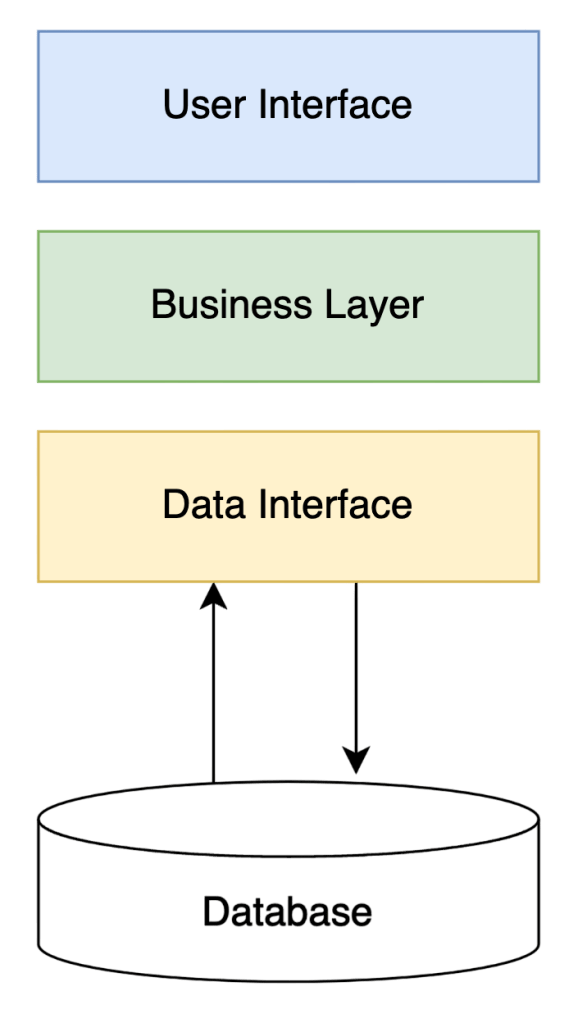
A monolithic pattern is most suitable for small or medium-sized applications that don’t require a highly scalable or complex architecture. It can be a good choice for applications that are relatively simple and don’t require frequent updates or modifications.
Advantages
- A monolithic pattern is relatively simple to understand and implement because all the components of the application are contained in a single codebase.
- Because all the components of a monolithic application are closely interconnected, it can be relatively easy to test the application as a whole.
- Applications with a monolithic pattern typically have better performance because everything is in place and strongly connected.
Disadvantages
- Scaling a monolithic architecture becomes challenging with the growth of an application due to tight coupling among components, leading to difficulties in incorporating new features or scaling without extensive modifications to the entire codebase.
- Maintaining a monolithic architecture becomes challenging with the growing size and complexity of an application due to tight coupling among components, making updates or modifications cumbersome and requiring significant changes to the entire codebase.
Layered pattern
A layered pattern divides a system into units or layers. This is one of the most frequently used methods. Every layer is a collection of modules that provide a consistent set of services. The software program is organized into horizontal levels in a tiered architecture, with each layer sitting on top of a lower layer. Generally, a layer is reliant on one or more levels below it (depending on whether the layers are open or closed) but is independent of the ones above it. It might be possible that different layers reside on different physical systems.
The model-view-controller (MVC) pattern is one of the well-known layered patterns. The MVC pattern provides a structured and organized way to design and develop applications. It divides an application into the following three primary components, each with its distinct role:
- Model: It encapsulates the business logic and data, maintaining the application’s state and executing operations through a set of classes that define the data structure and the associated functionalities.
- View: In a software application, it handles the presentation of the user interface by receiving data from the model and generating HTML, CSS, and JavaScript code through templates or scripts.
- Controller: It manages user input and interactions by receiving requests from the view, directing them to the model for processing, receiving processed data from the model, and sending it to the view for display, which is typically implemented as a set of classes or functions overseeing request routing and processing.
Here’s a diagram illustrating the relationship between the model, view, and controller in the MVC architecture pattern.

Let’s now look at a few advantages and disadvantages of using layered patterns.
Advantages
- A layered pattern simplifies the organization of a software application by partitioning it into separate layers, each with a designated function, enabling independent comprehension and manipulation of each layer without requiring knowledge of others. This division of concerns diminishes complexity, enhancing the application’s clarity and manageability.
- Reducing dependencies between layers in a layered pattern facilitates seamless substitution of implementations within a specific layer, streamlining development and maintenance by enabling modifications in one layer without concern for repercussions in other layers.
- The testability of a software application using a layered pattern is enhanced by partitioning it into layers and utilizing interfaces for inter-layer communication, enabling the isolation of a specific layer for testing while using mocks or stubs for the remaining layers.
Disadvantages
- Layered applications, especially those with multiple tiers, might require more code to provide the necessary interfaces and logic for communication between the different layers.
- Requests going through multiple layers can result in inefficiencies.
- Deploying multiple layers on different tiers can impact the performance of the application.
Client-server pattern
The client-server pattern is a two-layered, distributed program in which clients and servers communicate directly with one another. A client requests a resource or uses a service provided by a server, and the server answers the client’s requests. A single server can have several clients connecting to it.
The client component of the program includes the user interface code in this design, whereas the server part contains the database. Both the server and the client contain the business logic. The majority of the application’s business logic is saved on the server, although it may be stored on the client as well. The application logic of the server may reside in software components, the database, or both.

Consider the example of an HTTP client-server interaction. When a user accesses a website through a web browser (client), it sends an HTTP request to a server hosting the website. The server processes the request and sends back the requested web page, which is then rendered by the client’s browser.
Let’s now look at some advantages and disadvantages of using the client-server pattern.
Advantages
- A client-server pattern can improve the performance of an application by distributing processing tasks between the client and server.
- It allows for easy scalability by adding more clients or servers to the network. This can help increase the workload and support more users.
- It allows for better security because the server can be secured separately from the client. This can help protect sensitive data and prevent unauthorized access.
- It allows for centralized management of data and resources, making it easier to maintain and update the application.
Disadvantages
- A client-server pattern relies on a central server, which can be a single point of failure. If the server goes down, the entire application might become unavailable.
- The pattern relies on a network connection, which can be a limiting factor for certain applications. The application might not function properly if the network is unavailable or slow.
Some of these issues can be resolved by using a peer-to-peer (P2P) pattern, which is described below.
Peer-to-peer pattern
In a usual client-server pattern, multiple clients can communicate with servers that are usually centralized. On the other hand, in the case of a decentralized network, nodes can work as both clients and servers at the same time. Such a pattern is known as the peer-to-peer (P2P) pattern.
In a P2P network, the workload is distributed (not necessarily equally) among various peers within the system. There’s no need for a centralized server in a P2P network. Nearly all of the nodes both contribute and consume resources within a network.
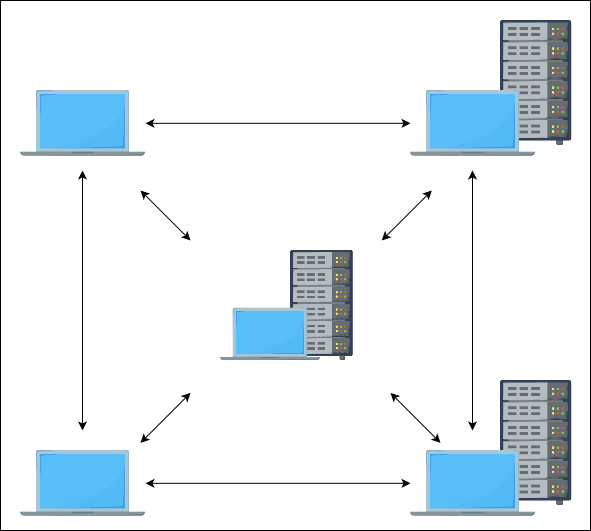
P2P networks can be classified into structured and unstructured P2P networks.
In structured P2P networks, such as distributed hash tables (DHTs), nodes are organized in a specific manner, often forming a structured overlay. Search operations are efficient and deterministic in structured P2P networks due to the organized nature of the overlay. This allows for quick and precise location of content or resources. Churn, or the continuous joining and leaving of nodes, can be managed more effectively in structured networks. The organized structure enables systematic updates to the overlay.
Unstructured P2P networks, on the other hand, lack a specific organization, and nodes can be connected in a more random or decentralized manner. Search operations in unstructured networks are typically less efficient and can involve broadcasting queries to multiple nodes. The lack of a structured organization can result in slower and less predictable search outcomes. Similarly, churn can be more challenging to handle in unstructured networks because the lack of a specific structure can lead to frequent updates and reorganization.
P2P networks, exemplified by systems like BitTorrent, are frequently employed for the distribution of substantial files, like music, movies, and software. In a P2P file-sharing network such as BitTorrent, users have the ability to download and upload files directly from one another’s devices, bypassing the need for a centralized server.
Let’s take a look at some advantages and disadvantages of this pattern.
Advantages
- Due to the absence of a central server or governing authority in a P2P network, the network exhibits increased resilience against censorship, unavailability, and other challenges that could impact centralized servers.
- Scalability in P2P networks is better compared to traditional client-server networks because nodes possess the ability to directly communicate and share resources with one another.
- P2P networks typically exhibit greater resilience to failures because there is no central point of failure; if a single node experiences an issue, the network can persist because other nodes maintain communication and resource sharing among themselves.
Disadvantages
- P2P networks can be vulnerable to security threats such as malware, hacking, and spoofing, especially if nodes are not properly secured.
- In a P2P network, it can be challenging for nodes to discover and locate resources because there’s no central server or directory.
Hexagonal pattern
A hexagonal pattern, also known as a ports and adapters pattern, is a design pattern that separates the core functionality of an application from its external dependencies. The idea is to enhance the application’s flexibility, modularity, and testability by clearly dividing the business logic from the connections to the outside world.
Here’s a quick breakdown of the key elements and principles of the hexagonal architecture:
- Core domain: It is the heart of the application, representing the business logic and the entities that make up the application’s domain. The core domain should be isolated from external dependencies and should contain no knowledge of the infrastructure or details of how it’s used.
- Adapters: They connect the core domain to the outside world, providing an interface between the core domain and external systems (databases, web services, etc.). Adapters can further be implemented as input adapters, which receive data from external systems, or output adapters, which send data to external systems.
- Ports: They are the interfaces defining the contracts between the core domain and adapters. They specify the methods and data structures the adapters must implement to interact with the core domain.
- Drivers: They provide the concrete implementation of the ports. They can be implemented as part of the core domain or as standalone components that connect to the core domain through the ports.
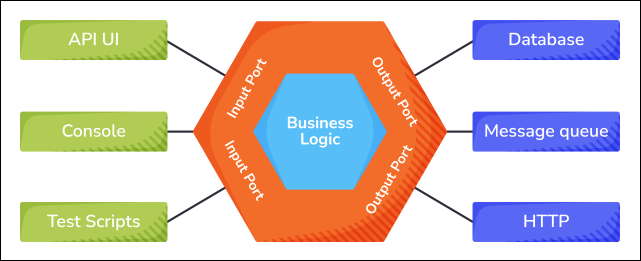
Let’s take a look at some advantages and disadvantages of this pattern.
Advantages
- The hexagonal pattern makes it easier to unit test the core domain by isolating it from external dependencies.
- It promotes the creation of modular components that can be easily replaced or modified without affecting the rest of the system.
- It allows an application to be easily extended or modified by adding or modifying adapters without changing the core domain.
Disadvantages
- A hexagonal pattern can add complexity to an application, especially for developers unfamiliar with the pattern.
- Implementing a hexagonal pattern requires careful planning and design, which can add overhead to the development process.
- It can be more difficult for developers unfamiliar with hexagonal patterns to understand and maintain the codebase.
Broker pattern
The broker pattern, also known as the intermediary pattern, serves as a strategic design approach that introduces a central intermediary, known as a broker, into the interaction between service users (clients) and service providers (servers). This pattern establishes a clear separation between clients and servers, promoting a loosely coupled architecture where clients have no knowledge about the existence and details of the underlying servers.
In the broker pattern, the client operates in a fully disconnected mode from the servers, enhancing flexibility, maintainability, and scalability. When a client necessitates a particular service, it communicates its request to the broker through a well-defined service interface. The broker forwards the client’s request to the most suitable server capable of fulfilling the service.
Upon receiving the client’s request, the selected server executes the necessary actions and produces the outcome. The server then communicates the results, along with any exceptions, back to the broker. The broker relays this information back to the initiating client. This seamless communication cycle abstracts the intricate details of the server interaction, providing clients with a streamlined and consistent experience.
The illustration below shows a basic broker pattern.

Advantages
The advantages of using a broker pattern include the following:
- The broker pattern helps decouple service providers and consumers by allowing them to communicate through the broker rather than directly with each other. This can make changing or replacing one component easier without affecting the other.
- It allows service providers and consumers to be added or removed from the system without requiring changes to the other components. This can make scaling the system up or down easier as needed.
- The broker pattern can help improve security by acting as a gatekeeper between service providers and consumers, which can contribute to preventing unauthorized access to sensitive data.
- By acting as an intermediary, the broker can help improve the reliability of the system by handling communication failures and other issues that might arise.
- The broker pattern can help improve the performance of the system by offloading some of the communication and processing tasks from the service providers and consumers, allowing them to focus on their core functions.
Disadvantages
- The broker pattern introduces an additional layer of abstraction, which can result in some performance overhead because data is passed between the broker and the service providers and consumers.
- The broker pattern can create a dependency on the intermediary component, which can make it more difficult to change or replace the component if necessary.
- If there are problems with the system, it can be more difficult to troubleshoot when using the broker pattern because of the additional layer of abstraction introduced by the broker.
Pipe and filter
In the pipe and filter pattern, the system is composed of filters, each representing a transformation operation. These filters are like processing units, each designed to execute a specific transformation on the input data. The brilliance of this pattern lies in the simplicity and modularity it introduces, making it easier to understand, maintain, and extend the data processing pipeline.
The interaction between filters is facilitated through pipes, which serve as conduits for the flow of data between successive filters. The unidirectional nature of the data flow, moving from one filter to the next through these pipes, ensures a clear and predictable sequence of transformations. This design is analogous to the assembly line concept in manufacturing, where each station (filter) contributes a specific task to the overall production process.

The pipe and filter pattern promotes reusability and composability. Filters can be independently developed, tested, and reused in various combinations across different pipelines. This modular nature allows for easy substitution or addition of filters to accommodate new data transformations or adapt to changing requirements without affecting the entire system.
There are various pipe and filter applications. For example, data analytics applications, such as data warehousing and business intelligence systems, often use the pipe and filter architecture to process large amounts of data. For example, a data warehouse might have filters that extract data from various sources, transform the data, and load it into a central repository.
Another example can be a compiler. A compiler takes an input that performs lexical analysis and generates tokens. These tokens are used for syntax analysis, which generates a parse tree, followed by semantic analysis, and so on. An output of one function becomes the input of the next, and so data flows.
Advantages
The advantages of using the pipe and filter pattern include the following:
- The pipe and filter pattern allows for the creation of independent, reusable components that can be easily combined and reused in different configurations.
- Parallel processing can be achieved because the filters can be designed to operate independently, allowing for parallel processing of data as it flows through the system. Each filter can potentially run concurrently on separate threads or processes, leading to parallelism.
- This pattern allows for the parallel execution of independent components, making it easier to scale the system to handle larger amounts of data.
- The pipe and filter pattern allows for the isolation and replacement of individual components, making it easier to maintain and troubleshoot the system.
Disadvantages
The disadvantages of the pipe and filter pattern include the following:
- The creation of complex systems using the pipe and filter architecture can require generating a large number of components, which can be difficult to manage and maintain.
- It can involve a significant amount of overhead in terms of data transfer and communication between components.
- It might not be well-suited for systems that require a high degree of adaptability or the ability to handle unexpected input or change in real time.
Publish and subscribe
Publish and subscribe is an architectural pattern in which certain clients publish the information, and certain clients receive that information. The publish and subscribe pattern is commonly implemented using protocols like Message Queuing Telemetry Transport (MQTT) and popular message queue frameworks such as Apache Kafka or RabbitMQ. There are mainly three components present in this architecture:
- Publishers: They publish the information without having details about the users who will be using the published data.
- Subscribers: They get the information without having details about who posted the information.
- Event bus: This is responsible for smoothly transferring messages or information from publishers to subscribers.

This pattern finds extensive use in real-world applications, especially in sensor networks. For instance, in an Internet of Things (IoT) ecosystem, sensors can publish data to a central hub, and various applications or devices subscribe to receive relevant information. This enables a flexible and dynamic data distribution model.
Advantages
The publish and subscribe pattern has several advantages, including:
- Publishers and subscribers do not need to be online simultaneously. Publishers can emit messages, and subscribers, whenever they come online, can receive relevant messages that match their interests. This asynchronous nature enhances flexibility and responsiveness.
- It allows for a high degree of flexibility because publishers and subscribers can be added or removed from the system without affecting the other components.
- It’s highly scalable because it allows for the creation of complex message routing patterns and the addition of new publishers and subscribers without affecting the performance of the system.
- It allows for asynchronous communication between the publisher and subscriber, which can improve the performance of the system by allowing both to operate independently of each other.
Disadvantages
- The message broker adds a layer of complexity to the system, which can increase overhead and reduce performance.
- In some cases, the message broker might be unable to deliver a message to a subscriber, either due to a failure in the broker or because the subscriber is unavailable. This can result in lost messages, which might not be acceptable in some applications.
Now that we have looked at some of the more well-known architectural patterns, let’s discuss some key considerations for choosing them.
Key considerations for choosing an architectural pattern
We begin by thoroughly understanding the system requirements. We have to consider factors (also known as quality attributes) such as scalability, performance, maintainability, and flexibility. Different architectural patterns are better suited to different requirements, so aligning the pattern with the system’s needs is crucial. The table below compares different architectural patterns along with the different factors.
Quality Attributes of Different Architectural Patterns
| Agility | Scalability | Security | Performance | Testability | Ease of deployment | |
| Layered Pattern | HighPromotes modularity | LowMight be constrained due to layer dependencies | VariableVulnerability in one layer can compromise the entire system | LowOverhead due to multiple layers | HighIsolation of layer helps in unit testing | HighClear seperation of layers helps in deployment |
| Client-Server Pattern | HighSeparation between client and server enables independent development | VariableMight be constrained due to layer dependencies | VariableServer dependency | VariableCan introduce overhead due to multiple layers | HighIsolation of layers helps in unit testing | HighClear separation of layers helps in deployment |
| Peer-to-Peer Pattern | HighDecentralized architecture helps in adaptability | HighPeers can be added or removed when needed | LowDifficulty in managing security and untrustworthy peers | HighGood because of distributed systems | HighPeers can be tested one at a time | HighPeers can join dynamically |
| Hexagonal Architecture Pattern | HighModular design | HighCan be scaled by deploying additional resources | HighFlexibility in adapting security measures, modularity | HighProperly implemented communication mechanisms contribute to efficient data flow | HighFacilitates testing by isolating the core logic from external dependencies | HighDifferent components can be deployed easily |
| Broker Pattern | HighDecoupling between components aids in agility | HighCan be made scalable easily | HighCentralized control facilitates communication | VariableThe broker can become a bottleneck | HighComponents can be tested one at a time | HighComponents can be connected easily via the broker |
| Pipe and Filter Pattern | HighFilters can be added where required | HighFilters can be added where required | HighModularity leads to the isolation of security measures | HighEfficient for processing pipelines | HighFilters can be tested independently | HighFilters can be deployed easily |
| Publish-Subscribe Pattern | HighCan easily accommodate changes, additions, or removals of publishers and subscribers | LowCan be complicated due to complex coordination between publishers and subscribers | VariableUnauthorized subscribers are hard to control | VariableDepends on coordination between publishers and subscribers | VariableDepends on coordination between publishers and subscribers | HighComponents can be deployed independently |
| Monolithic Pattern | LowAll components are tightly coupled | LowScalability requires replicating the entire structure | VariableSimplicity in security management, easy deployment, but vulnerabilities affect the entire application | VariableBecause of everything packed together, efficiency can improve | HighAll components can be tested together | LowRequires the entire application to be deployed at the same time |
Note: Other than these quality attributes, we need to assess the expertise of the development team. Choosing a pattern that the team is familiar with can lead to quicker development and a better overall system. However, introducing a new pattern can be a learning opportunity for skill development.
Steps for choosing an architectural pattern
- We first need to clearly outline the functional and non-functional requirements of the system.
- Next, we need to familiarize ourselves with various architectural patterns and their characteristics and understand how each pattern addresses specific concerns.
- We should then assess the trade-offs associated with each pattern by comparing different quality attributes such as performance, scalability, testability, etc.
- We have to choose a pattern that aligns with the overarching goals of the system. Whether it’s optimizing for performance, scalability, or maintainability, the selected pattern should contribute to achieving these goals. We have to also consider a pattern that accommodates future growth and changes in requirements. A flexible architecture can adapt to evolving needs without requiring a complete overhaul.
- If feasible, we create a prototype or proof of concept to validate the chosen architectural pattern. Testing it in a real-world scenario can uncover potential challenges and help refine the decision.

Conclusion and next steps
Selecting the right architectural pattern is a pivotal step in the system design process. By carefully considering system requirements, scalability, team expertise, and other key factors, developers can make informed decisions that contribute to the long-term success of the software system. Remember that there is no one-size-fits-all solution, and the best architectural pattern will depend on the unique characteristics and goals of the project.
To continue your learning journey and deepen your understanding of system design, here are some valuable resources. They cover basic principles and real-world case studies. These resources are great for building a strong understanding of modern system design: