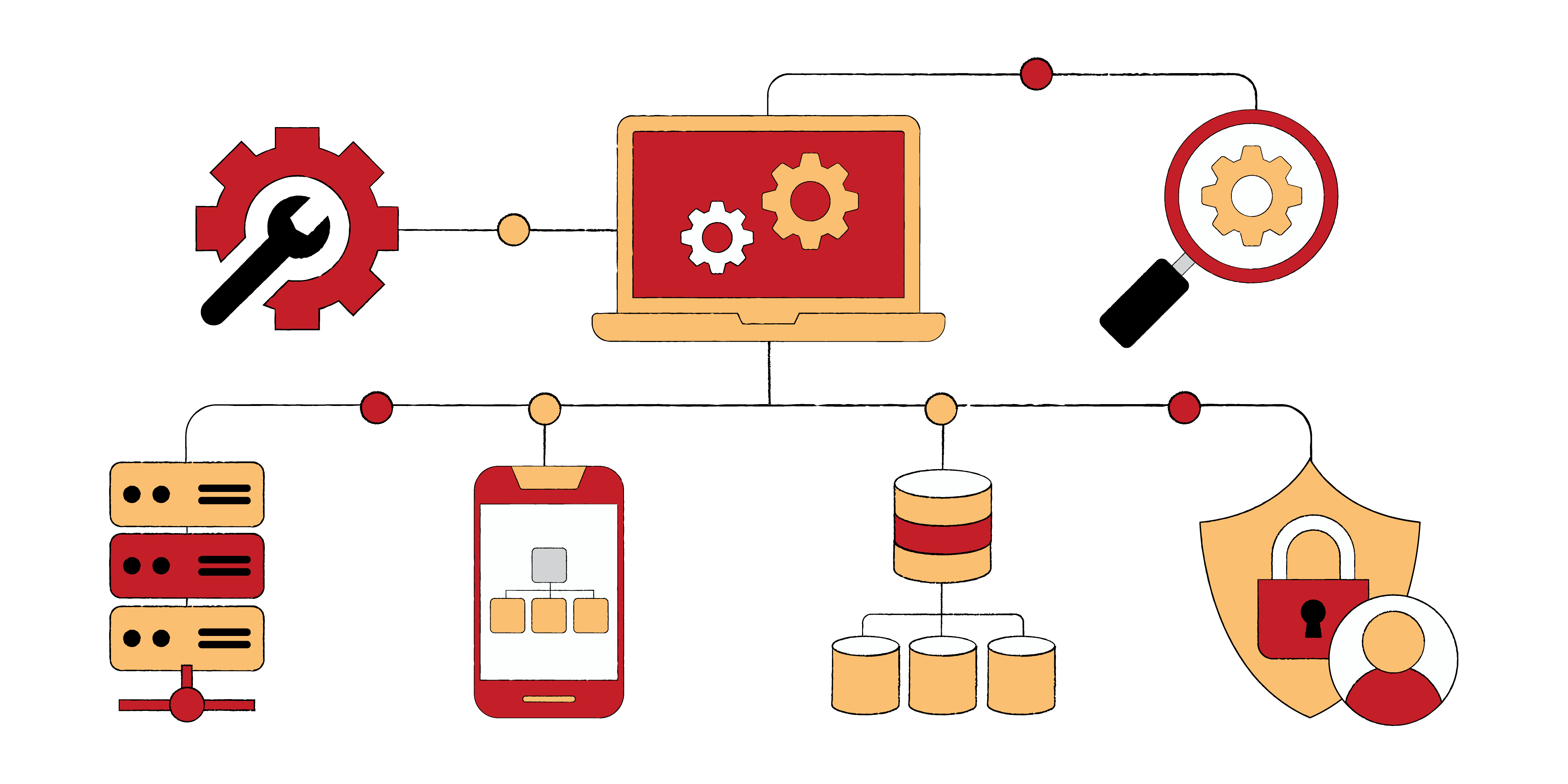
System design is more than diagrams or documents. It defines how systems are structured, deployed, and scaled in real-world conditions. Before any code is written, engineers must decide how to architect the system. These early choices affect maintainability, performance, reliability, and cost.
This blog explores the most common types of system design used in modern software engineering. Each type reflects a different architectural approach, with its own structure, behavior, and trade-offs.
Whether you’re building a startup prototype or scaling a global service, these designs form the foundation of your system’s architecture.
1. Monolithic system design
Monolithic system design is one of the most traditional types of system design. It builds the entire application as a single, unified codebase. All components, like user interface, business logic, and database access, are bundled into one deployable unit.
Unified structure for early-stage systems
This type of system design is well-suited for startups and small teams. It simplifies development by consolidating all parts of the system into one cohesive codebase. Local development and testing require fewer tools, and deployment happens in a single step.
Performance through tight integration
With all modules sharing memory and processes, internal communication is fast and efficient. There are no network calls between components, resulting in lower latency and improved runtime performance, especially for tightly bound features.
Scalability challenges as teams grow
As the codebase expands, the monolithic structure can become rigid. Teams find it harder to work independently. A small change in one area might require regression testing for the whole system. Over time, this type of system design introduces friction and slows release cycles.
2. Microservices system design
Microservices system design breaks a system into multiple independently deployable services. Each service is responsible for a specific domain and communicates with others via APIs or message queues.
Modularization at the system level
This type of system design is ideal for complex applications with evolving requirements. Each microservice has its own codebase, database, and release schedule. Teams can scale and deploy services independently without impacting the entire system.
Autonomous development and scaling
Microservices empower teams to own specific services end-to-end. This autonomy speeds up development cycles and makes it easier to scale based on load. Services can even be written in different programming languages if needed.
System complexity through distribution
While microservices promote agility, they also increase architectural complexity. Service discovery, load balancing, logging, and fault tolerance require a robust infrastructure. Teams need to manage inter-service contracts and monitor distributed systems effectively.
3. Event-driven system design
Event-driven system design is a reactive type of system design. It structures applications around the production, detection, and consumption of events. Instead of synchronous requests, services emit events that others listen to and act upon.
Asynchronous and decoupled architecture
In this type of system design, components are loosely coupled. A producer does not know which services will consume its events, improving flexibility, extensibility, and fault isolation. New features can be added by subscribing to events without modifying core logic.
Use cases with dynamic flows
Event-driven architecture is commonly used in systems that require real-time responses, such as order tracking, analytics, user activity logging, and automation workflows. It allows developers to build reactive chains that scale independently.
Debugging and state consistency challenges
Since events can be delayed, duplicated, or lost, teams must build for eventual consistency. This type of system design demands careful consideration of event schemas, idempotent handlers, and observability tools that support tracing asynchronous workflows.
4. Service-oriented architecture (SOA)
Service-oriented architecture (SOA) is another foundational type of system design. It builds software systems by integrating shared, reusable services that communicate through well-defined interfaces, typically over a middleware layer like an enterprise service bus (ESB).
Designed for integration and reuse
SOA was created to solve the problem of software silos in large enterprises. In this type of system design, services expose business capabilities to be reused across departments or products. This improves standardization and reduces redundant development.
Formal contracts and middleware coordination
Services in SOA publish formal contracts using protocols like SOAP and WSDL. An ESB manages message routing, security, and transformation. These features support reliable communication between heterogeneous systems.
Governance and centralized control
SOA introduces governance models to manage service versions, access rules, and compliance standards. It requires strong architectural planning but provides long-term value in environments where integration and stability are more important than speed.
5. Cloud-based system design
Cloud-based system design is a modern type of system design that prioritizes scalability, elasticity, and availability by leveraging cloud-native technologies and infrastructure.
Infrastructure without ownership
Cloud-based systems run on platforms like AWS, GCP, or Azure. Engineers do not manage physical hardware. Instead, they use managed services for storage, compute, messaging, and networking. This accelerates delivery and simplifies operations.
Stateless design for dynamic scaling
Most cloud-based systems are stateless, which allows load balancers to distribute traffic across instances seamlessly. State is offloaded to external services like distributed databases or object storage, making the system more fault-tolerant and easier to recover.
Cloud-native principles
This type of system design follows cloud-native patterns such as infrastructure as code, autoscaling, redundancy across availability zones, and cost optimization. Engineers focus on building logic, while the platform handles reliability and scale.
Other supporting types of system design
Beyond architectural strategies like microservices or monolithic structures, several other supporting types of system design guide how systems are planned, structured, and implemented. These types operate at different abstraction levels and play a critical role in translating business needs into engineering solutions.
Logical system design
Logical system design represents the system’s functionality from a conceptual standpoint. It defines what the system should do without specifying how it will be implemented. This includes process flows, data relationships, and entity behavior. Logical models help stakeholders agree on requirements before committing to any infrastructure. It’s a foundational type of system design used during early analysis.
Physical system design
Physical system design focuses on how system components will be deployed and connected in the real world. It involves server specifications, network topology, database hosting, and integration points. This type of system design ensures that logical plans can be supported by real infrastructure. It bridges the gap between design intent and hardware constraints.
High-level system design
High-level design outlines the architecture in broad strokes. It includes module boundaries, service responsibilities, external APIs, and data pipelines. This is one of the most critical types of system design used during technical planning and cross-team collaboration. It provides a blueprint without delving into code-level specifics.
Low-level system design
Low-level system design delivers the implementation blueprint. It describes classes, functions, data types, and interaction logic. Developers use this type of system design to build code that adheres to system-wide standards. It reduces ambiguity during development and ensures the system functions as expected at runtime.
UI and database design
User interface and database design address how humans interact with systems and how data is structured behind the scenes. UI design maps out screens, forms, and interactions. Database design handles table structures, indexes, and queries. These types of system design are critical for usability, data integrity, and performance optimization.
Together, these supporting types of system design enable teams to move from abstract concepts to fully operational systems. They complement architectural choices and provide the granularity needed to build systems that are scalable, reliable, and aligned with user needs.
Final word
Each system design type plays a specific role in shaping how a product functions and evolves. The architectural patterns, including monolithic, microservices, event-driven, SOA, and cloud-based, guide decisions about scalability, modularity, and infrastructure.
Supporting types like logical, physical, high-level, and low-level design provide the scaffolding needed to bring the architecture to life. When learning system design, understanding all the types makes systems robust and production-ready.
To apply all these design types effectively in both interviews and real-world engineering, check out these guided resources: