Designing a software system, whether it’s a scalable backend API, a user-facing web app, or a real-time data pipeline, starts with understanding what the system must do and how it should behave under different conditions.
This brings us to the core of software design: functional vs. nonfunctional requirements in system design.
While functional requirements focus on the actual functionality delivered to the end user, non-functional requirements specify constraints and qualities such as performance, reliability, and security. Both are essential, but they serve fundamentally different purposes and influence system architecture in distinct ways.
Below, we’ll explore the 10 key differences between functional and nonfunctional requirements in system design, complete with practical insights into why each matters and how it shapes real-world systems.
1. Definition

The most foundational difference between functional and non-functional requirements in the system design process lies in their definition.
- Functional requirements define the system’s function. They include core features and user interactions such as authentication, data processing, content retrieval, and user workflows.
- Non-functional requirements define how the system behaves under specific conditions. These cover aspects such as performance metrics, uptime guarantees, system security, and scalability.
While functional requirements define the capabilities of a system, non-functional requirements set the standards and constraints within which those capabilities must operate.
2. Focus Area
Functional requirements concern business processes and user expectations. They are typically derived from user stories, product specifications, and customer use cases. For example, a user must be able to upload a photo, edit their profile, or search for an item.
In contrast, non-functional requirements are system-level concerns. They focus on system properties like response time, system availability, consistency guarantees, and fault tolerance. These don’t usually tie directly to a single feature but influence how all features are implemented and experienced.
Understanding this distinction is critical in designing functional vs. nonfunctional requirements systems, especially when translating business needs into scalable architecture.
3. Validation and Testing Methods
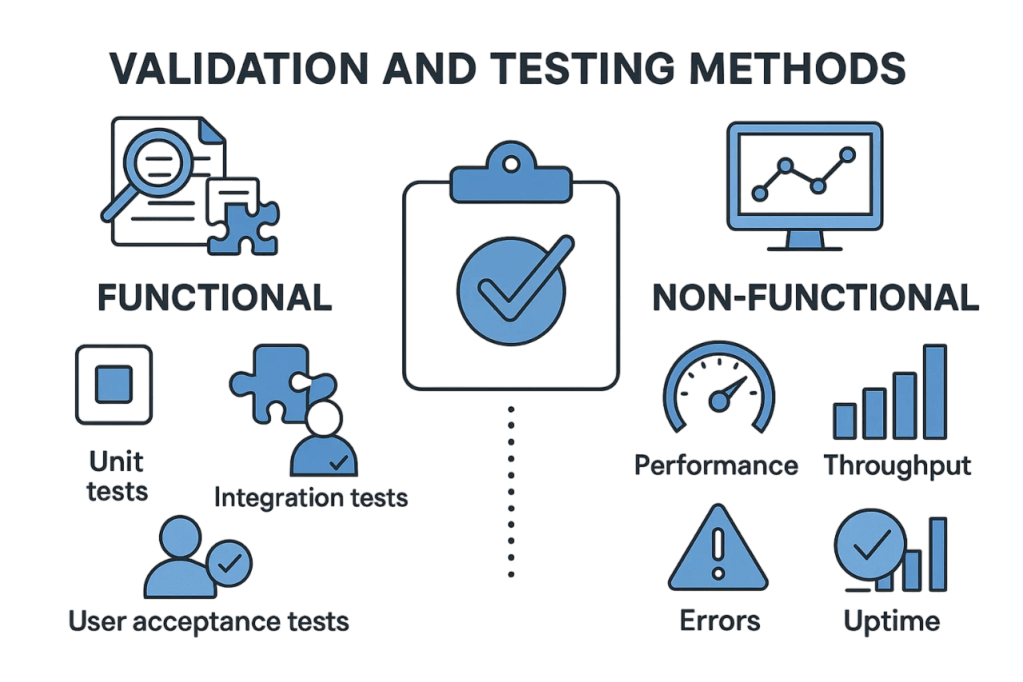
Functional requirements are verified using traditional testing methods, such as unit tests, integration tests, and user acceptance tests. These tests focus on correctness—does the system perform the specified function when given valid input?
Non-functional requirements require a different validation strategy. Performance testing, load testing, stress testing, and real-time monitoring are used to measure whether the system meets its quality constraints. Metrics such as latency percentiles, error rates, throughput, and system uptime are often part of the validation plan.
In any robust system, addressing both functional and non-functional requirements is key to ensuring both correctness and reliability.
4. Influence on System Architecture
Functional requirements dictate the core components that must be built, such as services, endpoints, user interfaces, and databases. They also help define the data model, business logic layers, and API structure.
Non-functional requirements, on the other hand, shape the underlying architecture. For example:
- A performance requirement may lead to implementing caching layers (Redis or CDN).
- High availability requirements may require multi-region deployments and failover mechanisms.
- Scalability needs might encourage the use of microservices or event-driven architectures.
Understanding how non-functional requirements guide architectural choices is central to mastering functional vs non-functional requirements system design.
5. Examples of Each Type
When distinguishing between functional vs non-functional requirements in system design, examples provide the clearest clarity.
Functional Requirements:
These are directly related to the specific functions or behaviors a user expects. For example:
- A user should be able to sign up using their email or phone number.
- The system should allow users to reset their passwords via a verification code.
- An e-commerce platform should let users add items to a cart and proceed to checkout.
Functional requirements are often articulated in user stories and mapped directly to UI components, APIs, and database transactions. They define what the system should do from the user’s perspective.
Non-Functional Requirements:
These define quality attributes and operational constraints. For example:
- The system must return search results within 300 milliseconds for 95% of requests.
- The API must handle 20,000 requests per second at peak traffic.
- The application must support multi-factor authentication and comply with GDPR.
Non-functional requirements ensure that the features built through functional requirements are usable, scalable, secure, and reliable under real-world conditions. They often appear in engineering documentation, SLAs, or compliance checklists and require architectural-level decisions to satisfy.
Recognizing and separating these requirement types is essential in any system design discussion, as it ensures both product completeness and technical feasibility.
6. Stakeholders Responsible
Functional requirements are generally owned by product managers, business analysts, and customer stakeholders. They are directly tied to business value and end-user satisfaction.
Architects, infrastructure engineers, DevOps teams, and security specialists typically concern themselves with non-functional requirements. These stakeholders ensure the system is robust, scalable, and reliable under real-world loads.
This division of responsibility reinforces the importance of cross-functional collaboration in system design discussions.
7. Impact on Scalability and Performance
Scalability and performance are two of the most important dimensions of non-functional requirements in system design. While functional requirements define what services need to exist, such as a login endpoint or a recommendation engine, they don’t specify how these services should behave under heavy load or how they should grow with user demand.
Non-functional requirements, particularly those concerning scalability and performance, directly impact the core architecture of a system. For instance:
- If your system must handle 100,000 concurrent users, you’ll need to introduce techniques like horizontal scaling, database sharding, caching (e.g., Redis or Memcached), and asynchronous queues (e.g., Kafka, RabbitMQ).
- If the application must return results in under 200ms, you may need pre-computed indexes, read replicas, or a CDN to serve static content with minimal latency.
Scalability influences how data models are designed, how services communicate (synchronous vs asynchronous), and how failure is handled gracefully.
In functional vs non-functional requirements system design, it’s often the non-functional demands like latency thresholds or traffic estimates that separate a prototype from a production-grade system. Designing for scalability early on also prevents the need for costly architectural rework when traffic spikes or data volume grow significantly.
8. Role in Fault Tolerance and Availability
Functional requirements rarely describe what happens when systems fail.
Non-functional requirements, however, include expectations for disaster recovery, error handling, and availability targets. These can be expressed as Service Level Objectives (SLOs) or Service Level Agreements (SLAs), such as:
- “System must be available 99.99% of the time.”
- “Failed requests should be automatically retried up to three times.”
These requirements dictate the need for features like retries, fallbacks, circuit breakers, and replication—all crucial architectural patterns in distributed systems.
9. Maintainability and Future-Proofing
Functional requirements address users’ immediate needs. They evolve as business priorities shift, but they don’t necessarily influence long-term technical strategy.
Non-functional requirements such as maintainability, observability, and extensibility shape how easy it will be to support and evolve the system. These include:
- Code readability and modularity
- Test coverage expectations
- Deployment automation and CI/CD integration
In functional vs non-functional requirements system design, long-term sustainability depends far more on well-defined non-functional requirements than most engineers realize.
10. Security and Compliance Requirements
Security concerns are rarely covered under functional requirements unless explicitly modeled as features (e.g., two-factor authentication).
Non-functional requirements often include:
- Encryption at rest and in transit
- Access control mechanisms
- Audit logging and compliance with regulations such as GDPR, HIPAA, or SOC 2
Neglecting these non-functional aspects can lead to serious technical and legal liabilities, especially in regulated industries like healthcare and finance.
Final Thoughts
A successful system is about delivering it at scale, securely, reliably, and efficiently. Understanding the differences in functional vs. non-functional requirements in system design is key to building systems that not only work but thrive in production environments.
Whether you’re preparing for a system design interview or working on a large-scale project, always identify both functional and non-functional requirements upfront. These requirements guide the architecture, inform the technology stack, and ensure that the system is designed for the real world, not just ideal conditions.
Recommended Reading and Practice:
If you’re serious about mastering system design, check out the following resources:
- Grokking the System Design Interview
- System Design Interview: Fast-Track in 48 Hours
- System Design Deep Dive: Real-World Distributed Systems
These courses cover everything from traditional backend architecture to frontend scalability and emerging AI systems, giving you the breadth and depth needed to succeed in interviews and real-world engineering roles.