

System success begins with a clear understanding. Before designing components or writing code, teams need to know what the system must achieve. This happens during the requirement gathering phase. It defines the foundation for all system planning, design, and execution.
In this blog, we explore requirement gathering techniques in analysis and system design. You will learn how different methods help uncover system needs, improve communication, and reduce the risk of missed expectations.
These techniques are used across industries to capture business goals, user behaviors, and technical constraints.
What is requirement gathering in system analysis and design?
Requirement gathering is the process of identifying what a system needs to do. It involves collecting information from stakeholders, users, documents, and existing systems. The goal is to define functional and non-functional requirements before any design begins.
Functional requirements describe what the system must accomplish. This includes tasks, workflows, and user interactions. Non-functional requirements describe system behavior such as performance, security, and reliability.
Clear requirements reduce ambiguity in software projects. They guide design, development, testing, and validation. Requirement gathering techniques in system analysis and design provide a structured way to capture these details from the right sources.
Top requirement gathering techniques in system analysis and design

Gathering requirements is not a one-size-fits-all activity. Different projects call for different methods. Teams must select techniques that match the context, stakeholders, and complexity of the system being developed. Below are ten reliable requirement gathering techniques in system analysis and design that help teams collect accurate and actionable inputs.
Stakeholder interviews
Interviews are one of the most direct ways to gather requirements. They involve one-on-one or small-group discussions with users, sponsors, domain experts, or technical leads. Interviews help uncover pain points, business rules, and expected behaviors.
This technique is highly effective when personalized detail is needed. Interviewers can ask follow-up questions and clarify ambiguous answers. Interviews also help build trust between analysts and stakeholders. As part of requirement gathering techniques in system analysis and design, interviews set the stage for deeper exploration.
Surveys and questionnaires
Surveys allow analysts to reach large groups efficiently. They are especially useful when input is needed from many users across departments or locations. Depending on the type of data required, surveys include open and closed questions.
This technique helps identify trends, quantify feature demand, and validate assumptions. It is most effective when the goals are clear and participants have enough context to answer meaningfully. Surveys complement other requirement gathering techniques in system analysis and design by adding breadth to depth-focused methods like interviews.
Observation and shadowing
Observation involves watching users perform tasks in their actual environment. Analysts take notes on actions, decisions, errors, and workarounds. Shadowing may involve informal conversations to understand why users act a certain way.
This technique reveals real behaviors that users may not articulate in interviews. It often highlights usability issues, bottlenecks, and undocumented processes. Observation is one of the most insightful requirement gathering techniques in system analysis and design when user actions do not match written procedures.
Document analysis
Reviewing existing documents offers valuable historical and organizational insight. These documents may include business process guides, requirement specs from previous projects, system logs, helpdesk tickets, or user manuals.
This technique helps uncover legacy behavior, repeated issues, or policy-driven constraints. Document analysis adds context and helps validate stakeholder inputs. It supports requirement gathering techniques in system analysis and design by anchoring new insights to past learnings.
Workshops and group sessions
Workshops bring together multiple stakeholders to brainstorm, prioritize, and align on system needs. Facilitators guide structured activities like feature mapping, journey modeling, or use case identification.
These sessions promote shared understanding, fast feedback, and early conflict resolution. Workshops are useful for complex systems with many stakeholders. They are a valuable part of collaborative requirement gathering techniques in system analysis and design.
Use case and user story writing
Analysts often use structured narratives to describe system behavior from a user’s point of view. Use cases define interactions, goals, and outcomes. User stories break down features into concise descriptions.
These tools capture functional requirements and support later testing and validation. Writing use cases also clarifies system boundaries and edge conditions. As part of requirement gathering techniques in system analysis and design, this method connects user needs to system behavior.
Prototyping
Prototypes provide early visual representations of how a system or feature will look and behave. They range from low-fidelity wireframes to clickable UI models.
This technique helps stakeholders give specific feedback. Prototypes reduce ambiguity by showing proposed interfaces instead of describing them in words. Prototyping is a visual and interactive method that strengthens requirement gathering techniques in system analysis and design by aligning user expectations with system planning.
Brainstorming sessions
Brainstorming sessions gather ideas quickly. Participants include users, engineers, designers, and analysts. The goal is to list as many potential requirements, features, or problems as possible.
This technique encourages creativity and removes early judgment. After brainstorming, the ideas are filtered, grouped, and evaluated. It works well in the early discovery phase. Brainstorming supports rapid exploration and is often paired with other requirement gathering techniques in system analysis and design.
Contextual inquiry
This method combines observation and interviewing. Analysts watch users work while asking questions in real time, allowing for a deeper understanding of workflows, decisions, and rationale.
Contextual inquiry is done in the user’s actual environment. It reveals hidden dependencies, habitual workarounds, and system limitations. This technique strengthens requirement gathering techniques in system analysis and design by uncovering needs that users may not even be aware of.
Interface and system walkthroughs
In this method, users or system owners walk through an existing application or process with the analyst. They explain what each part does, what works well, and what causes confusion.
This hands-on activity helps document the current state, identify gaps, and plan transitions. Walkthroughs are especially helpful when systems already exist and new development builds on them. As part of effective requirement gathering techniques in system analysis and design, walkthroughs validate assumptions and capture practical feedback.
Why requirement gathering is essential
Requirement gathering is the first major step in system analysis. It ensures that design begins with an accurate understanding of the problem. Teams that skip or rush this step often face issues later, such as scope changes, unclear priorities, or failed deliveries.
Here are the key reasons why requirement gathering matters:
- Aligns stakeholders on a shared vision
- Prevents rework caused by misunderstood needs
- Improves estimation of effort and timelines
- Reduces gaps between user expectations and delivered features
- Sets the baseline for validation and testing
Requirement gathering techniques in system analysis and design help teams ask the right questions, document the answers, and build trust early in the project.
How to choose the right technique
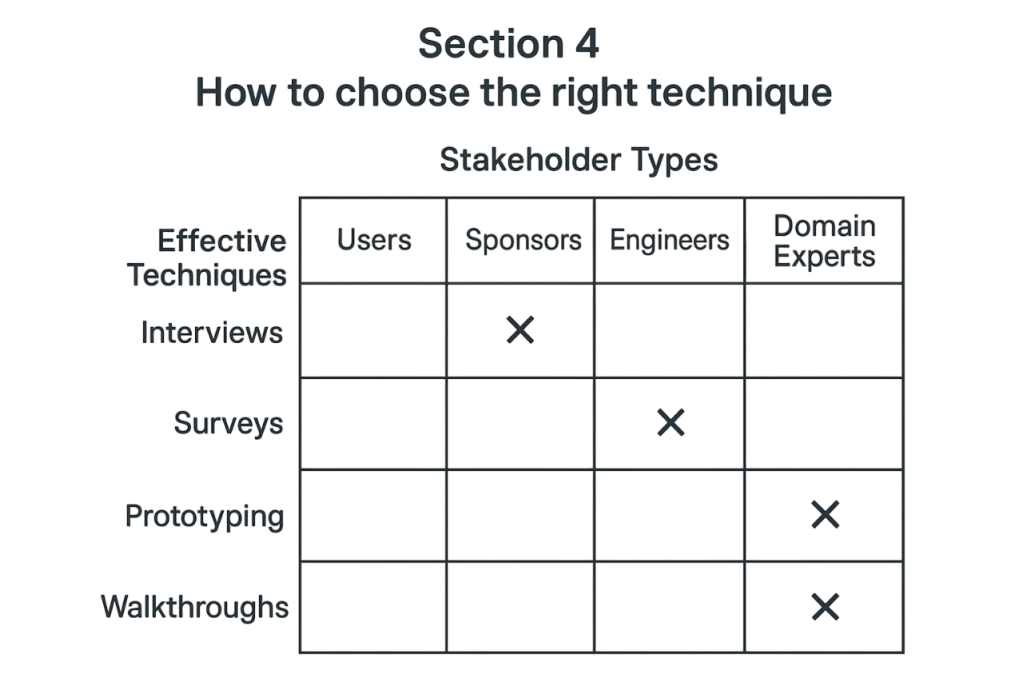
Selecting the right technique depends on the project context. Some techniques work better for technical users. Others work best for end-users or business sponsors.
Consider these factors:
- Project size and complexity
- Number and availability of stakeholders
- Type of system being built
- Access to existing documentation or systems
- Time and resources available for analysis
In most projects, a combination of techniques works best. Interviews provide depth, surveys provide scale, observations add real-world context, documents provide history, and workshops provide alignment.
Applying a mix of requirement gathering techniques in system analysis and design gives teams a fuller view of the problem and better data for decision-making.
Final word
Clear requirements create strong systems. They guide design, development, and delivery, reduce risk, and improve outcomes. Without them, teams build systems based on assumptions.
The right techniques help teams gather accurate, complete, and actionable information. These techniques support alignment, reduce surprises, and create shared understanding.
To get the most from your system projects, practice structured requirement gathering techniques in system analysis and design. Use interviews, surveys, observation, documents, and workshops to capture the full picture. You can also use detailed learning resources like: