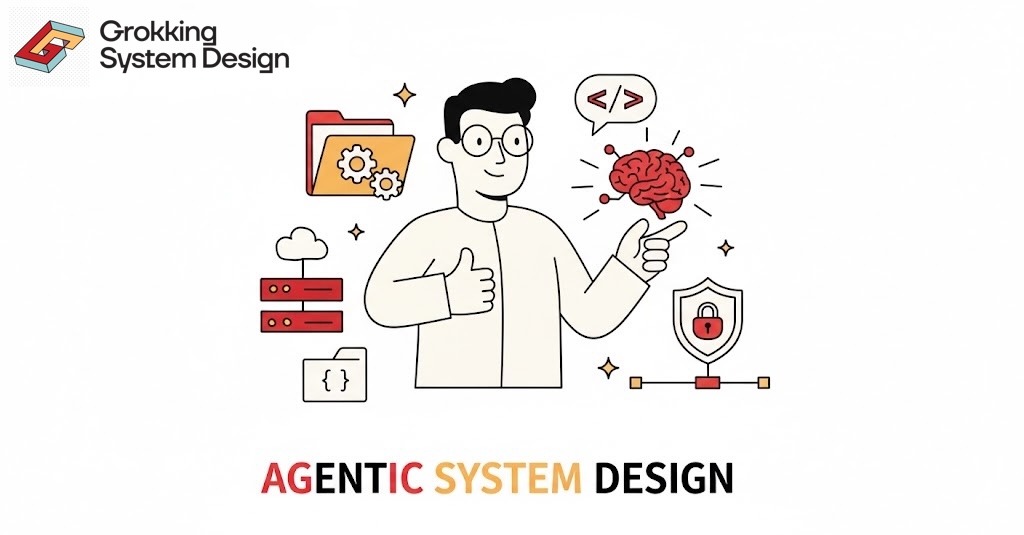
The moment you ask an AI system to do something beyond a single question-answer exchange, traditional architectures collapse. Research a topic across multiple sources. Monitor a production environment and respond to anomalies. Plan and execute a workflow that spans different tools and services. These tasks cannot be solved with a single prompt-response cycle, yet they represent exactly what organizations now demand from AI applications. The challenge is no longer whether language models are capable enough. They are. The challenge is designing systems that channel that capability into reliable, controllable autonomous behavior.
Agentic System Design addresses this gap directly. It is the practice of architecting AI systems that can reason, decide, act, observe outcomes, and adjust their behavior over time rather than simply responding to isolated inputs. You are no longer treating AI as a passive function call. You are designing it as an active participant with defined goals, constrained authority, and measurable accountability. This guide provides the architectural foundations, coordination patterns, and safety frameworks you need to build agentic systems that perform reliably in production environments.
What makes this moment particularly important is that large language models have crossed a threshold in their capabilities. They can now maintain context across extended interactions, call external tools, reason through multi-step problems, and adapt strategies based on intermediate results. However, without proper System Design, those capabilities quickly turn into brittle demonstrations or unreliable automation.
You are no longer just choosing a model. You are choosing how much autonomy to grant it, how it plans, how it remembers, and how it knows when to stop. The architectural decisions you make determine whether the system amplifies human capability or introduces unpredictable risk.
The following diagram illustrates how these components interact within a typical agentic architecture, showing the relationship between the agent core, memory systems, tool interfaces, and feedback mechanisms that together enable autonomous operation.

How agentic systems differ from traditional AI and software architectures
To understand agentic System Design, you first need to unlearn some assumptions from traditional software and even traditional AI systems. In conventional architectures, control flow is explicit and developer-defined. You decide what happens next. Even in machine learning pipelines, the model is usually a bounded component inside a deterministic system that processes inputs and produces outputs according to fixed logic. Agentic systems invert that relationship entirely. The system defines constraints and objectives, but the agent determines the sequence of actions needed to achieve them.
In traditional software design, you write logic that reacts to events in predictable ways. In agentic systems, you design an environment in which an agent operates with varying degrees of autonomy. That difference sounds subtle, but it fundamentally changes how you think about responsibility, failure modes, and correctness criteria.
When you build an agentic system, you are not just designing APIs and services. You are designing incentives, feedback loops, and stopping conditions. You must assume the system will surprise you, not because it is broken, but because autonomy introduces variability that deterministic systems never exhibit.
Historical note: Traditional software architectures evolved from mechanical computing where every operation was precisely sequenced. Agentic design borrows more from control theory and robotics, where systems must handle uncertainty and adapt to environmental feedback rather than following rigid scripts.
Another key difference is that agentic systems blur the line between application logic and AI behavior. In traditional systems, logic lives in code that you can inspect, test, and version control with established practices. In agentic systems, some logic lives in prompts, memory structures, and planning strategies. That forces you to treat prompts and agent policies as first-class architectural artifacts rather than implementation details buried in configuration files.
If you approach agentic System Design with a traditional mindset, you often overconstrain the agent and lose the benefits of autonomy. Alternatively, you underconstrain it and create a system that behaves erratically under novel conditions.
Execution model differences represent one of the most fundamental architectural shifts. Traditional AI systems operate synchronously, processing a request and returning a response in a single bounded operation. Agentic systems operate asynchronously and event-driven, initiating actions, waiting for results, and responding to environmental changes over extended periods. This shift from reactive to proactive behavior enables agents to monitor conditions and act without explicit triggers when thresholds are met. It also introduces complexity around state management, timeout handling, and graceful degradation.
Delegated intent changes the relationship between humans and AI systems fundamentally. In traditional architectures, humans specify exactly what they want done. In agentic architectures, humans specify goals and constraints while delegating the decision-making about how to achieve those goals to the agent. This higher-order autonomy requires careful design of goal representations, success criteria, and escalation pathways to ensure the agent’s interpretation of intent aligns with human expectations.
| Dimension | Traditional AI systems | Agentic systems |
|---|---|---|
| Control flow | Explicit and developer-defined | Emergent and agent-driven |
| Execution pattern | Synchronous, single-step or fixed pipelines | Asynchronous, multi-step iterative loops |
| State handling | External and often stateless | Internal memory and evolving state |
| Error handling | Deterministic retries and rules | Reflection, replanning, or escalation |
| Role of the model | Passive prediction engine | Active decision-making entity |
| Proactivity | Reactive to explicit triggers | Proactive monitoring and autonomous action |
| Intent delegation | Explicit task specification | Goal-based with delegated decision-making |
Understanding these distinctions prepares you to think about the fundamental components that every agentic system requires regardless of its specific application domain. The building blocks themselves are not complex, but the way you combine and constrain them determines whether your system feels intelligent and reliable or chaotic and unpredictable.
Core building blocks of agentic System Design
Every agentic system, regardless of complexity, is built from a small set of conceptual building blocks. An agent is the central actor in this architecture. It is not merely a model invocation but an entity with an identity, a purpose, and the ability to initiate actions. The agent interprets its environment, makes decisions based on available information, and executes actions to achieve its objectives. The agent does not operate in isolation. It exists within a system you design with deliberate boundaries.
Goals define what success looks like for the agent. Unlike static prompts that disappear after a single interaction, goals persist across multiple steps and guide planning, prioritization, and termination decisions. A well-designed agentic system makes goals explicit and machine-interpretable rather than embedding vague instructions in lengthy text prompts. This clarity enables the agent to evaluate its progress and decide when a task is genuinely complete rather than continuing indefinitely.
Pro tip: Define goals using measurable criteria whenever possible. Instead of “analyze this data,” specify what analysis means, what output format is acceptable, and what conditions indicate completion. This precision dramatically improves agent reliability.
Actions are how agents interact with the world beyond their reasoning processes. These may include calling APIs, querying databases, writing files, sending messages, or even spawning other agents for subtasks. Actions must be carefully scoped because every action expands the agent’s influence over your system and the external environment.
Memory allows the agent to maintain continuity over time rather than treating each interaction as isolated. Without memory, an agent is reactive and short-sighted, unable to learn from past attempts or build context across related interactions. Feedback loops connect actions to outcomes, forming the heartbeat of agentic behavior. After an action is taken, the agent observes the result and decides what to do next based on whether the outcome moved it closer to or further from its goal.
The following diagram shows how these building blocks connect to form a functional agentic system, with goals driving planning, actions executing against the environment, and feedback informing subsequent decisions.

The key insight here is that none of these components is optional for a functional agentic system. If one is missing, you either lose the autonomy that makes agentic approaches valuable or lose the control that makes them safe. Agentic System Design is fundamentally about balancing these forces rather than maximizing any single capability. With these building blocks established, the next consideration is how to design the agent itself with appropriate roles and behavioral constraints.
Designing intelligent agents with roles, goals, and behaviors
When you design an agent, you are effectively defining a role within your larger system. This role determines how the agent interprets information, what decisions it is authorized to make, and when it must defer to humans or other system components. The most common mistake practitioners make is treating an agent as a general-purpose problem solver that can handle any request. While that approach may work in demonstrations, it fails reliably in production environments where specificity and predictability matter.
Intelligent agent design starts with constraints rather than capabilities. You begin by defining the agent’s role explicitly. Is it a researcher that explores information broadly? An executor that performs specific operations conservatively? A validator that checks outputs against defined criteria? A coordinator that orchestrates other agents?
Each role implies different expectations around reasoning depth, tool usage, and appropriate autonomy levels. A research agent may explore widely and tolerate uncertainty, while an execution agent should behave conservatively and predictably even when facing ambiguous situations.
Watch out: Avoid defining agent roles too broadly. An agent described as a “general assistant” will struggle with prioritization and boundary decisions. Narrow roles with clear authority limits produce more predictable and trustworthy behavior.
Goals translate that role into actionable intent that the agent can pursue across multiple steps. Effective goals are specific, bounded, and measurable. They act as a stabilizing force when the agent encounters ambiguity or unexpected situations. Behavior emerges from the interaction between role, goals, and the environment the agent operates within. This is where prompts, system instructions, and planning strategies come into play. You are not scripting behavior step by step. You are shaping decision-making tendencies that guide the agent toward appropriate actions without requiring explicit instructions for every possible scenario.
The four traits of agency
Research from cognitive science and AI System Design identifies four psychological traits that characterize effective agents. These are intentionality, forethought, self-reactiveness, and self-reflectiveness.
Intentionality refers to the agent’s ability to form and pursue goals deliberately rather than simply responding to stimuli. This trait enables agents to maintain focus across extended interactions and resist distractions that would derail less purposeful systems. Forethought involves anticipating future states and planning actions that account for likely consequences. Agents with strong forethought capabilities can reason about multi-step plans and select actions based on expected outcomes rather than immediate rewards alone.
Self-reactiveness describes the agent’s capacity to monitor its own progress and adjust behavior when circumstances change. This trait enables agents to recognize when current approaches are not working and adapt strategies without external intervention. Self-reflectiveness goes further by enabling agents to evaluate their own reasoning processes and learn from experience. Self-reflective agents can identify patterns in their successes and failures, improving performance over time.
When designing agents, consider which of these traits are most important for your use case. Ensure your architecture supports them through appropriate memory, feedback, and planning mechanisms.
Real-world context: Companies like Anthropic design their Claude agents with explicit self-reflection phases where the agent reviews its reasoning before committing to actions. This architectural choice reduces confident but incorrect outputs and improves alignment with user intent.
An important design choice is how much initiative the agent possesses. Some agents operate reactively, waiting for explicit triggers before taking action. Others operate proactively, monitoring conditions and acting without direct prompts when certain thresholds are met. Higher initiative increases usefulness for autonomous workflows but also increases risk of unintended actions.
You also need to decide how the agent handles uncertainty. Does it retry with variations? Escalate to a human reviewer? Log the situation and stop? These behaviors are not afterthoughts. They are core aspects of agentic System Design that determine whether stakeholders can trust the system over time.
Designing intelligent agents is less about making them clever and more about making them predictable within their defined scope. A successful agentic system is one where autonomy feels intentional rather than accidental, and where stakeholders understand what the agent will and will not do. The next critical consideration is how agents interact with external tools and services to accomplish their goals.
Tool use and action orchestration
Tool use is the moment when an agentic system stops being theoretical and starts affecting the real world. The instant an agent can call an API, write to a database, trigger a workflow, or send a message, it crosses from reasoning into execution with real consequences. That transition is where most agentic systems either become genuinely powerful or dangerously fragile depending on how carefully tool integration is designed.
In agentic System Design, tools are not just utilities that extend agent capabilities. They are extensions of the agent’s agency itself. Every tool you expose expands what the agent can do and, equally importantly, what it can do incorrectly. Because of this dual nature, tool design should be treated as a security and reliability concern rather than a convenience feature added late in development.
At a system level, you are responsible for defining which tools exist, what inputs they accept, what outputs they produce, and what side effects they can trigger. The agent is responsible for deciding when and how to use them within those boundaries. This separation of concerns is critical for maintaining control.
Pro tip: Think of tools as contracts between the agent and the system rather than raw capabilities. Each contract defines not just what the agent can do but under what conditions it should do it and what responses indicate success or failure. Explicit tool contracts dramatically reduce unexpected behavior.
Action orchestration is the layer that connects agent reasoning to tool execution. Rather than letting the agent directly invoke raw APIs with arbitrary parameters, you typically introduce an orchestration layer that validates intent, enforces constraints, and observes outcomes. This layer allows you to log actions for debugging and compliance, retry operations safely when transient failures occur, or block execution entirely when something appears incorrect or dangerous. The orchestration layer becomes your primary mechanism for maintaining system-level control while still granting agents meaningful autonomy.
Production frameworks and protocols
Several frameworks have emerged to standardize tool integration in agentic systems. Model Context Protocol (MCP) provides a standardized way for agents to discover and invoke tools with consistent interfaces, reducing integration complexity when agents need to work across multiple external services. MCP defines how tools advertise their capabilities, how agents request actions, and how results are returned in a structured format that supports error handling and retry logic.
LangChain offers abstractions for tool definition, chaining, and memory management that simplify building agents with complex tool dependencies. AutoGen focuses on multi-agent conversations and coordination, providing patterns for agents that need to collaborate on tasks requiring diverse capabilities. Semantic Kernel from Microsoft provides a lightweight SDK for orchestrating AI capabilities with traditional code, while MetaGPT implements software development workflows using specialized agent roles.
When selecting frameworks, evaluate them against your specific requirements for governance, observability, and production readiness. Many frameworks excel at prototyping but lack features essential for production deployment such as comprehensive logging, access control, and graceful degradation under load.
One of the most important design choices is whether tools are atomic or composable. Atomic tools perform a single, well-defined operation and reduce risk by limiting what any single tool call can accomplish. Composable tools allow more flexibility by combining operations but increase the chance of unintended action sequences. In production-grade agentic System Design, atomicity almost always wins because it makes behavior more predictable and failures easier to diagnose.
| Tool design choice | Impact on agent behavior | System-level implication |
|---|---|---|
| Broad, powerful tools | Faster task completion | Higher blast radius on errors |
| Narrow, scoped tools | Safer execution | More orchestration complexity |
| Direct API access | Lower latency | Reduced control and observability |
| Mediated execution layer | Slightly slower actions | Strong governance and auditability |
Real-world context: Production agentic systems at companies like Anthropic and OpenAI implement strict tool sandboxing. Agents cannot directly access raw APIs but instead interact through mediated layers that validate requests, enforce rate limits, and log all actions for audit purposes.
When tool use is designed carefully with appropriate boundaries and validation, the agent feels competent and reliable to users and operators. When it is not, the system feels unpredictable regardless of how sophisticated the underlying model is. With tools enabling action, the next consideration is how agents maintain context and learn from experience through memory systems.
Memory design for short-term, long-term, and shared context
Memory is what transforms an agent from a reactive system that forgets everything between interactions into one that appears consistent, purposeful, and capable of learning over time. Without memory, every interaction resets the agent’s understanding of the world, forcing users to re-explain context and preventing the agent from building on previous work. With properly designed memory, the agent can maintain continuity across sessions, learn from past outcomes, and adapt its behavior based on accumulated experience.
In agentic System Design, memory is not a single concept but a layered architectural concern with different lifetimes, storage mechanisms, and design responsibilities. Short-term memory holds immediate context such as the current task, recent actions, intermediate reasoning steps, and information gathered during the current session. This memory enables planning and reflection but is intentionally ephemeral, clearing when the task completes or the session ends. Short-term memory is usually implemented as a bounded context window or structured scratchpad that the agent can read and write during execution.
The following diagram illustrates the three-tier memory architecture commonly used in production agentic systems, showing how information flows between immediate working memory, persistent long-term storage, and shared coordination layers.

Long-term memory persists across sessions and allows the agent to retain knowledge, user preferences, domain expertise, or historical outcomes that inform future decisions. This memory often uses external storage such as databases or vector stores that support efficient retrieval of relevant information.
Vector stores are particularly valuable because they enable semantic search, allowing the agent to find relevant past experiences even when the current situation does not exactly match historical patterns. Long-term memory must be curated carefully to avoid drift where outdated or incorrect information accumulates and degrades agent performance.
Pro tip: Implement memory decay or relevance scoring for long-term memory. Not everything an agent learns remains useful indefinitely. Periodically reviewing and pruning stored information prevents context pollution and keeps retrieval focused on genuinely relevant knowledge.
Shared memory enables coordination across multiple agents or system components that need access to common context. This introduces additional complexity around consistency, access control, and conflict resolution when multiple agents attempt to update shared state simultaneously. In multi-agent systems, shared memory becomes critical for maintaining alignment on goals, avoiding duplicated work, and enabling agents to build on each other’s discoveries. However, it also introduces failure modes where one agent’s incorrect update can propagate errors to others.
The challenge with memory is that it is both powerful and expensive. Persisting everything increases storage costs and introduces noise that makes relevant information harder to find. Persisting too little leads to repetitive behavior where the agent makes the same mistakes or asks the same questions repeatedly. Your job as a system designer is to decide what the agent should remember, what it should forget, and how memory access affects both performance and cost.
Memory design also affects trust. When an agent remembers past interactions, users may assume it understands intent or context better than it actually does. Clear boundaries around memory scope and usage help prevent overconfidence in system capabilities.
| Memory type | Purpose | Key design tradeoff |
|---|---|---|
| Short-term memory | Immediate reasoning and planning | Limited capacity constrains complexity |
| Long-term memory | Learning and persistence | Cost and relevance maintenance |
| Shared memory | Coordination and alignment | Consistency and access control |
In well-designed agentic systems, memory supports goals rather than driving them independently. The agent remembers what is useful for future decisions without accumulating everything it has ever encountered. With memory providing continuity, the next consideration is how agents decide what to do next through control flow and planning mechanisms.
Control flow and planning for agent decision-making
Control flow is where agentic systems truly diverge from traditional software architecture. Instead of following a predefined sequence of operations, the agent evaluates its current state, considers its goal, assesses available actions, and decides what step to take next. This decision-making loop repeats until the goal is achieved, abandoned due to impossibility, or escalated to human oversight. The emergent nature of this control flow is both the source of agentic systems’ power and the primary challenge in making them reliable.
At the heart of this process is planning. Some agents operate reactively, choosing the next action based solely on the current input and immediate context without looking ahead. Others generate multi-step plans before execution and work through them incrementally, adjusting when intermediate results differ from expectations. Planning increases effectiveness on complex tasks that require coordinated sequences of actions but introduces new risks such as infinite loops when plans fail to terminate or over-optimization when agents pursue subgoals beyond their intended scope.
Watch out: Agents with deep planning capabilities can become trapped in reasoning loops where they continually refine plans without executing them. Implement step limits and progress checks that force execution after a bounded planning phase.
Agentic System Design requires you to decide how much planning autonomy to allow based on your specific context. Shallow planning leads to faster responses but more mistakes when tasks require coordination across multiple steps. Deep planning improves accuracy on complex tasks but increases latency, cost, and the risk of the agent pursuing elaborate strategies that diverge from user intent. There is no universally correct choice. The right level depends on the domain complexity, the stakes involved in incorrect actions, and user expectations around response time.
Control flow also includes termination logic that determines when the agent should stop. Knowing when to stop is just as important as knowing what to do next. Without clear stopping conditions, agents may continue acting long after they should have paused, accumulated enough information, or handed control back to a human reviewer. Effective termination conditions include goal completion criteria, step count limits, cost thresholds, confidence bounds, and explicit escalation triggers when the agent encounters situations outside its defined scope.
| Control strategy | Strength | Risk |
|---|---|---|
| Reactive loop | Fast and simple | Limited reasoning depth |
| Planned execution | Handles complex tasks | Higher latency and cost |
| Reflective loop | Self-correction capability | Costly and potentially unpredictable |
| Human-gated steps | Increased safety | Reduced autonomy and throughput |
Well-designed control flow makes agent behavior feel deliberate rather than erratic. The agent should appear to understand not just what it is doing but why it is doing it and when it should stop. This deliberateness builds user trust and makes the system’s behavior predictable enough for production deployment. As tasks grow more complex, single agents often become bottlenecks, leading to multi-agent architectures with their own coordination challenges.
Multi-agent System Design and coordination patterns
As tasks grow in complexity and scope, a single agent often becomes a bottleneck that limits system capability. Multi-agent System Design addresses this limitation by distributing responsibilities across specialized agents that collaborate toward shared objectives. Instead of one agent attempting to handle everything from research to execution to validation, you design a system where agents with distinct roles coordinate their efforts, delegate subtasks, and verify each other’s work.
Multi-agent architectures introduce new design challenges that do not exist in single-agent systems. Communication becomes a first-class concern because agents must share information efficiently without overwhelming each other with irrelevant context or drifting out of alignment on shared goals. Coordination strategies determine whether agents operate independently on partitioned tasks, hierarchically with manager agents directing worker agents, or collaboratively with peer agents negotiating responsibilities dynamically based on their capabilities and current load.
The following diagram illustrates the three primary coordination patterns used in multi-agent systems, showing how information and control flow differently in hierarchical, peer-based, and specialized role architectures.

Hierarchical coordination uses a manager agent that decomposes complex tasks into subtasks and assigns them to worker agents with appropriate capabilities. This pattern works well for structured workflows where task decomposition is straightforward and the manager can effectively evaluate worker outputs. The primary risk is that the manager becomes a single point of failure and a bottleneck for all task routing decisions.
Peer collaboration allows agents to negotiate responsibilities dynamically based on their current state and capabilities. This pattern supports creative or exploratory tasks where the optimal decomposition is not known in advance but introduces alignment challenges when agents develop divergent interpretations of shared goals.
Real-world context: Companies deploying multi-agent systems for customer service often use validator agents that review outputs from primary response agents before delivery. This pattern catches errors and hallucinations while maintaining response quality without requiring human review of every interaction.
Specialized roles assign distinct responsibilities to agents based on their expertise. Research agents gather information, execution agents perform actions, and validator agents check outputs against defined criteria. This pattern supports high-reliability systems where separation of concerns improves auditability and reduces the blast radius of individual agent failures. The tradeoff is increased integration complexity as handoffs between specialized agents must be carefully designed.
Agent communication protocols
Effective multi-agent systems require standardized communication protocols that define how agents discover each other, exchange messages, and coordinate actions. Agent-to-Agent (A2A) protocols establish conventions for direct agent communication, including message formats, acknowledgment patterns, and error handling. Agent Network Protocol (ANP) extends this to support discovery and routing in larger agent ecosystems where agents may not know about each other in advance.
The Contract Net Protocol provides a market-based mechanism where agents bid on tasks based on their capabilities and current availability. A manager agent announces a task, worker agents submit bids describing their suitability, and the manager selects the best candidate. This protocol works well when tasks can be clearly specified and agent capabilities are comparable, but it adds coordination overhead that may not be justified for simpler workflows.
| Coordination pattern | Best use case | Primary challenge |
|---|---|---|
| Manager-worker | Structured workflows | Single point of failure |
| Peer collaboration | Creative or exploratory tasks | Alignment drift |
| Specialized roles | High-reliability systems | Integration complexity |
| Validator agents | Safety-critical outputs | Increased latency |
Multi-agent systems amplify both strengths and weaknesses of individual agents. When designed well, they enable parallelism that reduces total execution time, specialization that improves quality for specific subtasks, and resilience that allows the system to continue functioning when individual agents fail. When designed poorly, they create cascading failures that are difficult to debug because problems propagate across agent boundaries in unpredictable ways. The key to successful multi-agent System Design is clarity about each agent’s role, authority, and limitations. With multiple agents working together, ensuring reliable and safe behavior becomes even more critical.
Reliability, safety, and guardrails
Reliability is where agentic System Design stops being experimental and starts being engineering. The moment an agent can take actions without direct human input, you are responsible for ensuring those actions remain safe, predictable, and aligned with system goals over time. Unlike traditional software where failure is often binary and immediately apparent, failure in agentic systems can be subtle. The system may appear to work while quietly drifting toward incorrect, inefficient, or unsafe behavior that only becomes apparent after significant damage has occurred.
One of the defining challenges is that agents reason in ways that are probabilistic rather than deterministic. Even with identical inputs, an agent may choose different action paths on different runs depending on model sampling, context variations, or intermediate results. This inherent variability makes traditional testing approaches insufficient on their own. You cannot exhaustively test all possible execution paths because the space of possible behaviors is effectively unbounded. Instead, you must design guardrails that operate continuously during execution rather than relying solely on upfront validation before deployment.
Watch out: Do not assume that an agent working correctly on test cases will behave correctly in production. Novel input combinations, edge cases, and environmental changes can trigger unexpected behavior. Continuous monitoring with anomaly detection is essential for production agentic systems.
Guardrails exist at multiple architectural layers, each providing different types of protection. At the reasoning layer, you constrain what the agent is allowed to consider and how it evaluates success, preventing it from pursuing goals outside its intended scope. At the action layer, you validate tool calls before execution, checking that parameters fall within acceptable ranges and that the agent has authorization for the requested operation. At the system layer, you observe behavior patterns across interactions and intervene when anomalies emerge that suggest the agent is operating outside normal parameters.
Governance staging and data sensitivity
Production agentic systems require explicit governance staging that defines how autonomous the agent is allowed to be at different phases of deployment and for different types of actions. Early deployment stages typically require human approval for all consequential actions, with autonomy gradually expanding as the system demonstrates reliable behavior. This staged approach allows you to build confidence incrementally while limiting exposure to catastrophic failures during the learning period.
Data sensitivity classification determines how the agent handles information of different confidentiality levels. Agents processing sensitive data require stricter access controls, more comprehensive logging, and tighter constraints on what information can be retained in memory or shared with external services. Explicit data handling policies prevent agents from inadvertently exposing confidential information through their outputs or tool calls.
Failure containment ensures that when agents do fail, they degrade capability rather than expand impact. An agent that is uncertain should slow down, request clarification, or stop entirely rather than attempting increasingly risky actions in hopes of recovering.
| Failure mode | Why it happens | Design mitigation |
|---|---|---|
| Hallucinated actions | Ambiguous goals or poorly defined tools | Explicit tool contracts with validation |
| Infinite loops | Missing termination logic | Step limits, timeouts, and progress checks |
| Overconfident outputs | Lack of validation mechanisms | Secondary checking agents or human review |
| Unsafe side effects | Excessive autonomy without oversight | Action gating and approval workflows |
Historical note: Early agentic systems at research labs frequently exhibited runaway behavior where agents would consume unlimited resources pursuing increasingly unlikely strategies. Modern architectures incorporate budget signals and cost awareness directly into agent planning to prevent these failure modes.
A reliable agentic system is not one that never fails. It is one that fails in controlled, observable, and recoverable ways. Your goal is not perfection, which is unattainable given the probabilistic nature of these systems. Your goal is building trust through transparency about system limitations and consistent behavior within defined boundaries. With reliability foundations established, the final production consideration is how these systems scale under real-world load.
Scalability and performance considerations
Scaling an agentic system is fundamentally different from scaling a traditional web service. You are not just scaling requests per second or concurrent connections. You are scaling reasoning depth, memory usage, tool invocations, and coordination overhead across potentially many agents. Each of these dimensions introduces unique cost and latency considerations that interact in complex ways depending on workload characteristics.
One of the first scaling challenges you encounter is unpredictability in resource consumption. Two users may trigger vastly different execution paths depending on task complexity, required tool calls, and planning depth. A simple request might complete in seconds with minimal resources while a complex request could require minutes of processing, dozens of tool invocations, and significant memory allocation. This variability makes traditional capacity planning approaches insufficient. You must think in terms of budgets and resource limits rather than fixed allocations, with graceful degradation when limits are approached.
Pro tip: Implement cost signals that the agent can observe and incorporate into its planning. When approaching budget limits, the agent should prefer simpler strategies, reduce exploration, and prioritize completing core objectives over optional enhancements.
Latency is another critical factor that varies significantly across agentic applications. Planning, reflection, and multi-agent coordination all add overhead that increases response time. In some applications, such as real-time copilots assisting human workers, latency must be tightly controlled to maintain a responsive user experience. In others, such as background research agents that run asynchronously, longer execution times are acceptable if they produce higher quality results. Agentic System Design requires you to align architectural choices with user expectations and application requirements.
Cost management becomes a design constraint that directly influences agent behavior rather than merely an operational concern handled after deployment. Decisions about memory retention duration, planning depth limits, validation frequency, and model selection all affect cost trajectories. Effective systems treat cost as a signal that informs agent behavior in real time, not just an accounting metric reviewed monthly. When cost considerations are integrated into agent design, the system naturally balances capability against efficiency.
| Scaling dimension | Optimization focus | Tradeoff |
|---|---|---|
| Concurrency | Parallel agent execution | Coordination complexity increases |
| Latency | Shallow planning, faster models | Reduced accuracy on complex tasks |
| Cost | Memory limits, tool restrictions | Lower adaptability and capability |
| Throughput | Task batching, request queuing | Reduced responsiveness per request |
Scalable agentic systems are not necessarily the fastest or most capable. They are the ones that degrade gracefully under load while maintaining acceptable behavior for users and staying within resource constraints. Understanding these production considerations provides context for examining how agentic systems manifest in actual applications.
Real-world use cases and applications
Agentic System Design becomes more concrete when you examine how it manifests in production applications. In practice, these systems rarely look like a single monolithic agent handling everything. They are ecosystems of agents, tools, memory systems, and guardrails working together to solve problems that would be impractical with traditional approaches.
Autonomous research systems demonstrate agentic capabilities clearly. These systems break down broad questions into targeted subtopics, gather information from diverse sources, synthesize findings into coherent summaries, and produce structured outputs suitable for human consumption. The value comes not from any single model call but from the system’s ability to iterate, refine, and adapt its research strategy based on what it discovers. A research agent might realize mid-task that its initial approach is insufficient and pivot to alternative sources or methodologies without human intervention.
Historical note: Early autonomous research systems often produced impressive but unreliable results due to hallucination and source conflation. Modern implementations address this through multi-agent validation, explicit source tracking, and confidence scoring that allows downstream systems to assess output reliability.
In enterprise environments, agentic systems increasingly power internal copilots that assist employees with complex multi-step workflows. These agents monitor system states, respond to incidents following established procedures, answer questions by synthesizing information from multiple internal knowledge bases, and guide users through processes that span multiple tools and departments. Their success depends less on raw intelligence and more on reliability, integration depth with existing enterprise systems, and adherence to organizational policies and approval workflows.
Workflow automation represents another domain where agentic approaches excel. Instead of rigid automation scripts that fail when encountering unexpected situations, agentic workflow systems adapt based on context, handle exceptions intelligently, and pursue goals flexibly when standard paths are blocked. This adaptability allows automation to handle edge cases that would otherwise require human intervention while still operating within defined safety boundaries. Frameworks like CrewAI, LangGraph, and AutoGen have emerged specifically to support these production workflow patterns, providing pre-built coordination mechanisms and tool integrations that accelerate development.
Across these use cases, a consistent pattern emerges. Agentic systems excel when tasks are open-ended, contextual, and goal-driven. They struggle when requirements are ambiguous, when autonomy exceeds governance capabilities, or when the cost of errors is higher than the value of automation. The following diagram shows a typical iterative development workflow for building production agentic systems.

How to approach agentic System Design as an engineer
If you are approaching agentic System Design as an engineer, the most important mindset shift is recognizing that you are designing behavior rather than just functionality. You are shaping how a system thinks, decides, and acts under uncertainty. This requires thinking about incentives, feedback loops, and failure modes in addition to traditional concerns like APIs, data models, and service boundaries.
The most successful agentic systems start small with limited autonomy, narrow goals, and strict guardrails. As confidence builds through observation and iteration, you gradually expand capabilities. This incremental approach allows you to observe actual behavior in realistic conditions, identify failure modes before they cause significant damage, and refine design assumptions based on evidence rather than speculation. Attempting to build fully autonomous systems from the start almost always produces unpredictable results that undermine stakeholder trust.
Pro tip: Maintain a decision log that captures why the agent took specific actions during execution. This observability is invaluable for debugging unexpected behavior and demonstrating to stakeholders that the system operates according to its design rather than unpredictably.
Observability must be treated as a core feature rather than an afterthought. Logging decisions, actions, and outcomes is essential for debugging problems, building trust with users and operators, and improving system performance over time. Without visibility into why an agent behaved a certain way, improvement becomes guesswork and trust erodes when unexplained behaviors occur. Invest in instrumentation that captures reasoning traces, action sequences, and outcome evaluations in queryable formats.
Remember that agentic System Design is not a one-time effort that concludes when the initial version ships. Models evolve and improve, tools change and expand, user expectations shift based on experience, and organizational requirements develop over time. Your system must be designed to adapt to these changes without requiring complete rewrites. That adaptability is itself a design goal that should influence architectural decisions from the beginning. Building in extension points, configuration-driven behavior, and clear abstraction boundaries enables evolution without disruption.
Conclusion
Agentic System Design represents a fundamental shift in how software interacts with the world. You are no longer writing code that executes predetermined instructions in fixed sequences. You are creating systems that reason about goals, decide on actions, and adapt based on outcomes within boundaries you define. This shift does not make engineering less important. It makes engineering more critical because the quality of an agentic system depends far more on architecture, constraints, and feedback loops than on the raw capabilities of any underlying model.
The trajectory of AI applications is moving steadily from assistive features toward autonomous systems. Copilots are becoming coworkers. Automation scripts are becoming decision-makers. Organizations that master the architectural patterns covered in this guide will build AI applications that reliably amplify human capability while maintaining appropriate oversight. This includes memory design, tool orchestration, multi-agent coordination, and governance staging. Those that approach these systems without an agentic mindset will face unpredictable behavior, escalating costs, and systems they cannot fully trust or explain.
As you design agentic systems, you are effectively defining the relationship between humans and autonomous software for your organization and users. Done well with appropriate attention to roles, goals, tools, memory, and guardrails, these systems become force multipliers that handle complexity humans cannot manage alone. Done poorly without sufficient constraints, observability, and governance, they introduce risk and unpredictability that undermines the value they were meant to provide. The future of AI applications will be shaped less by what models can do and more by how thoughtfully you design the systems around them.