A missed meeting reminder can cost someone a job interview. A duplicated event can send an executive to the wrong conference room. A timezone miscalculation can strand a traveler at the wrong terminal. These are not hypothetical failures. They happen when calendar systems break down, and the consequences ripple through people’s professional and personal lives within minutes. Unlike social media feeds where a delayed post causes mild annoyance, calendar failures create immediate real-world damage that users neither forgive nor forget.
Google Calendar serves over 500 million users who collectively trust it with billions of scheduling decisions each day. Behind its deceptively simple drag-and-drop interface lies one of the most sophisticated distributed systems challenges in modern software engineering. The system must guarantee near-instant synchronization across devices while handling complex recurring event logic that extends years into the future. It must resolve conflicts when multiple users edit shared events simultaneously while delivering time-sensitive reminders with millisecond precision across global infrastructure.
What makes Google Calendar System Design such a compelling study is its intersection of nearly every major distributed systems concept. You will encounter storage modeling with versioned records and conflict resolution using immutable event patterns. You will see replication across regions using technologies like Spanner alongside delta-based synchronization for bandwidth efficiency. Background processing frameworks schedule millions of reminders per minute while offline clients queue changes that must reconcile cleanly upon reconnection without overwriting other users’ modifications.
This guide walks through the complete architecture of a production-grade calendar system. You will learn how to model events with recurrence rules following the RRULE standard, design write and read paths optimized for time-range queries, implement real-time collaboration with offline support, and build notification systems that never silently drop reminders. By the end, you will understand why a calendar appears trivial as a product but demands sophisticated engineering as a backend system. You will also have the vocabulary to discuss these tradeoffs in any System Design interview.
Requirements that shape calendar architecture
Designing a calendar system begins with understanding that scheduling applications cannot sacrifice correctness for performance. Unlike content feeds where eventual consistency is acceptable, a calendar event shown at the wrong time or missing entirely creates consequences that extend far beyond the digital realm. Users miss flights, skip medical appointments, and lose business opportunities. This unforgiving requirement shapes every architectural decision from storage layer selection to synchronization protocol design.
Core functional capabilities center on event management with rich metadata including titles, start and end times with timezone handling, descriptions, locations, color categories, and configurable reminders. Users must create recurring events following patterns like daily, weekly, monthly, or complex rules such as the first Monday of every month. The system must support exceptions where individual occurrences are modified or canceled without affecting the series. This is a deceptively complex requirement that competitors often underestimate.
Invitation workflows require attendees to accept, decline, or propose alternative times, with changes propagating to all participant calendars. Real-time synchronization ensures that an event edited on a laptop appears instantly on a phone. Access controls enforce private, shared read-only, and shared read-write permissions at both calendar and event levels.
Real-world context: Google Calendar handles traffic spikes during Monday mornings when millions of users simultaneously check their weekly schedules. The system must scale elastically to handle these predictable surges without degrading response times for users in any region.
Non-functional requirements demand low-latency reads where monthly views load in under 100 milliseconds even for calendars spanning years of data. High availability means regional outages cannot prevent users from accessing their schedules. Strong consistency for event edits ensures users never see stale information on shared calendars. This requirement drives architectural choices toward globally consistent databases rather than eventually consistent alternatives.
Horizontal scalability supports organizations with thousands of calendars containing millions of events. Fault tolerance guarantees that system crashes never cause lost reminders or missing updates. Offline support allows users to create and modify events without connectivity, then synchronize cleanly when reconnected without overwriting other users’ changes.
Performance targets and latency constraints
Concrete performance targets distinguish production calendar systems from academic exercises. Day view rendering should complete within 50 milliseconds at the 95th percentile, while month view rendering should stay under 100 milliseconds at p95. Month view involves more complex recurrence expansion. Free-busy availability queries across multiple calendars must return within 200 milliseconds to support real-time meeting scheduling interfaces. Write operations including event creation and modification should acknowledge within 150 milliseconds at p99, though background propagation to all attendees may take longer.
These latency constraints directly influence architectural decisions. The sub-100ms read targets push systems toward aggressive caching and precomputed views rather than on-demand computation. The write acknowledgment targets require fast primary storage commits with asynchronous fan-out for secondary updates. The availability query targets demand specialized indexes or precomputed busy-time intervals rather than scanning raw event data at query time.
Pro tip: When presenting calendar System Design in interviews, state specific latency targets upfront. Saying “month view loads in under 100ms at p95” demonstrates practical understanding that generic statements about “low latency” cannot convey.
These combined requirements create the foundation for understanding why calendar systems demand sophisticated distributed systems engineering. The next section explores how these requirements translate into concrete architectural components and the communication patterns that connect them.
High-level architecture and component design
A production calendar system consists of interconnected services working together to handle event lifecycle management, real-time synchronization, persistent storage, notification delivery, and collaborative sharing. Understanding how these components interact reveals why seemingly simple operations require careful coordination across multiple subsystems. The architecture must support both the interactive latency requirements of user-facing operations and the throughput requirements of background processing that handles millions of reminders and sync operations per minute.
Client applications and synchronization layer
Calendar clients span browser applications, native mobile apps for iOS and Android, and desktop integrations with operating system calendars. Each client maintains a local database that enables near-instant loading when users open their calendars and supports offline editing when network connectivity is unavailable. This local-first architecture means the client can render calendar views immediately from cached data while simultaneously checking for server updates in the background.
The synchronization layer implements delta-based updates using change tokens rather than timestamp-based polling. Each client tracks its last synchronized revision, and subsequent sync requests return only events created, modified, or deleted since that revision. This approach reduces bandwidth consumption by orders of magnitude compared to full calendar downloads. This is particularly valuable for mobile users with limited data plans or users with calendars spanning years of historical events. The sync protocol handles both push-based updates through WebSocket connections for active sessions and pull-based reconciliation for clients reconnecting after periods offline.

The API gateway serves as the entry point for all client requests, handling authentication to verify user identity, rate limiting to prevent abuse, request validation to ensure data integrity, and logging for observability. The gateway routes requests to appropriate microservices based on operation type. Event modifications go to the Event Service, search queries go to the indexing layer, notification preferences go to the reminder system, and availability queries go to specialized free-busy services. This separation of concerns allows each component to scale independently based on its specific load patterns, with read-heavy services like calendar view rendering scaling differently than write-heavy services like invitation processing.
Watch out: Rate limiting must be intelligent enough to distinguish between legitimate high-volume users (like organization admins managing thousands of calendars) and abusive traffic patterns. Simple per-user limits can break valid workflows.
Event service and storage architecture
The Event Service handles core operations including creating, updating, and deleting events while enforcing permission checks and managing version control. When processing updates, this service applies recurrence rule modifications, propagates changes to attendee calendars through fan-out operations, and resolves conflicts using revision-based versioning. The service maintains clear separation between organizer-owned fields (time, location, title) and attendee-owned fields (response status, personal reminders) to enable fine-grained conflict resolution.
Storage technology choices significantly impact system behavior at scale. Many calendar systems use hybrid architectures combining relational databases for transactional consistency with NoSQL systems for high-throughput read operations. Google’s internal systems leverage Spanner, a globally distributed database that provides strong consistency across regions through synchronized clocks and two-phase commit protocols. Spanner enables calendar systems to maintain correctness guarantees even when users in different continents edit the same shared event simultaneously. For teams building similar systems outside Google’s infrastructure, alternatives like CockroachDB or YugabyteDB offer comparable globally consistent semantics with different operational characteristics.
The storage layer maintains authoritative event records, access control lists, attendee rosters with response statuses, and complete version histories for conflict resolution. Time-range indexing is critical because calendar queries almost universally involve date windows rather than individual event lookups. B-tree indexes on composite keys combining user identifier with start timestamp enable efficient range scans that retrieve only events within requested windows without scanning entire user histories.
Historical note: Early calendar systems stored events in simple append-only logs, relying on full scans filtered by date. As users accumulated years of data, performance degraded until time-range indexing became essential. Modern systems design for this pattern from the start.
The following table summarizes how different query patterns map to indexing strategies and caching approaches in production calendar systems.
| Query type | Index strategy | Caching approach |
|---|---|---|
| Single day view | B-tree on (user_id, start_time) | Client-side cache with 1-hour TTL |
| Monthly view | Composite index with date partitioning | Server-side per-month shards |
| Free/busy lookup | Inverted index on time blocks | Precomputed availability windows |
| Search by title | Full-text index with time filtering | Query result cache with invalidation |
| Attendee lookup | Secondary index on attendee email | Per-user event list cache |
Beyond core event storage, the architecture includes specialized services for specific functions. The recurrence engine handles RRULE parsing and instance generation. The notification scheduler manages reminder timing and delivery. The search service maintains inverted indexes for text queries. The free-busy service computes availability across multiple calendars. Each service can scale and evolve independently while communicating through well-defined interfaces.
Recurrence engine and dynamic expansion
Recurring events present one of the most intellectually interesting challenges in calendar design, and handling them correctly distinguishes production systems from naive implementations. A weekly team meeting scheduled for the next ten years would generate over 500 individual events if stored naively. Multiplied across millions of users, this approach would explode storage costs and make modifications unwieldy. Instead, calendar systems store a single master event with attached recurrence rules following the RRULE standard from the iCalendar specification (RFC 5545).
The RRULE encodes patterns declaratively. A rule like FREQ=WEEKLY;BYDAY=MO,WE,FR represents meetings every Monday, Wednesday, and Friday. More complex patterns like FREQ=MONTHLY;BYDAY=2TU capture the second Tuesday of every month. The recurrence engine parses these rules and computes visible instances on demand rather than pre-expanding all future dates. When a user requests their monthly view, the engine evaluates RRULE patterns and generates instances within the requested time window, caching these expanded instances for fast retrieval on subsequent requests.

Exception handling and series modifications
Exception handling adds substantial complexity because users may modify or cancel individual occurrences without affecting the series. When a user reschedules just one instance of a weekly meeting, the system stores an exception record that overrides the computed instance for that specific date. The exception maintains a reference to its parent series while storing its own modified properties. During expansion, the recurrence engine must check for exceptions at each computed date and substitute the exception’s properties where they exist.
The most challenging scenario involves modifications that affect “this and all future” instances. When a user changes a recurring meeting’s time starting from next month, the system must split the series into two separate events. The original series gets an end date added, and a new series starts from the modification point with updated properties. This series split operation requires careful handling to preserve exception records that fall before or after the split point, update attendee calendars correctly, and maintain proper version histories for both resulting series.
Watch out: Series splits can trigger significant write amplification. A single “this and future” modification may require updating reminder schedules, search indexes, and cached views for hundreds of future instances across multiple attendee calendars.
The system typically pre-expands a limited horizon such as the current month plus two or three months ahead, caching these expanded instances in a format optimized for read operations. Additional windows are computed dynamically when users navigate to future dates. This hybrid approach balances storage efficiency against read performance. Frequently accessed near-term instances are immediately available while distant future instances are computed on demand.
The recurrence engine must also handle edge cases like events that span timezone boundaries, recurring events that fall on daylight saving time transitions, and patterns that reference dates that don’t exist in all months (like the 31st).
Write path and event modification workflow
The write path defines how the system handles event modifications with strong consistency guarantees. Every edit must propagate correctly across all users and devices without causing scheduling conflicts, data corruption, or lost updates. This workflow becomes particularly complex when multiple users edit shared events simultaneously or when users make changes while offline that must reconcile with server state upon reconnection.
Request processing and concurrency control
When a user edits an event on any device, the request flows through a carefully orchestrated sequence. The client submits the modification to the API gateway along with the event’s current revision identifier (often called an etag). The gateway authenticates the user and routes the request to the Event Service, which performs deeper validation including checking time range validity, verifying the user has edit permissions, and confirming the event exists in its expected state. The service retrieves the current event version from storage and compares it against the version the client believes it is modifying.
Concurrency control through versioning prevents conflicting edits from corrupting data. Each event maintains a revision identifier that increments with every modification. Clients must include their expected version when submitting updates. If the server’s current version differs from the client’s expectation, the server returns a conflict response rather than blindly applying the change. The client must then fetch the latest version, potentially merge changes if they do not overlap, or prompt the user to resolve conflicts manually. This optimistic concurrency approach allows high throughput while maintaining correctness.
Pro tip: Separate ownership between organizer-controlled fields (time, location, title) and attendee-controlled fields (response status, personal notes). This separation enables automatic merging of many concurrent edits that would otherwise conflict.
Editing recurring events introduces additional complexity because users may intend to modify the entire series, a single occurrence, or all future occurrences. The UI must capture this intent clearly, and the backend must translate it into appropriate storage operations. Modifying a single occurrence creates an exception record. Modifying the entire series updates the master event and invalidates all cached expansions. Modifying “this and future” triggers the series split operation described earlier, potentially affecting reminder schedules, search indexes, and attendee calendar views across a large number of computed instances.
Fan-out operations and secondary updates
Events with multiple attendees require fan-out operations where the modification propagates to every participant’s calendar. When an organizer moves a meeting to a new time, each attendee’s calendar must receive the updated event, refresh cached views, synchronize to their devices, and potentially reschedule reminders. This fan-out must be distributed across multiple workers to handle events with hundreds of attendees without creating bottlenecks. Message queues like Kafka enable reliable asynchronous propagation where updates are enqueued and processed by worker pools that scale horizontally based on load.
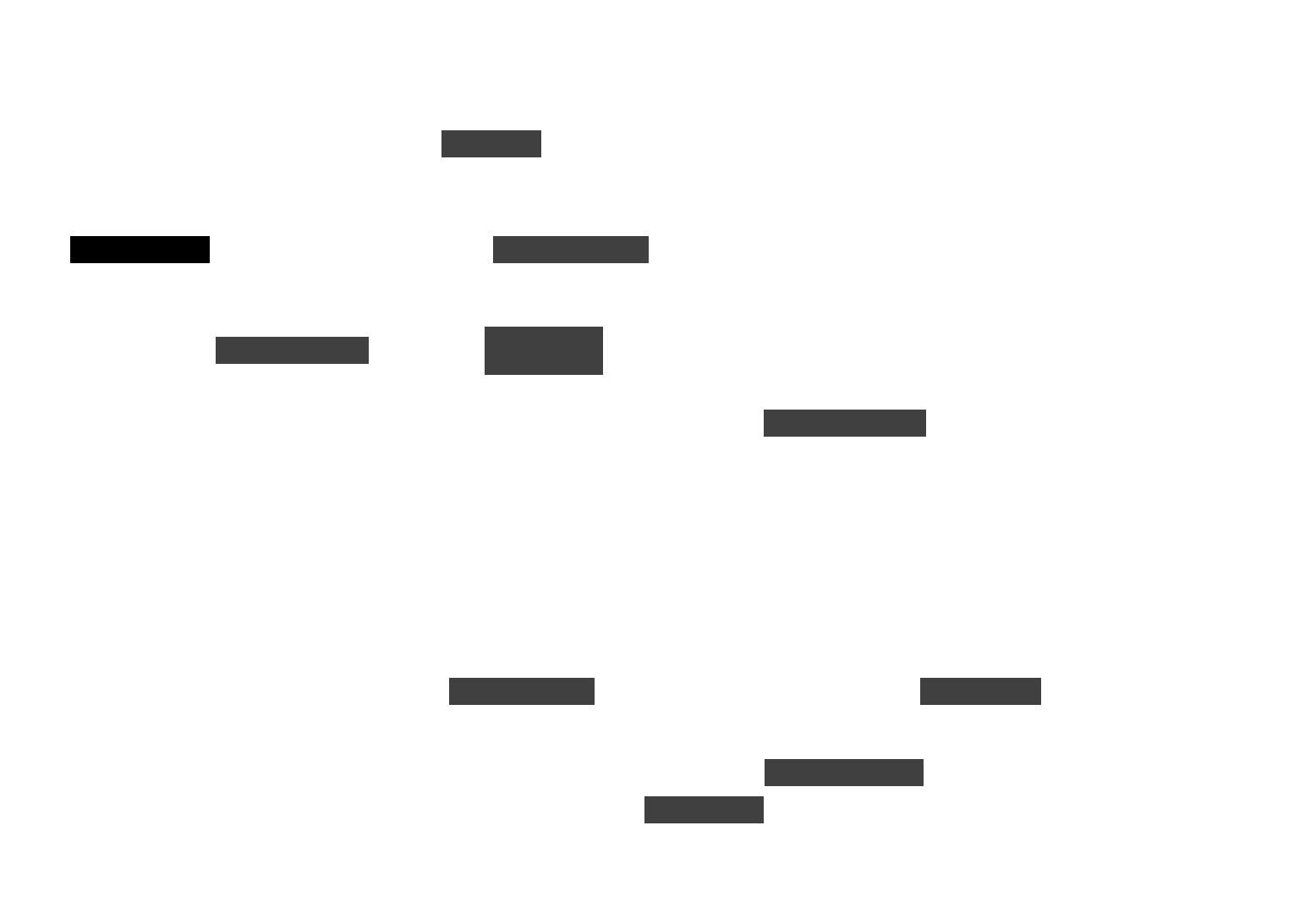
Secondary system updates extend beyond attendee calendars. A single event modification may trigger search index updates so the changed title or description becomes discoverable, notification scheduler updates to adjust reminder timing, email generation for invitation updates sent to external attendees, and time-range cache invalidation to ensure future reads reflect the change. These side effects must occur atomically where possible or with correct eventual consistency behavior where atomicity is impractical. The system must handle partial failures gracefully, retrying failed updates without creating duplicate notifications or inconsistent state.
Users expect instant confirmation when they save changes, immediate UI updates reflecting their modifications, and real-time synchronization on their other devices. Meeting these expectations requires fast primary storage writes with synchronous acknowledgment, followed by asynchronous background processing for secondary updates. The boundary between synchronous and asynchronous processing significantly impacts perceived responsiveness. Primary event storage and same-user device sync should complete before acknowledgment, while cross-attendee propagation and email delivery can proceed in the background.
Read path and time-range query optimization
The read path represents one of the most performance-sensitive components in calendar System Design. Users expect their monthly or weekly views to load instantly, even when their calendars span years of historical data, include multiple subscribed calendars, and contain complex recurring events. Since calendar applications generate far more read operations than writes (often by a ratio of 100:1 or higher), read path optimization directly impacts user experience and infrastructure costs.
Calendar queries almost universally involve time ranges rather than individual event lookups. Users request all events for today, everything scheduled this week, or meetings during a specific month. These time-range queries differ fundamentally from typical database access patterns where primary key lookups dominate. A naive implementation that scans all events for a user and filters by date becomes prohibitively expensive as calendars accumulate years of data, violating the sub-100ms latency targets that production systems require.
Historical note: The shift from scan-based to index-based calendar queries mirrors the broader evolution of database systems. Early personal information managers could scan small datasets efficiently, but cloud-scale systems with decades of user history require fundamentally different approaches.
Multi-calendar aggregation and caching
Multi-calendar aggregation adds another dimension of complexity. Users in collaborative environments subscribe to team calendars, project schedules, and organization-wide event calendars. A single view may aggregate events from dozens of sources, each potentially containing recurring events requiring expansion. The system must fetch events from each subscribed calendar, expand recurrence rules, merge results, sort by time, and return the combined view. All of this must happen within the latency budget.
Efficient caching at both the per-calendar and per-user-view levels avoids repeated computation for popular shared calendars. Hierarchical caching strategies cache expanded instances for shared calendars centrally while maintaining per-user caches for personalized views with overlaid calendars. Cache invalidation must be precise. When a shared calendar event changes, the system must invalidate cached views for all subscribers without requiring full recalculation. Version-based cache keys enable efficient invalidation where a cache entry is valid only if its version matches the current calendar version.
Search functionality extends beyond time-range queries to support finding events by title, attendee, location, or description. A dedicated search and indexing layer, potentially using Elasticsearch or similar technology, maintains inverted indexes on text fields while supporting combined filtering with time ranges. This infrastructure must scale independently from core event storage to handle query volumes without impacting primary operations. Search indexes require careful synchronization with primary storage. Stale search results that show deleted events or miss recently created ones damage user trust.
Free-busy and availability queries
Free-busy queries represent a specialized read pattern that deserves dedicated optimization. When scheduling a meeting, users need to see overlapping availability across multiple attendees. This could involve dozens of people whose individual calendars must be consulted. Naive implementations that expand all events for all attendees quickly become prohibitively expensive, violating the 200ms latency targets that interactive scheduling interfaces require.
Production systems typically precompute busy-time intervals as a separate data structure optimized for availability queries. When an event is created or modified, the system updates a compact representation of busy blocks for affected time ranges. Availability queries then merge these precomputed intervals rather than scanning raw event data. This approach trades storage space and write-path complexity for dramatically faster read performance on availability queries. The precomputed intervals must handle recurring events correctly, expanding instances within the query window and accounting for exceptions that modify individual occurrence times.
Pro tip: Consider caching free-busy results at coarser granularity (hourly blocks rather than minute-level precision) for initial availability display, then refining with exact times only when the user selects a specific slot. This progressive refinement improves perceived responsiveness.
With read and write paths established, the next critical capability is ensuring all these operations remain synchronized across devices and users in real time. This is particularly important when users make changes while disconnected from the network.
Real-time synchronization and offline support
Real-time synchronization transforms a calendar from a static record into a living collaboration tool. When one user edits an event, all other participants and devices must reflect the change immediately. This requirement spans multiple challenging scenarios including users with multiple devices open simultaneously, attendees editing shared events concurrently, and users making modifications while offline that must reconcile with server state upon reconnection. The synchronization layer must handle all these cases while maintaining the consistency guarantees that calendar applications require.
Push-based update delivery
Real-time updates require the server to push changes to clients rather than waiting for clients to poll. Modern implementations use WebSocket connections that maintain persistent bidirectional communication channels between clients and sync servers. When an event changes, the sync server identifies all active sessions that should receive the update and pushes compact notifications through their WebSocket connections. The notification contains just enough information for the client to update its local cache. This typically includes the event identifier, new revision number, and change type rather than the complete event payload.
Mobile platforms additionally support push notification services like Firebase Cloud Messaging or Apple Push Notification Service for updates when the app is not actively running. These platform services have different delivery guarantees and latency characteristics than WebSocket connections. They provide best-effort delivery without guaranteed timing, but they can wake sleeping applications to trigger synchronization. The sync layer must handle the case where a push notification arrives before or after the WebSocket update, using idempotent update operations that produce correct results regardless of delivery order.
Real-world context: Google Calendar’s sync latency typically stays under 2 seconds for same-user cross-device updates. Achieving this requires co-locating sync servers with user sessions and optimizing the path from write acknowledgment to push delivery.
Conflict resolution and offline reconciliation
Conflicts arise when multiple users modify the same event or when a user edits offline while others make changes online. The system must detect these conflicts and resolve them without data loss or corruption. Several strategies apply depending on conflict severity and the specific fields involved.
Last-write-wins is the simplest approach where the most recent modification overwrites previous changes. This works for low-stakes conflicts but risks data loss for significant edits. Field-level merging examines which specific fields each user modified and combines non-overlapping changes automatically. If one user changed the title while another changed the location, both modifications can be preserved. User prompting presents conflicts to users when automatic resolution is insufficient, allowing manual decision-making for critical scheduling decisions.
Offline support presents particular reconciliation challenges because users may make multiple sequential changes that compound conflicts. The client application maintains a local database containing cached events and queues modifications made while offline. Upon reconnection, the sync layer must reconcile local changes with server state that may have evolved independently.
The offline sync protocol typically follows a three-phase approach. First, the client uploads queued local changes with their base revision identifiers. Second, the server processes these changes using standard conflict resolution, returning success confirmations or conflict notifications. Third, the client downloads all server changes since its last synchronized revision, applying them to local state while preserving any unresolved local modifications for user attention.
Immutable event records simplify conflict handling by treating each modification as a new version rather than an in-place update. The storage layer maintains the complete history of changes, enabling the system to reconstruct any previous state and understand exactly what each user intended to modify. This approach aligns with event sourcing patterns where the authoritative data is the sequence of changes rather than current state. UUID generation for event identifiers ensures global uniqueness across distributed servers without coordination, preventing identifier collisions when events are created simultaneously on different devices or in different regions.
Timezone handling and temporal correctness
Timezone handling represents one of the most error-prone aspects of calendar System Design, and getting it wrong creates user-visible bugs that are difficult to diagnose and fix. A meeting scheduled for “3 PM” means different moments in time depending on whether the user is in New York, London, or Tokyo. The system must track not just timestamps but also the timezone context in which they were created, then render events correctly regardless of where the user is viewing them.
Production calendar systems typically store event times in UTC with accompanying timezone metadata. The timezone metadata preserves the user’s original intent. When someone schedules a meeting for “3 PM Pacific,” the system stores both the UTC equivalent and the “America/Los_Angeles” timezone identifier. This approach enables correct handling when timezone rules change. Governments occasionally adjust daylight saving time rules, and events scheduled far in the future must adapt to these changes. Storing the timezone identifier rather than a fixed UTC offset allows the system to recalculate correct times when timezone databases are updated.
Watch out: Recurring events that span daylight saving time transitions require special handling. A “9 AM daily” meeting should occur at 9 AM local time regardless of whether DST is active, meaning the UTC timestamp shifts by an hour at the transition boundary.
The complexity multiplies for recurring events because different instances may fall on different sides of daylight saving time transitions. A weekly meeting scheduled for 2:30 PM might occur at 19:30 UTC during standard time but 18:30 UTC during daylight saving time. The recurrence engine must evaluate each instance against the timezone rules applicable at that instance’s date, not the rules applicable when the series was created. This calculation becomes computationally expensive for long-running series or complex timezone rules, motivating the caching strategies discussed earlier.
Display logic must also handle timezone conversion correctly. When a user in Tokyo views a meeting created by a colleague in New York, the system must convert the event time to the viewer’s local timezone while optionally showing the original timezone context. Users traveling across timezones may want to see events in their home timezone, their current location’s timezone, or the event’s original timezone. The UI must expose these options clearly while defaulting to sensible behavior that minimizes user confusion.
Notifications and reminder scheduling
Reminder delivery represents a critical reliability requirement because missed notifications directly impact user trust. A reminder arriving five minutes late for a job interview or not at all for a flight departure creates real consequences. At global scale, the system must schedule and deliver millions of reminders per minute with precise timing, handle recurring event reminders that extend years into the future, and gracefully recover from outages without dropping or duplicating notifications.
Scheduling architecture and timing precision
Two primary approaches exist for scheduling reminders at scale. Pre-scheduling creates reminder tasks during event creation, storing them in distributed task queues with scheduled execution times. Workers pull tasks as their scheduled times arrive and trigger notification delivery. This approach provides predictable load distribution but requires updating queued tasks whenever events are modified or canceled. A modification to a recurring event may require updating hundreds of queued reminders.
Polling-based scheduling uses a scheduler service that periodically scans upcoming events, identifies reminders due within the next polling window, and enqueues them for immediate delivery. This approach simplifies event modification handling but requires careful polling frequency tuning to balance timeliness against database load.
Hybrid architectures combine both strategies, pre-scheduling reminders for the near-term window (typically 24-48 hours) while using polling for longer-horizon events. Distributed timing wheels partition upcoming reminders across multiple servers based on scheduled time, allowing horizontal scaling of the scheduling infrastructure. Each partition handles reminders within its time slice, with handoff protocols ensuring reminders are not lost during partition rebalancing or server failures. Recurring event reminders require special handling because each instance may have different reminder preferences, and exceptions may override parent event settings. The reminder scheduler must evaluate recurrence rules and exceptions when computing which notifications to generate.
Pro tip: Implement reminder idempotency using keys derived from event identifier, instance date, and reminder offset. This prevents duplicate delivery during outage recovery or retry scenarios while ensuring legitimate reminders are never suppressed.
Multi-channel delivery and failure handling
Modern calendar systems deliver reminders through multiple channels including push notifications to mobile devices, browser notifications for web applications, email for persistent records, and SMS for critical alerts. Each channel has different latency characteristics, reliability guarantees, and retry behaviors. Push notification services provide best-effort delivery without guaranteed timing, while email offers reliable delivery but with variable latency.
The notification system must track delivery status across channels and potentially escalate to alternative channels if primary delivery fails. If a push notification fails to deliver within a reasonable window, the system might fall back to email to ensure the user receives the reminder.
Outage recovery presents particular challenges for reminder systems. When the notification infrastructure experiences downtime, reminders scheduled during the outage accumulate in backlogs. Recovery procedures must replay missed reminders while avoiding duplicate delivery for notifications that were successfully sent before the outage. De-duplication logic tracks which reminders have been delivered, using the idempotency keys described above.
The system must also handle the case where outage recovery occurs after the reminder time has passed, potentially skipping stale reminders or delivering them with appropriate context about the delay. A reminder that arrives an hour after the event started provides negative value and may confuse users.
Building systems that maintain these guarantees at global scale requires attention to scalability, reliability, and operational excellence across all components.
Scalability and multi-region reliability
A calendar platform serving hundreds of millions of users must scale horizontally while maintaining the consistency and availability guarantees that users depend upon. Large organizations may have thousands of shared calendars with millions of events, creating hotspots that naive architectures cannot handle. Regional outages must not prevent users from accessing their schedules, yet the system must avoid the split-brain scenarios that distributed systems are prone to during network partitions.
Horizontal scaling and hotspot prevention
Storage scaling begins with sharding strategies that distribute data across multiple database nodes. User-based sharding assigns each user’s calendars to a specific shard based on their identifier, enabling straightforward scaling as user counts grow. However, shared calendars complicate this model because a single calendar may be accessed by thousands of users assigned to different shards.
Solutions include placing shared calendars on dedicated shards optimized for high-fanout reads, replicating shared calendar data to user shards for read performance while maintaining authoritative copies centrally, or implementing cross-shard query routing that aggregates results from multiple shards transparently.
Hotspot prevention addresses the challenge of popular events or calendars that receive disproportionate traffic. A public event calendar for a major organization or a viral meeting invitation can generate traffic that overwhelms a single shard. Consistent hashing distributes load based on event or calendar identifiers, but hot items may still concentrate on specific nodes. Adaptive load balancing monitors traffic patterns and dynamically replicates hot data to additional nodes, spreading read load while maintaining write consistency through the primary copy. Time-based partitioning for large calendars splits events by month or quarter, preventing any single partition from growing unboundedly as users accumulate years of calendar history.

Real-world context: Google’s Spanner database achieves global strong consistency through GPS-synchronized atomic clocks that bound clock skew to microseconds. This enables linearizable transactions across continents, a capability previously thought impractical at global scale.
Fault tolerance and consistency trade-offs
Multi-region replication ensures availability during regional outages but introduces consistency challenges. Calendar systems typically require strong consistency for event modifications because users cannot tolerate seeing different versions of shared events depending on which region serves their request. Globally consistent databases like Spanner achieve this through synchronized atomic clocks and distributed consensus protocols, allowing strong consistency across regions with latency penalties for writes that must coordinate globally.
The CAP theorem forces explicit trade-offs during network partitions. Calendar systems generally prioritize consistency over availability for write operations, refusing modifications rather than risking divergent state. Read operations may accept slightly stale data during partitions.
Operational monitoring must track metrics that directly indicate user-facing impact. Reminder accuracy measures the difference between scheduled and actual delivery times. Even seconds of delay may matter for time-sensitive events. Sync latency measures how quickly changes propagate across devices. Conflict rates may indicate usability issues with shared calendars. Additional metrics include read and write path latencies at various percentiles, indexing delays that could cause stale search results, and device sync success rates broken down by platform and network conditions. Alerting thresholds must be aggressive for reminder delivery while tolerating more variance for background processing tasks.
End-to-end example tracing an event update through the system
Tracing a single event modification through the complete system architecture demonstrates how the components described throughout this guide interact to deliver the seamless experience users expect. Consider a scenario where a user moves a team meeting to a new time using their mobile phone while several attendees have the calendar open on various devices.
The update begins when the user drags the meeting to its new time slot. The mobile client captures the modification and submits it to the API gateway along with the event’s current revision identifier. The gateway authenticates the request using the user’s credentials and routes it to the Event Service. The service validates that the new time range is valid, confirms the user has edit permissions as the meeting organizer, and retrieves the event’s current state from the primary Spanner database. Finding that the client’s revision matches the server’s current revision, the service accepts the update and writes the new event state with an incremented revision number.
With the primary write complete, propagation to secondary systems begins in parallel. The search indexer receives a notification to update its indexes with the new meeting time, ensuring future searches return accurate results. The reminder scheduler cancels previously queued reminders for the old time and creates new reminder tasks for the updated time across all notification channels. The fan-out service identifies all meeting attendees and enqueues calendar update messages for each participant. These messages flow through Kafka to worker pools that update each attendee’s calendar view and invalidate cached data.
Pro tip: When presenting calendar System Design in interviews, walk through this end-to-end flow to demonstrate understanding of how components interact. Highlight where consistency matters most, where eventual consistency is acceptable, and how the system handles failures at each stage.
The sync service detects that a new revision exists for calendars subscribed to by active sessions. For the organizer’s other devices, it pushes a delta update through established WebSocket connections, causing their laptop browser to immediately refresh the event display. For attendees with active sessions, similar push notifications trigger UI updates showing the new meeting time. Mobile devices not currently running the calendar app receive push notifications through platform notification services, which will trigger delta sync when the app next opens. Each attendee receives an email notification about the time change, generated by the notification service and dispatched through the email delivery infrastructure.
The entire flow from user action to all attendees seeing the update typically completes within seconds, though background tasks like email delivery and full index updates continue longer. This holistic propagation demonstrates why Google Calendar System Design represents one of the most comprehensive learning topics in distributed systems architecture. A single user action touches event storage, recurrence logic, search indexing, notification scheduling, multi-device synchronization, permission enforcement, and attendee calendar management.
Conclusion
Calendar System Design reveals how everyday applications that appear simple require sophisticated distributed systems engineering beneath the surface. The most critical insights center on three interrelated challenges that any production calendar platform must solve.
First, storage and data modeling must balance efficiency against flexibility. Using recurrence rules with dynamic expansion avoids storing millions of individual event instances while still supporting complex exception handling, series splits, and modification patterns that users expect.
Second, consistency requirements are non-negotiable for scheduling applications where users cannot tolerate stale or conflicting event information. This drives architectural choices toward globally consistent databases and careful conflict resolution strategies rather than the eventual consistency that suffices for social media feeds.
Third, real-time synchronization across devices and users demands push-based architectures with delta synchronization to minimize bandwidth while ensuring immediate propagation of changes. This includes graceful handling of offline edits that must reconcile with server state upon reconnection.
Looking ahead, calendar systems will increasingly integrate with artificial intelligence capabilities that suggest optimal meeting times based on participant availability and preferences, automatically reschedule conflicting events, and provide intelligent reminders based on context like travel time or preparation needs. Natural language interfaces will allow users to create and modify events through conversation rather than form fields. Integration with external data sources will enable automatic event creation from flight bookings, restaurant reservations, and package deliveries. The foundational architecture described here provides the building blocks for these advanced features while maintaining the reliability that users depend upon for their most important commitments. The emphasis on strong consistency, real-time synchronization, and flexible data modeling supports this evolution.
For engineers preparing for System Design interviews or architects building scheduling platforms, Google Calendar System Design demonstrates how to combine theoretical distributed systems concepts with practical product requirements. The patterns explored here apply broadly across applications that require collaborative real-time data with strong correctness guarantees. These patterns include time-range indexing, immutable event records, and multi-region consistency. A calendar that silently drops a reminder or shows the wrong meeting time fails at its most fundamental purpose. Building systems that avoid these failures at global scale, across millions of users and billions of events, represents distributed systems engineering at its most consequential.