

Every second, millions of users swipe through an endless stream of short videos, each one tailored to their interests. Behind this seamless experience lies one of the most sophisticated distributed systems ever built. TikTok processes billions of video interactions daily, delivers content with sub-second latency, and continuously adapts its recommendations based on real-time behavior. For system designers, understanding how TikTok achieves this at scale reveals fundamental principles that apply far beyond social media platforms.
The TikTok architecture represents a convergence of three engineering challenges that rarely coexist at this magnitude. Real-time video delivery must span global infrastructure while maintaining video startup latency under 200 milliseconds for 95% of users. Personalized feed generation relies on advanced machine learning pipelines that process hundreds of features per ranking decision. Massive user engagement demands ultra-low-latency interactions where feedback loops operate in seconds rather than hours.
Unlike platforms optimized for long-form content, TikTok thrives on bite-sized videos under sixty seconds but with exponentially higher interaction rates per minute of viewing. This fundamentally changes how the system must prioritize rapid ingestion, GPU-accelerated transcoding, immediate availability through adaptive bitrate streaming, and lightning-fast recommendation loops powered by candidate generation and fine-ranking stages.
This guide breaks down the TikTok architecture layer by layer, from video ingestion through hot, warm, and cold storage tiers to the two-stage recommendation engine with its diversity mechanisms. You will learn how TikTok handles capacity at planetary scale using multi-CDN strategies and edge nodes, why its recommendation system feels highly accurate through real-time feature stores, and what trade-offs the engineering team makes between latency, consistency, and cost.
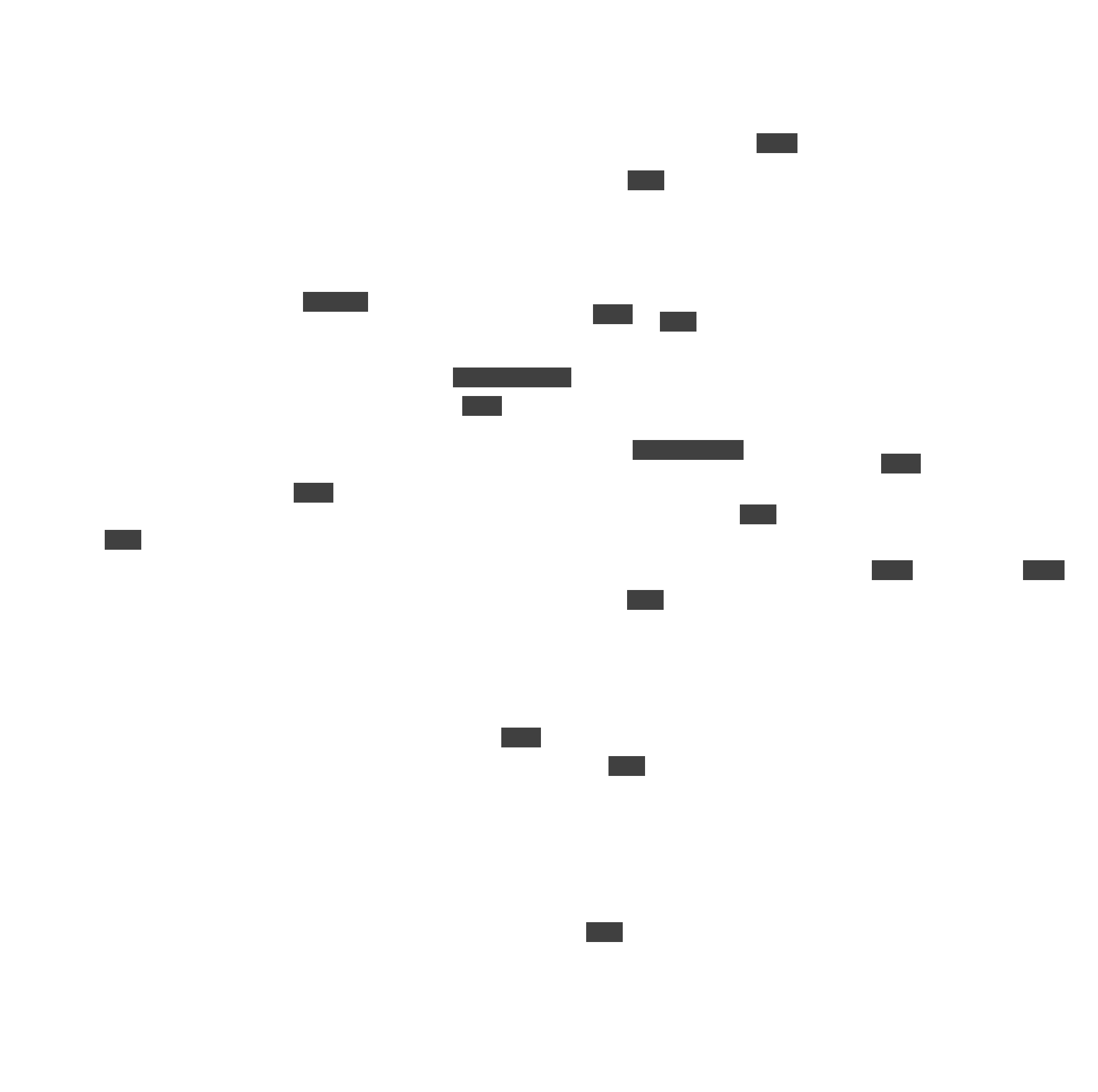
Whether you are preparing for a System Design interview or architecting your own high-engagement platform, these patterns provide a blueprint worth studying. The following diagram illustrates how TikTok’s major systems connect and communicate with each other.
Core objectives and requirements
Designing a system that serves billions of videos to hundreds of millions of users worldwide requires careful balance between functional capabilities and non-functional guarantees. At TikTok’s scale, every architectural decision directly impacts user experience. This includes how videos are stored across hot and cold tiers and how the recommendation engine generates candidates. Understanding these requirements provides the foundation for every subsequent design choice in the system.
Functional requirements define what the system must do. Video upload and playback must support various formats, resolutions, and network conditions through adaptive bitrate streaming. This accommodates users on high-speed fiber and those on congested mobile networks alike. Engagement features including likes, comments, shares, duets, stitches, and live streaming form the social backbone of the platform and feed directly into the recommendation pipeline.
The discovery and recommendation system, particularly the “For You” page, represents TikTok’s core differentiator through its two-stage architecture of candidate generation and fine-ranking. Search functionality requires indexed, multi-faceted queries across videos, users, hashtags, and sounds using systems like Elasticsearch. Notifications must deliver real-time alerts for interactions, trending content, and live streams without overwhelming users.
Non-functional requirements define how well the system performs these functions. Video startup latency must remain under 200 milliseconds for 95% of sessions to prevent user drop-off, measured from swipe to first frame rendered. Service availability targets 99.99% uptime or higher, translating to less than 53 minutes of downtime annually across all regions.
Global scalability must handle traffic surges exceeding 10x normal load, especially when videos go viral and demand spikes by orders of magnitude within minutes. Fault tolerance through graceful degradation ensures automatic failover when components or entire data centers fail. This allows core features to continue even when secondary systems experience issues. Data privacy and compliance requirements vary by region, including GDPR in Europe, CCPA in California, and stricter data localization laws requiring user data to remain within national borders.
Watch out: The “99.99% uptime” requirement sounds straightforward, but at TikTok’s scale, even 0.01% downtime affects millions of users simultaneously. This drives the need for multi-region redundancy, graceful degradation strategies that serve cached recommendations when the primary system fails, and fallback to trending content when personalization services experience issues.
What makes TikTok’s requirements uniquely challenging is that the feed changes in real time based on continuous user behavior signals. Unlike static media apps where content remains relatively stable, TikTok’s backend must constantly adapt recommendations as users watch, swipe, and interact using stream processing tools like Apache Flink.
This real-time feedback loop drives every architectural choice. These choices span from microservice boundaries to database selection including graph databases for social relationships to multi-CDN deployment strategies with proactive cache warming. The following section examines how these requirements translate into a concrete high-level architecture.
High-level architecture overview
At the highest level, TikTok follows a distributed microservices architecture where each service handles a specific domain with clear boundaries. This separation allows independent scaling, deployment, and fault isolation across the platform. When the transcoding service experiences heavy load during a viral challenge, it can scale horizontally without affecting the recommendation engine. When a bug affects the notification system, it can be fixed and deployed without risking the core video playback path that users depend on.
The API Gateway serves as the entry point for all mobile and web client requests. It handles authentication through OAuth 2.0, rate limiting to prevent abuse, and request validation before routing to appropriate backend services via gRPC or HTTP/3. The Video Ingestion Service manages chunked uploads, metadata extraction, and initial moderation checks using AI-powered content screening. Once uploaded, the Transcoding Service converts videos into multiple resolutions including 240p, 480p, 720p, and 1080p using GPU-accelerated encoding for adaptive bitrate streaming delivery.
The Content Delivery Network layer employs a multi-CDN strategy combining providers like Akamai and Cloudflare with ByteDance’s proprietary edge network. This distributes video files to edge nodes globally for ultra-low-latency playback.
The Recommendation Engine powers the “For You” feed through a two-stage architecture combining candidate generation with fine-ranking, supported by a real-time feature store and stream processing pipelines. The Social Graph Service tracks user relationships and interactions using graph databases like Neo4j for network-driven content surfacing and collaborative filtering. The Live Streaming Service handles broadcasts and real-time chat through WebSocket connections.
The Engagement Service processes likes, comments, shares, and notifications, feeding signals back into the recommendation pipeline within milliseconds. The Analytics Pipeline ingests billions of events daily through Kafka and Flink to refine recommendations, measure performance, and detect anomalies.
Real-world context: ByteDance, TikTok’s parent company, operates its own service mesh infrastructure similar to Istio for managing inter-service communication. This handles service discovery, load balancing, mTLS encryption, and observability without requiring each service to implement these capabilities independently. This reduces development overhead across hundreds of microservices.
These services communicate through multiple patterns optimized for different use cases. Synchronous calls using gRPC or HTTP/3 handle user-facing actions requiring immediate response, such as fetching the next video in the feed. These protocols offer lower latency and better multiplexing than traditional REST over HTTP/1.1. Asynchronous messaging through Apache Kafka or Pulsar handles background tasks like transcoding job orchestration, content moderation queuing, and analytics event aggregation where immediate response is unnecessary. WebSockets and server-sent events enable real-time updates in live streams and interactive features where the server must push data to clients without polling.
In this architecture, data flows continuously between ingestion, tiered storage, and delivery. Machine learning models constantly update based on user behavior signals from the feature store. This allows TikTok to adapt the feed dynamically, ensuring every swipe feels fresh and personalized through the tight integration of stream processing and recommendation serving. Understanding this high-level flow sets the stage for examining individual components in depth, starting with how videos enter the system through the upload pipeline.
Video upload and ingestion pipeline
One of the defining strengths of TikTok’s System Design is its ability to ingest millions of video uploads daily without creating bottlenecks anywhere in the pipeline. The ingestion system must be fast, reliable, and scalable. It ensures that a newly uploaded video can be processed and made available for streaming within seconds rather than minutes. This speed directly impacts creator satisfaction and overall platform engagement, as delays in video availability discourage content creation.
The pipeline faces three primary challenges that shape its architecture. Massive concurrency means hundreds of thousands of uploads may happen simultaneously during peak times. This includes times after major global events or during viral challenges that prompt millions of users to create response videos. Global distribution means uploads originate from anywhere with varying network speeds and reliability, from fiber connections in Seoul delivering stable high-bandwidth streams to congested mobile networks in rural areas with frequent packet loss. Moderation at upload time requires screening content through AI models before it goes live without creating unacceptable delays in availability that frustrate creators.
Upload workflow and chunked transfers
The upload process begins when the client requests an upload session from the API gateway. The client submits metadata including video length, target resolution, codec information, and device characteristics. Rather than uploading the entire file at once, videos are broken into smaller chunks typically around 5MB each using a chunked upload protocol. This approach enables resumable transfers for users on unstable connections. If a network interruption occurs, only the failed chunk needs retransmission rather than the entire file, dramatically improving success rates on mobile networks.
Device-side compression plays a crucial role before chunks even leave the user’s phone. It reduces both upload time and server-side processing requirements. TikTok’s mobile app performs initial compression using H.264 or HEVC codecs and format normalization directly on the device. This reduces upload size by 40-60% while ensuring consistent input for server-side processing. This approach shifts computational work to the edge where it costs nothing in infrastructure, reduces bandwidth costs at scale, and ensures the server receives predictable input formats that simplify transcoding pipelines.
Uploaded chunks are stored in a staging bucket within a distributed object storage system similar to Amazon S3 while pre-processing occurs in parallel. Basic validation checks enforce format compatibility against supported codecs, resolution constraints ensuring videos meet platform standards, and duration limits for different content types. Metadata extraction captures timestamps, audio track fingerprints for music identification, hashtags parsed from descriptions, and other relevant information for search indexing through Elasticsearch. The video then enters a moderation pipeline combining automated AI scans using computer vision models trained to detect policy violations with optional human review for content flagged with medium confidence scores.
Pro tip: The moderation and transcoding pipelines run in parallel rather than sequentially. This design choice significantly reduces time-to-availability. If a video passes moderation quickly while transcoding is still in progress, the system can begin promoting the video in recommendations as soon as the first resolution variant completes. This parallelization represents a fundamental trade-off. It accepts slightly more complexity in orchestration to achieve dramatically faster creator feedback loops.
The following diagram illustrates how a video moves through the ingestion pipeline from the moment a user taps upload to when the content becomes available for discovery.
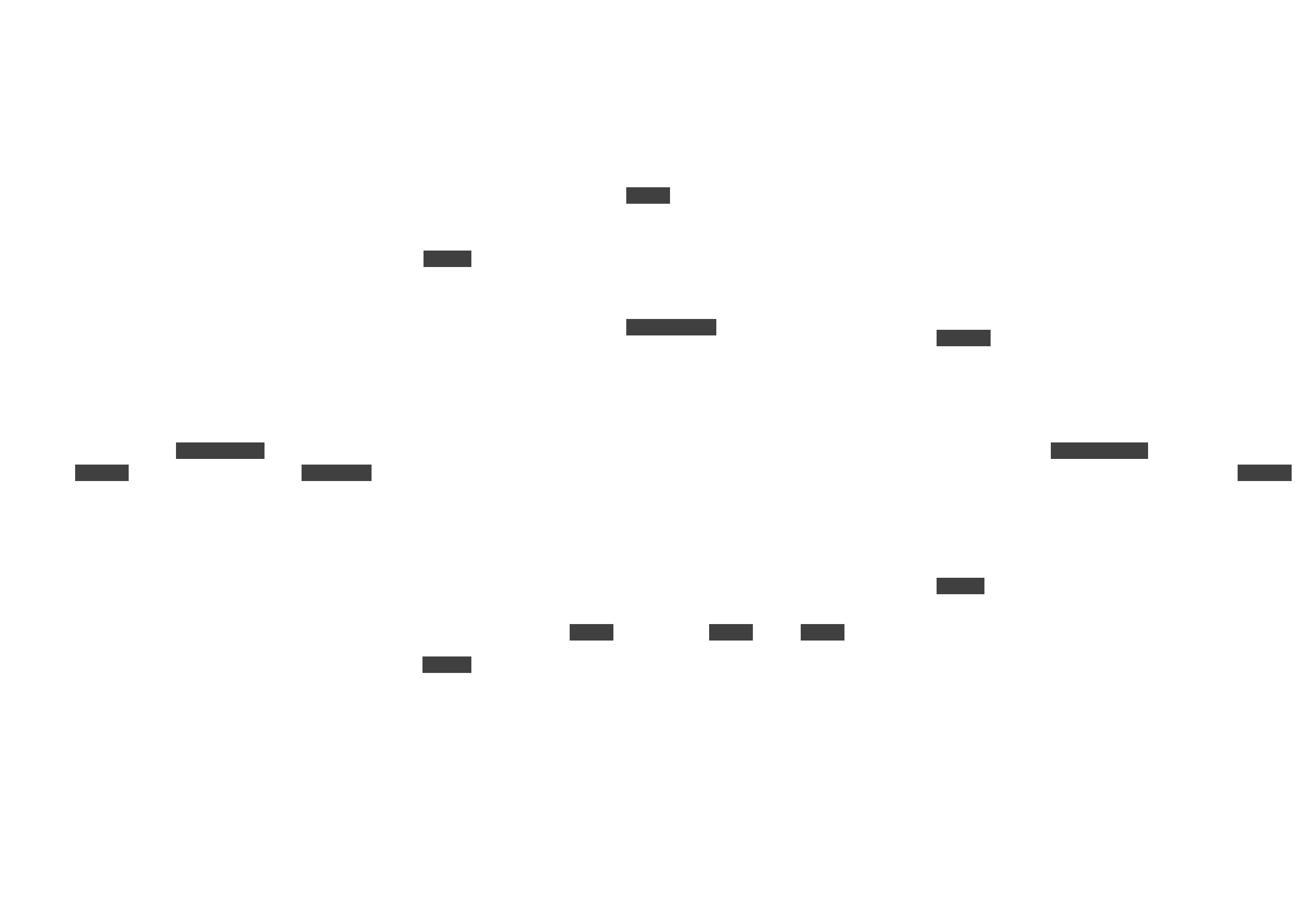
This flow ensures content moves from user device to playback-ready status as quickly as possible while still protecting platform integrity through comprehensive content screening. The parallel processing approach accepts orchestration complexity to achieve significantly faster time-to-availability. This typically reduces the gap between upload completion and global availability from minutes to seconds. Once a video completes ingestion successfully, it moves to storage and transcoding where multiple versions are created for different playback scenarios across diverse devices and network conditions.
Video storage and transcoding
Once a video completes ingestion and passes moderation checks, it must be stored efficiently and made accessible for delivery across diverse devices and network conditions worldwide. This is where multi-resolution storage and adaptive bitrate streaming become essential components of the architecture. The storage strategy directly impacts both user experience through playback quality and operational costs at TikTok’s scale of billions of videos.
Storage tiering strategy
TikTok stores multiple versions of every video, typically at 240p, 480p, 720p, and 1080p resolutions. This ensures optimal playback based on the user’s device capabilities and current network quality through adaptive bitrate streaming protocols. However, not all videos require the same storage performance characteristics, and treating them uniformly would be prohibitively expensive. A tiered storage approach optimizes the balance between access speed and cost by categorizing content based on access patterns.
Hot storage holds frequently accessed content in high-performance, low-latency storage systems using NVMe SSDs in geographically distributed data centers with access latency under 10 milliseconds. Newly uploaded videos automatically enter hot storage to ensure fast initial distribution, and currently viral content remains here as long as demand stays elevated.
Warm storage contains recently uploaded but less active content in slightly slower but significantly cheaper storage with latency between 50-200 milliseconds, typically using high-density HDDs or lower-tier SSDs. Videos that had initial engagement but have settled into normal viewing patterns migrate here after approximately one week based on access frequency metrics.
Cold storage archives content that is rarely accessed but must remain available on demand. It uses high-density tape or archival object storage with retrieval times measured in seconds rather than milliseconds. A video from two years ago that suddenly goes viral due to a trend revival can be retrieved from cold storage and automatically promoted back to hot storage as demand increases.
| Storage tier | Content type | Access latency | Relative cost | Typical retention |
|---|---|---|---|---|
| Hot | Viral content, new uploads, trending videos | <10ms | High | 0-7 days |
| Warm | Recent uploads, moderate engagement | 50-200ms | Medium | 7-90 days |
| Cold | Archived content, rarely accessed | 1-5 seconds | Low | 90+ days |
This tiering strategy dramatically reduces storage costs while maintaining performance where it matters most. At TikTok’s scale of billions of videos with petabytes of storage, keeping everything in hot storage would cost orders of magnitude more than the tiered approach. Intelligent migration policies based on access pattern analysis, engagement decay curves, and content age ensure the right content lives in the right tier automatically.
Historical note: Early video platforms like early YouTube stored all content uniformly, leading to massive storage costs as libraries grew. The tiered storage approach emerged from lessons learned by Netflix and YouTube about the importance of access-pattern-aware storage policies. TikTok’s implementation represents the current state of the art, with machine learning models predicting optimal tier placement based on content characteristics and early engagement signals.
GPU-accelerated transcoding
The transcoding process converts uploaded videos into the standardized formats and resolutions required for adaptive bitrate delivery across the diverse device ecosystem. Format standardization converts all videos into common delivery formats. This typically means H.264 for broad compatibility and H.265/HEVC for newer devices that support more efficient compression. This ensures uniform handling throughout the delivery pipeline.
Parallel encoding simultaneously creates all resolution variants from 240p through 1080p. Each resolution is encoded as an independent job that can run on separate GPU cores. Audio and video synchronization verification ensures lip sync accuracy and timing precision post-transcoding. This is a particularly important quality check for the music-heavy, dialogue-rich content common on TikTok. Finally, mobile delivery optimization creates specially tuned lower bitrate versions for users on slow or congested networks without compromising too much on perceived visual quality through perceptual quality metrics.
TikTok uses GPU-accelerated transcoding clusters to handle this workload at scale. These clusters leverage NVIDIA NVENC or similar hardware encoders that can process video orders of magnitude faster than CPU-based encoding. Modern GPUs can encode multiple streams simultaneously, and the embarrassingly parallel nature of transcoding multiple resolutions makes GPU clusters ideal for this workload. Multiple encoding jobs run in parallel across different servers orchestrated by Kafka-based job queues. This ensures a newly uploaded video can be globally available in seconds to minutes rather than the hours that older platforms required. The cost per transcode drops significantly with GPU acceleration despite higher hardware costs, as throughput improvements outpace the price premium.
Watch out: GPU transcoding clusters require careful capacity planning because GPU memory is a constrained resource that cannot be easily oversubscribed. Unlike CPU workloads where overcommitment is common, GPU jobs that exceed memory limits fail hard. TikTok likely maintains significant headroom and uses predictive scaling based on upload volume forecasts to prevent transcoding backlogs during peak creation periods.
With videos transcoded into multiple resolution variants and stored across appropriate tiers based on predicted access patterns, the next challenge is delivering them to users worldwide with minimal latency. This is where TikTok’s sophisticated content delivery strategy becomes critical to maintaining the instant-feeling swipe experience.
Content delivery network strategy
Even with efficient storage and transcoding, TikTok’s System Design would fail without a highly optimized CDN layer that brings content physically closer to users. The CDN ensures ultra-low latency playback by caching videos at edge nodes regardless of user location. When a user in São Paulo swipes to the next video, that content should ideally be served from a nearby edge node in South America rather than crossing the Atlantic to origin servers in the United States or Europe.
TikTok’s CDN requirements go significantly beyond typical web content delivery in both scale and sophistication. Global reach demands edge servers located close to major user bases on every inhabited continent, with particular density in high-engagement markets like Southeast Asia, India, Brazil, and the United States. Caching efficiency must reduce redundant requests to origin servers, particularly for viral content that millions of users request simultaneously within short time windows. Resilience requires automatic failover routing to backup CDN nodes when regional outages occur, ensuring users experience minimal disruption even during infrastructure incidents. The combination of these requirements drives a sophisticated multi-layered delivery architecture that goes beyond what single-vendor CDN solutions provide.
Multi-CDN architecture and edge computing
TikTok employs a multi-CDN strategy that blends commercial CDN providers like Akamai, Cloudflare, and Fastly with ByteDance’s proprietary edge network infrastructure. This approach provides redundancy against any single provider’s outages. It allows geographic optimization by routing to whichever CDN performs best in each region and enables aggressive cost negotiation between providers who compete for traffic share. If one CDN experiences performance degradation or an outage in a particular region, traffic automatically routes to alternatives within seconds based on real-time latency measurements.
Edge computing capabilities extend beyond simple video caching to enable lightweight computation at the network edge. ByteDance operates edge nodes that can perform format selection based on device capabilities, A/B test assignment for recommendation experiments, basic personalization using cached user preferences, and even initial content filtering without requiring round-trips to central data centers thousands of miles away. This pushes latency-sensitive decisions closer to users and reduces load on core infrastructure in primary data centers. As 5G adoption increases globally, edge computing becomes even more valuable by enabling more sophisticated real-time video processing, AR effect rendering, and personalized content assembly at the network edge.
The CDN workflow for trending content demonstrates this architecture in action when a video begins going viral. Monitoring systems detect the engagement spike within minutes through real-time analytics pipelines processing view counts and engagement rates. The system triggers proactive cache warming, replicating the trending video to edge nodes in high-demand regions before user requests arrive, rather than waiting for cache misses to drive distribution. Geo-replication ensures multiple copies exist in different global regions for both load balancing and fault tolerance. When users request the video, adaptive bitrate streaming protocols like HLS or DASH dynamically adjust quality based on real-time network condition measurements, switching between resolution variants seamlessly as bandwidth fluctuates.
Pro tip: TikTok’s client app pre-fetches the next several videos in the feed before the user swipes. It uses prediction based on scroll velocity and engagement patterns. Combined with edge caching and proactive warming for trending content, this makes transitions feel instantaneous even on moderate network connections. The latency users actually perceive is not the network fetch time but rather the time to start playback from already-buffered content in the client’s local cache.
This architecture keeps average video startup latency under 200 milliseconds for the vast majority of users globally. This is critical for maintaining the addictive swipe experience that defines TikTok. Users who experience buffering, stuttering, or startup delays are significantly more likely to close the app and switch to competing platforms. Research consistently shows that each additional 100 milliseconds of latency measurably decreases engagement and session length. With content delivery optimized for speed and reliability, the next layer to examine is the recommendation system that decides which videos appear in each user’s personalized feed.
Recommendation system architecture
If there is one feature that defines TikTok and differentiates it from every competitor, it is the “For You Page” that seems highly accurate in knowing what users want to watch next. The recommendation system achieves this level of personalization through real-time user interaction data, advanced machine learning pipelines with multiple stages, and distributed computation that updates within seconds of user behavior. Understanding this system reveals why TikTok’s engagement metrics consistently exceed those of competitors with larger content libraries and longer histories.
The recommendation system must satisfy seemingly contradictory requirements simultaneously. It must deliver highly relevant videos within milliseconds of a user swipe to maintain the instant-feeling experience. It must continuously refine recommendations based on new behavior signals in real time, not through daily batch updates that feel stale. It must balance personalization with content diversity to prevent users from getting trapped in narrow content bubbles that reduce long-term engagement and platform health. Meeting all three requirements at TikTok’s scale requires a sophisticated multi-stage architecture.
Two-stage recommendation with candidate generation and ranking
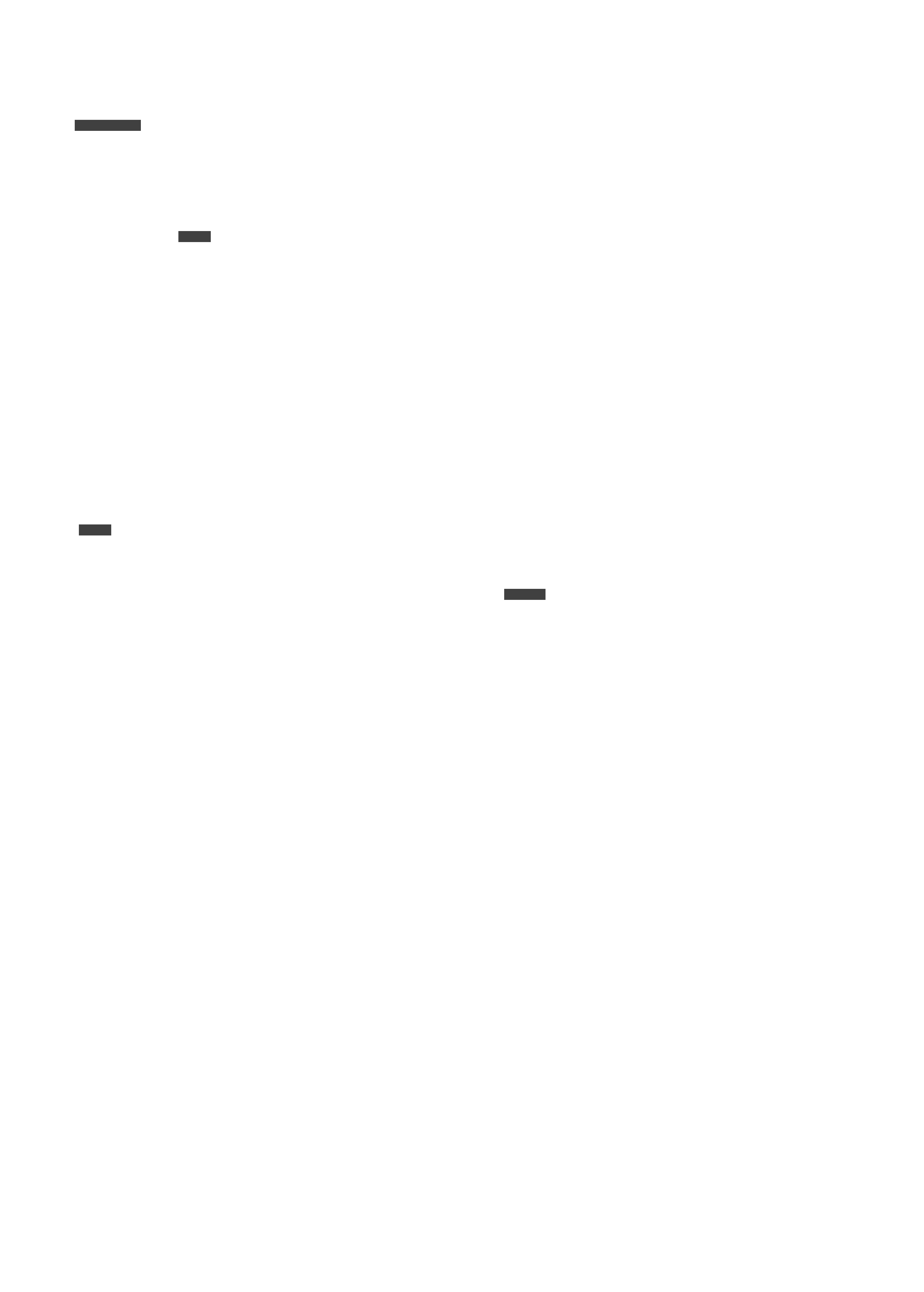
TikTok’s recommendation pipeline follows a two-stage architecture common in large-scale recommendation systems but implemented with particular sophistication and optimization for real-time responsiveness. The first stage, called candidate generation, retrieves a large pool of potentially relevant videos from the entire corpus of billions of videos using multiple retrieval methods running in parallel.
Collaborative filtering identifies videos that users with similar behavior patterns enjoyed, leveraging the social graph and interaction history. Trending metrics surface currently popular content that is resonating broadly across the platform. Content-based retrieval using nearest neighbor search finds videos with similar tags, audio fingerprints, or visual feature embeddings extracted through deep learning models. Social graph queries retrieve content from followed creators and videos that friends have recently engaged with.
Candidate generation must be fast and recall-oriented. This means it prioritizes not missing good content over precision at this stage. False positives are acceptable because the ranking stage will filter them, but false negatives mean potentially great content never gets considered. A typical candidate set might contain several thousand videos retrieved in under 50 milliseconds through highly optimized embedding lookups and inverted indexes. These candidates then pass to the second stage for detailed scoring.
The fine-ranking stage uses deep learning models, typically multi-layer perceptrons with specialized architectures for multi-task prediction, to score each candidate video based on predicted engagement across multiple dimensions. The ranking model considers hundreds of features organized into categories.
User features include viewing history embeddings, demographic signals inferred from behavior, time of day and day of week patterns, and session context like videos already watched. Video features include content category classifications, creator popularity metrics, freshness signals, historical engagement rates, and audio/visual embeddings. Context features capture device type and capabilities, current network quality estimates, and session length indicators.
The model predicts multiple outcomes simultaneously. These include probability of watching to completion, likelihood of explicit engagement like likes, probability of sharing to external platforms, and expected watch time in seconds. These multi-objective predictions combine through learned weights into a final relevance score.
Feature store and real-time adaptation
The Feature Store serves as centralized storage for both precomputed and real-time features, providing a unified interface that the recommendation models query during inference. Precomputed features like user embedding vectors capturing long-term preferences and video category classifications are updated through batch jobs running on Spark or similar frameworks, typically refreshed every few hours.
Real-time features like “videos watched in current session,” “seconds since last engagement,” and “recent content categories viewed” update continuously through stream processing pipelines built on Apache Flink. These features reflect user behavior within seconds of it occurring.
This hybrid approach balances computational efficiency with recommendation freshness in a way that pure batch or pure streaming approaches cannot achieve. Batch processing handles computationally expensive operations like re-training embedding models and computing global popularity metrics. Stream processing handles the latency-sensitive updates that make recommendations feel instantly responsive to user behavior changes.
Real-world context: TikTok reportedly experiments with thousands of model variants simultaneously through sophisticated A/B testing infrastructure that can partition users into treatment groups at massive scale. Small improvements in recommendation quality, even fractions of a percent in engagement metrics, translate to millions of additional hours of viewing time at TikTok’s scale. This makes continuous experimentation essential for maintaining competitive advantage.
What makes TikTok’s system uniquely responsive compared to competitors is that recommendations adapt within seconds of new behavior rather than waiting for nightly batch updates. If a user suddenly starts watching cooking videos after weeks of primarily consuming sports content, the next few swipes will likely begin reflecting this interest shift. This real-time adaptation uses Apache Flink stream processing that updates the feature store continuously, with fresh features feeding directly into the ranking model for every request.
After ranking produces scored candidates, a re-ranking and diversity layer applies business rules and ensures feed quality. Content policy violations detected by secondary safety models are removed from consideration. Diversity injection algorithms ensure users see variety across content categories, creators, and formats rather than repetitive content that might maximize short-term engagement but degrade long-term satisfaction. Creator fairness rules prevent any single creator from dominating a user’s feed, ensuring the platform surfaces a healthy mix of established and emerging creators. The final ordered list incorporating all these adjustments is then serialized and delivered to the client.
Understanding how user interactions feed back into this system completes the picture of TikTok’s engagement engine.
Real-time engagement and feedback loops
Unlike static content platforms where recommendations update periodically, TikTok thrives on real-time feedback loops where every interaction provides signals that immediately influence future recommendations. This tight coupling between user behavior and system response creates the sensation that the app “learns” preferences quickly. It adapts to mood shifts within a single session rather than requiring days of repeated behavior to detect patterns.
The feedback loop operates continuously throughout every user session. The moment a user likes a video, leaves a comment, or shares content externally, the event is logged with millisecond-precision timestamps and enriched with context like watch duration and replay count. This event streams into a real-time analytics pipeline built on Apache Kafka and Flink that processes it within tens of milliseconds. The updated interaction data pushes into the recommendation engine’s feature store, modifying the user’s real-time features that capture current session behavior. When the user swipes to the next video, the ranking model’s inference incorporates these fresh signals, adjusting content priorities based on the just-demonstrated preferences.
TikTok tracks multiple engagement metrics with carefully calibrated weights in the recommendation model reflecting their signal value. Watch time per video serves as the primary signal for interest level because it is difficult to fake and correlates strongly with genuine engagement unlike easily-gamed metrics like views. Completion rate distinguishes between strong and weak engagement, differentiating a 60-second video watched for 55 seconds from one abandoned after 10 seconds.
Replays signal exceptionally engaging content worth resurfacing and potentially promoting more aggressively. Shares and duets serve as strong virality indicators because they represent users willing to attach their identity to content, boosting visibility beyond the immediate viewer’s feed. Negative feedback including quick skips, explicit “Not Interested” tags, and hiding specific creators reduces future exposure for similar content through negative weight adjustments in the ranking model.
Watch out: Optimizing purely for watch time can lead to problematic outcomes such as promoting sensationalist, misleading, or emotionally manipulative content that captures attention but harms user trust and platform reputation over time. TikTok balances engagement metrics with content quality signals from classifier models, creator reputation scores, and policy enforcement systems to maintain long-term platform health rather than maximizing only short-term engagement.
This tight integration of real-time engagement data makes the TikTok system feel instantly responsive to user preferences in ways that competitors with batch-updated recommendations cannot match. The feedback loop’s speed, measured in seconds rather than the hours or days typical of older recommendation systems, is a primary reason the app feels so personally tailored compared to platforms with slower update cycles. Beyond individual engagement patterns, TikTok also leverages relationships between users through its social graph to inform content discovery and viral distribution.
Social graph and network effects
While TikTok’s recommendation engine can surface videos from anyone in the world through purely algorithmic means, the social graph plays a crucial role in feed composition and viral mechanics. It determines how creator-follower relationships, mutual interactions, and shared interests among connected users influence what content appears and how quickly compelling videos spread through the network.
TikTok stores its social graph in a highly optimized graph database infrastructure. This potentially uses Neo4j, a custom graph storage system, or sharded key-value stores with graph query capabilities. The graph must handle billions of nodes representing users and creators across all markets, tens of billions of edges representing follows, mutual connections, likes, duets, stitches, and shares, and real-time updates reflecting instant follow and unfollow actions that must propagate immediately to affect recommendations. Graph-based recommendation queries traverse this structure using efficient algorithms to find content that resonated with similar users based on graph proximity or within a user’s extended network several hops away.
The social graph influences feed composition through multiple mechanisms that blend with pure algorithmic recommendations. Content from followed creators blends into the algorithmic For You Page at a higher rate, providing familiar faces alongside novel discovery. Videos with high engagement from users in a person’s network receive amplification through social proof signals, appearing more frequently because friends’ endorsements carry weight. Collaborative content types like duets and stitches create new graph edges that introduce users to new creator circles, organically expanding the social graph over time and increasing content diversity.
Historical note: Facebook’s social graph gave it an insurmountable advantage in social networking for over a decade. TikTok’s approach showed that an interest graph built from behavioral signals could compete with and even surpass explicit social connections for content discovery. The platform uses social signals as one input among many rather than the primary organizing principle, allowing it to surface content from strangers that pure social networks would never show.
The network effects of this design create a viral loop that strengthens the platform with each interaction. Users watch content and engage with videos that resonate. This engagement makes compelling content visible to more people through both algorithmic amplification and social distribution. New users join after seeing content shared externally on other platforms. These new users begin creating and engaging, feeding more signals into the system. The cycle repeats with increasing velocity as the user base grows.
The more interactions happen within and across user networks, the stronger the engagement signals become, making TikTok’s algorithm more precise over time. This self-reinforcing dynamic explains how TikTok grew so rapidly despite launching years after established competitors with larger user bases and content libraries.
Maintaining a system this complex and fast-moving requires sophisticated analytics and monitoring infrastructure to catch problems before they impact users and to continuously optimize performance across thousands of interacting components.
Analytics and monitoring
For a platform operating at TikTok’s scale with hundreds of millions of daily active users, analytics and monitoring serve as the operational heartbeat that keeps everything running smoothly. They ensure performance targets are maintained across all services, user engagement trends are understood and acted upon, content moderation effectiveness is measured and improved, and potential failures are caught early before they cascade into user-visible incidents. Without comprehensive observability across every layer of the stack, running a system this complex would be operating without visibility in critical situations.
Analytics serve multiple organizational goals beyond just keeping the lights on. User behavior insights identify trending content categories, seasonal engagement patterns, emerging creator stars, and shifts in user preferences that product teams must respond to. System performance tracking measures API response times at various percentiles, CDN latency distributions across regions, transcoding throughput and queue depths, error rates across every microservice, and resource utilization patterns. Content moderation analytics evaluate how quickly and accurately harmful content is detected and removed. This provides feedback loops to improve automated classification systems and identify gaps requiring additional training data or model updates.
TikTok’s analytics architecture likely uses a lambda or kappa data processing model that combines batch and stream processing to serve different latency requirements. Batch processing through frameworks like Apache Spark generates daily and weekly trend reports from massive historical datasets. This identifies long-term patterns in user behavior, content performance decay curves, and seasonal variations that inform strategic decisions. Real-time processing through Apache Flink or Kafka Streams enables immediate detection of anomalies like sudden engagement drops, viral content spikes requiring CDN attention, or service degradation in specific regions that require immediate operational response.
The monitoring stack includes multiple specialized layers working together. Application Performance Monitoring through tools like Datadog, internal equivalents, or custom-built solutions tracks microservice health, request latency distributions, error rates by endpoint, and dependency performance. Log aggregation through centralized systems like Elasticsearch provides queryable event data for debugging incidents and conducting forensic analysis after problems occur.
Metrics collection through Prometheus or similar time-series databases captures both system-level metrics like CPU, memory, and network utilization alongside business-level metrics like videos served, engagement rates, and creator activity. Alerting systems automatically notify on-call engineers through PagerDuty or similar platforms when anomalies occur, such as sudden drops in engagement metrics, latency spikes exceeding SLA thresholds, or error rate increases in specific services.
Real-world context: Large-scale systems like TikTok increasingly use AIOps approaches that apply machine learning to operations data, moving beyond static threshold alerting. These systems learn normal patterns for each metric and service, predict failures before they occur based on leading indicators, automatically correlate related alerts to identify root causes, and suggest or even implement remediation automatically. This reduces mean time to detection and recovery for incidents while preventing alert fatigue from overwhelming operations teams.
With this layered observability approach combining real-time monitoring, historical analytics, and intelligent alerting, TikTok can detect, analyze, and respond to operational challenges within minutes rather than hours. This capability minimizes downtime and ensures smooth user experiences even as the system handles unpredictable load patterns from viral content and global events. This monitoring capability directly supports the next critical requirement. The system needs to maintain service availability and performance during failures and traffic spikes.
Scalability and fault tolerance
Scalability and fault tolerance are non-negotiable requirements for TikTok’s System Design given the platform’s global user base spanning every time zone and the inherently unpredictable nature of viral content surges. A video can go from zero views to millions within hours when it catches algorithmic momentum or gets shared by a celebrity. The infrastructure must handle this gracefully without degradation. Simultaneously, component failures are inevitable at the scale of thousands of servers and services. The system must continue serving users acceptably when they occur.
Scalability strategies
Horizontal scaling adds more server instances or containers rather than upgrading individual machines to larger configurations. This distributes load across a growing fleet of commodity hardware. This approach scales linearly with demand, avoids single points of failure inherent in vertical scaling, and allows incremental capacity additions rather than expensive forklift upgrades. Every service in TikTok’s architecture is designed to run as multiple replicas behind load balancers, enabling seamless capacity expansion.
Service sharding partitions databases and services by geography, user ID ranges, or content categories. This reduces the load that any single shard must handle while maintaining data locality. A user in Japan primarily hits infrastructure in the Asia-Pacific region, while a user in Germany routes to European data centers. This reduces cross-continental latency and enables regional compliance with data localization laws. Sharding also provides failure isolation, as problems in one shard do not directly affect users assigned to other shards.
Elastic resource allocation through auto-scaling groups in cloud infrastructure or equivalent internal systems automatically provisions additional capacity during peak usage periods. It scales down during quiet hours to optimize costs. Predictive scaling based on historical patterns anticipates known traffic increases like evening peak hours in major markets or expected viral events. Reactive scaling responds to unexpected demand spikes detected through real-time metrics. The combination ensures the platform maintains performance during 10x traffic surges while not paying for idle capacity during low-demand periods.
Fault tolerance and fallback strategies
Replication ensures critical data including user accounts, social graph relationships, and trending video metadata exists across multiple data centers in different geographic regions. Synchronous replication for critical writes guarantees consistency, while asynchronous replication for less critical data optimizes performance. If one data center fails completely, others contain complete copies of essential data and can continue serving requests.
Failover systems automatically reroute traffic to healthy nodes when services become unresponsive. The switch often completes within seconds based on health check failures. Circuit breakers prevent cascading failures by stopping requests to struggling services before they overwhelm downstream dependencies. Load balancers continuously monitor backend health and remove unhealthy instances from rotation.
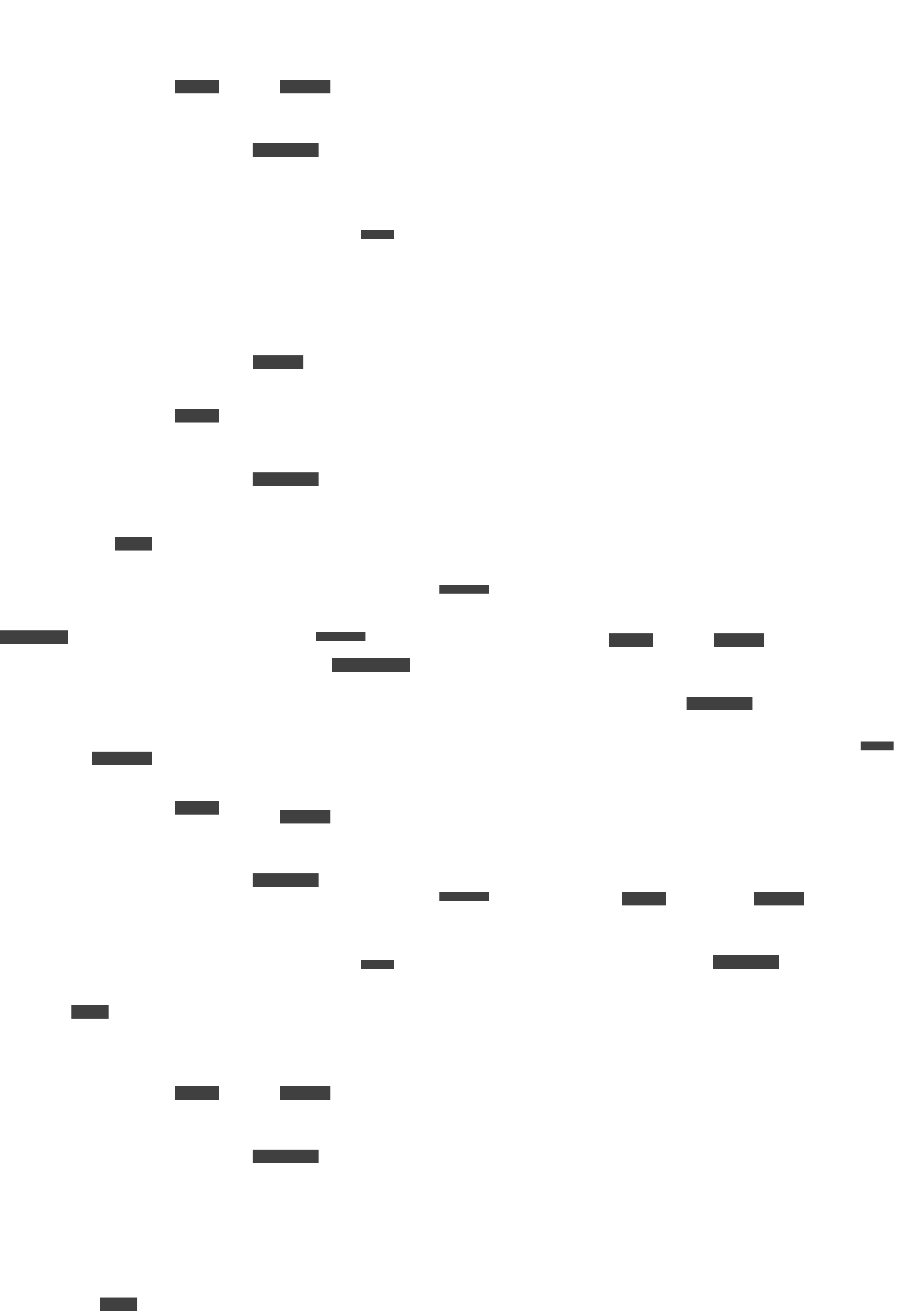
Graceful degradation maintains core functionality when secondary systems experience problems rather than failing entirely. If the personalized recommendation service experiences issues, TikTok can fall back to serving trending content that is popular globally or cached recommendations from the user’s recent sessions rather than showing error screens. If the social graph service is slow, the feed can temporarily weight algorithmic recommendations more heavily than social signals. Users experience reduced personalization rather than complete service unavailability.
TikTok likely runs regular chaos engineering experiments to validate these fault tolerance mechanisms under realistic conditions. Following practices pioneered by Netflix with their Chaos Monkey tool, ByteDance operates internal tools that simulate data center failures, inject network partitions between services, artificially slow dependencies, and create sudden traffic spikes. These controlled drills identify weaknesses before real incidents expose them in production, strengthening platform resilience systematically. The combination of elastic scaling for capacity and redundancy for availability ensures users experience minimal disruption even during massive viral trends, live global events, or infrastructure incidents.
Pro tip: When designing fault tolerance for recommendation systems specifically, the fallback strategy matters enormously for user experience. Showing an error message is unacceptable. Showing completely random content is confusing. Showing slightly less personalized content from a cached model or trending feed feels natural to users who may not even notice the degradation. Design your fallbacks to feel like intentional variety rather than system failures.
Beyond availability and performance under load, TikTok must also protect user data and comply with regulations across dozens of jurisdictions with different requirements. This makes security and privacy critical architectural concerns.
Security and privacy considerations
Security and privacy are major focal points in TikTok’s System Design. This is driven by the need to protect sensitive user behavioral data and by regulatory requirements like GDPR in Europe, CCPA in California, and various national data localization laws requiring data to remain within borders. Given the sensitive nature of the behavioral signals that power personalization and the platform’s high visibility in regulatory discussions, security failures would have significant reputational, legal, and business consequences.
Security operates in multiple defensive layers following defense-in-depth principles. Data encryption protects information both in transit using TLS 1.3 for all network communication and at rest using AES-256 encryption for stored data including videos, user profiles, and behavioral logs. Access control through role-based access control restricts internal system access to authorized personnel with appropriate clearances, while OAuth 2.0 handles user authentication with support for multi-factor authentication.
API gateway protections include rate limiting to prevent brute-force attacks and abuse, request validation to block malformed inputs, and bot detection to identify automated access attempts. Content security prevents malicious uploads including malware-laden video files or content designed to exploit vulnerabilities in client video players.
Privacy safeguards address both regulatory requirements and ethical responsibilities to users. Data localization stores user data in specific regions to comply with local laws, with some countries like China and Russia requiring data to never leave their borders under any circumstances. TikTok has invested heavily in regional data center infrastructure specifically to meet these requirements. Anonymization strips directly identifiable information from datasets used for analytics, model training, and aggregate reporting while preserving analytical utility. User consent management provides clear opt-ins for data usage, tracking, and targeted advertising with granular controls that vary by jurisdiction based on local regulatory requirements.
Security monitoring uses intrusion detection systems, behavioral analytics, and anomaly detection models to identify suspicious patterns before they become breaches. These systems spot unusual login attempts that may indicate credential compromise, fake account creation patterns suggesting bot farms, coordinated spam campaigns targeting the platform, and potential data exfiltration by compromised insider accounts. The combination of preventive controls that block attacks, detective monitoring that identifies incidents, and incident response capabilities that contain damage creates defense in depth that no single security measure could provide.
Watch out: TikTok faces unique scrutiny regarding data handling practices due to its Chinese ownership by ByteDance. This geopolitical context has led to additional transparency measures beyond regulatory minimums, third-party security audits, data residency commitments storing certain markets’ data in specific countries, and organizational structures like Project Texas that attempt to isolate US user data from Chinese access. These measures represent business-driven security investments that go beyond pure technical requirements.
TikTok’s System Design embeds security throughout the architecture rather than treating it as an afterthought or separate layer. Every service implements authentication, every data store encrypts at rest, every network path encrypts in transit, and every access is logged for audit purposes. This security-first approach ensures that scalability and performance do not come at the cost of data safety and regulatory compliance. Looking ahead, the platform must continue evolving its architecture to address emerging technical challenges, regulatory changes, and new content format opportunities.
Future evolution of TikTok System Design
TikTok already operates one of the most sophisticated distributed architectures in the world, but continued dominance in the competitive short-video market requires constant innovation across every layer of the stack. Evolving user expectations for more immersive experiences, emerging privacy regulations requiring new technical approaches, and rapid advancements in AI capabilities will shape how the System Design adapts over the coming years.
More edge computing for lower latency will push additional video processing, personalization logic, and content filtering closer to users as 5G network adoption increases and edge infrastructure matures. Edge inference could run lightweight recommendation models directly on edge nodes within tens of milliseconds of users, reducing round-trip latency to central data centers for ranking decisions. This enables faster response to user behavior signals and opens possibilities for real-time content adaptation that current architectures cannot support.
AI-driven content understanding will move beyond current classification capabilities to include deep video analysis that identifies themes, emotional tones, objects, activities, and even narrative structures without requiring creator-provided metadata. Advanced multimodal models can understand the relationship between visual content, audio, and on-screen text to produce richer feature representations for recommendation. Some implementations may even analyze viewer facial expressions captured through device cameras with appropriate consent to refine personalization based on emotional responses.
Real-time AR and VR integration represents the next frontier for immersive content creation and consumption. AR effects are already popular on TikTok, but expanding into mixed reality experiences with persistent virtual objects, spatial audio, and multi-user interactions will require real-time rendering pipelines with latency budgets measured in single-digit milliseconds and ultra-low latency streaming that pushes current architecture to its limits. This may drive further edge computing investment and new video codec development.
Privacy-first personalization through federated learning will become increasingly important as data regulations tighten globally and users become more privacy-conscious. Rather than collecting raw behavioral data in central servers, models can be trained partially on-device with only anonymized gradient updates sent back to servers for aggregation. This enables strong personalization while dramatically reducing the sensitive data that leaves user devices, addressing both regulatory requirements and user trust concerns.
Real-world context: Google has pioneered federated learning for mobile keyboard predictions, demonstrating that the approach works at scale. Applying similar techniques to video recommendations presents additional challenges due to the complexity of video features and the latency requirements of real-time feeds. TikTok’s engineering resources make them a likely leader in this space as privacy regulations evolve.
Advanced bot and spam detection will evolve to combat increasingly sophisticated fake accounts that current detection systems miss. Future detection likely involves AI models trained on behavioral biometrics including swipe patterns, touch pressure, scroll rhythm, and session behavior that create unique fingerprints for human users. These signals are extremely difficult for automated accounts to replicate convincingly, providing robust defense against manipulation campaigns that threaten platform integrity.
The future TikTok System Design will be more geographically distributed through edge computing, more intelligent through advanced AI understanding, more immersive through AR/VR capabilities, and more privacy-preserving through federated approaches while remaining resilient against failures and compliant with global regulations. The architectural patterns and engineering practices established today provide the foundation that makes these evolutions possible.
Conclusion
The TikTok System Design represents a strong example of building high-scale, high-engagement platforms that feel highly personalized to every user. It seamlessly integrates real-time video streaming through multi-CDN edge delivery with adaptive bitrate protocols, two-stage personalized recommendations combining candidate generation with fine-ranking models updated in real-time, social graph insights from graph databases that amplify content through network effects, and robust fault tolerance through multi-region replication and graceful degradation.
Every component from GPU-accelerated transcoding pipelines to tiered hot-warm-cold storage to millisecond-latency feature store updates optimizes for the same goal. The goal is making every swipe feel instant and every video feel personally selected.
The architecture succeeds because it treats real-time responsiveness as a first-class requirement woven through every design decision rather than an afterthought optimized later. The feedback loops between user engagement and recommendation updates operate in seconds rather than the hours or days typical of older platforms. This enables the system to adapt to changing user preferences within a single session. The multi-CDN strategy with proactive cache warming ensures viral content reaches edge nodes before demand peaks.
The two-stage recommendation system balances broad candidate generation that never misses good content with precise fine-ranking that surfaces the best matches, enabling personalization at planetary scale. These patterns extend beyond social media to any system requiring low-latency, personalized, high-engagement experiences where user satisfaction depends on speed and relevance.
As TikTok evolves, it will navigate challenges in AI ethics around recommendation transparency and potential harms, global data compliance requiring sophisticated data residency and consent management, and emerging immersive formats that demand new real-time processing capabilities. Edge computing will push more intelligence toward users, reducing latency and enabling new interaction modes. Federated learning will enable personalization while respecting privacy in ways current centralized approaches cannot. New content formats from extended reality to interactive video will demand architectural adaptations we cannot fully predict today. The engineering foundation built to handle today’s billions of daily interactions positions the platform to lead through these transitions while competitors work to catch up.