
Every second, search engines dispatch millions of requests across the internet. They systematically discover new pages, track content changes, and build the indexes that power modern search. What appears deceptively simple—fetching web pages—actually conceals one of the most complex distributed systems challenges in software engineering. A web crawler must navigate an environment it cannot control. Websites crash unpredictably, pages load slowly, servers block aggressive requests, and content duplicates across millions of URLs. The variability is relentless, and the scale is staggering.
This guide walks you through the complete architecture of a production-grade web crawler. You will learn how to design a URL frontier that manages billions of URLs using consistent hashing and domain-based sharding. You will understand how to build fetcher workers that scale horizontally across data centers while respecting politeness policies. You will implement deduplication strategies using SimHash, MinHash, and Bloom filters to eliminate redundant content. Finally, you will construct storage systems capable of handling petabytes of crawled content efficiently. Whether you are preparing for a System Design interview or building real crawling infrastructure, the patterns and trade-offs discussed here will give you the foundation to design systems that explore the web at scale.

Why web crawler System Design matters
A web crawler is a distributed system responsible for discovering, fetching, parsing, and storing content from the internet at scale. While simple scripts can fetch individual pages, a production crawler operates continuously. It explores billions of URLs, follows links, respects site policies, and maintains content freshness. This makes web crawling a foundational capability for search engines, data aggregators, monitoring platforms, research tools, and security systems that need comprehensive internet visibility.
What makes web crawling particularly challenging is the variability of environments you do not control. Websites differ drastically in structure, responsiveness, stability, and compliance with web standards. Some pages load instantly while others require multiple retries. Some provide clean HTML while others depend on complex JavaScript rendering that demands headless browser execution. A crawler must navigate these differences while maintaining politeness to avoid overloading servers, handling duplicates efficiently through content fingerprinting and shingling algorithms, discovering new URLs continuously via link extraction and XML sitemap parsing, and storing massive volumes of data without exceeding budgets.
Real-world context: Googlebot crawls hundreds of billions of pages and processes over 20 petabytes of data daily. Bingbot operates at similar scales. Even smaller crawlers for competitive intelligence or SEO tools handle millions of pages per day, requiring careful attention to incremental crawling and stale content refresh policies.
From a systems perspective, web crawler design is one of the richest learning topics because it touches on scheduling, queueing, parallel processing, sharding strategies, metadata management, link graph construction, large-scale storage, and fault tolerance. You will also encounter practical concerns like robots.txt handling, URL canonicalization, content hashing, and dealing with near-duplicate pages using algorithms like SimHash and MinHash. Understanding these components prepares you for both building real systems and tackling System Design interviews where crawler questions appear frequently. Before diving into component design, we must first establish clear requirements that will guide every architectural decision.
Functional and non-functional requirements
Before designing components or choosing architectural patterns, defining clear requirements establishes the constraints and performance expectations that shape the entire system. Formal requirements guide decisions around data structures, scheduling policies, storage systems, and worker architecture. Without this foundation, you risk building a crawler that technically works but fails under real-world conditions or gets blocked from major websites due to aggressive behavior.
Functional requirements
Processing seed URLs forms the starting point of any crawl. The crawler must accept a list of initial URLs, typically root domains or known high-value entry points, and expand coverage by discovering links within fetched pages. Beyond link extraction, the system should support alternative discovery mechanisms including XML sitemap parsing, RSS feed consumption, and API endpoint exploration to maximize coverage.
Maintaining a URL frontier is equally critical. It acts as a prioritized queue determining what to crawl next. It supports prioritization by domain, depth, freshness, and relevance while preventing any single domain from monopolizing resources through domain quotas and hotspot mitigation strategies.
Fetching web pages involves workers pulling URLs from the frontier with controlled concurrency. Each fetch includes HTTP requests, DNS resolution, redirect handling, rate limiting, and intelligent retries with exponential backoff. Once a page arrives, parsing and extraction transforms raw HTML into structured data, extracting hyperlinks, text content, and metadata like titles and canonical tags while cleaning malformed markup. For modern JavaScript-heavy websites, the system must support dynamic rendering through headless browsers or server-side rendering detection.
The crawler must also apply duplicate detection since duplicate pages are pervasive on the web. This includes detecting duplicate URLs through normalization, duplicate content through cryptographic hashing, and near-duplicate pages through SimHash, MinHash, and content shingling algorithms. Respecting robots.txt and politeness policies ensures the crawler behaves responsibly by obeying robots.txt rules, following crawl-delay directives, and throttling requests so individual domains are not overloaded.
Finally, storing raw and parsed data requires scalable storage systems for HTML content, metadata databases, and link graph databases. Monitoring and error tracking must provide visibility into crawl progress, worker failures, queue sizes, and domain-level statistics.
Non-functional requirements
Scalability demands support for tens or hundreds of thousands of URLs per second with billions of URLs in the frontier. This requires distributed queues and parallel fetchers that scale horizontally across data centers. High availability ensures workers continue crawling even when nodes fail, URLs time out, or queues become temporarily overloaded through stateless worker design and automatic failover mechanisms. Efficiency means using network bandwidth, storage, and compute intelligently by avoiding excessive recrawling, redundant fetching, and storing unnecessary data while implementing backpressure mechanisms to handle pipeline bursting.
Watch out: Failing to enforce politeness policies can get your crawler’s IP addresses blocked permanently by major websites. This effectively limits your coverage for important domains and can take months to resolve through reputation rebuilding.
Fault tolerance treats failures, timeouts, 500 errors, and connection resets as expected conditions rather than exceptions. A crawler must handle them gracefully without losing progress through retry queues and persistent state. Freshness is critical for search engines that value up-to-date content, requiring homepages and news sites to be recrawled frequently while deep pages refresh slowly based on historical change frequency analysis. Low-latency frontier scheduling ensures workers always have URLs available to crawl without bottlenecks that leave fetchers idle.
The following table summarizes how these requirements translate into concrete system targets that guide architectural decisions throughout the design process.
| Requirement category | Target metric | Design implication |
|---|---|---|
| Scalability | 100,000+ URLs/second | Distributed frontier with consistent hashing |
| Storage | Petabytes of raw HTML | Object storage with compression (70-90% reduction) |
| Freshness | Homepages recrawled hourly | Priority queues with freshness scoring |
| Availability | 99.9% uptime | Stateless workers with automatic failover |
| Politeness | Max 1 request/second per domain | Domain-level rate limiting with quotas |
| Deduplication | Less than 0.1% false positive rate | Bloom filters with SimHash clustering |
With requirements established, the next step is designing the high-level architecture that connects all these components into a cohesive system capable of operating continuously at web scale.
High-level architecture
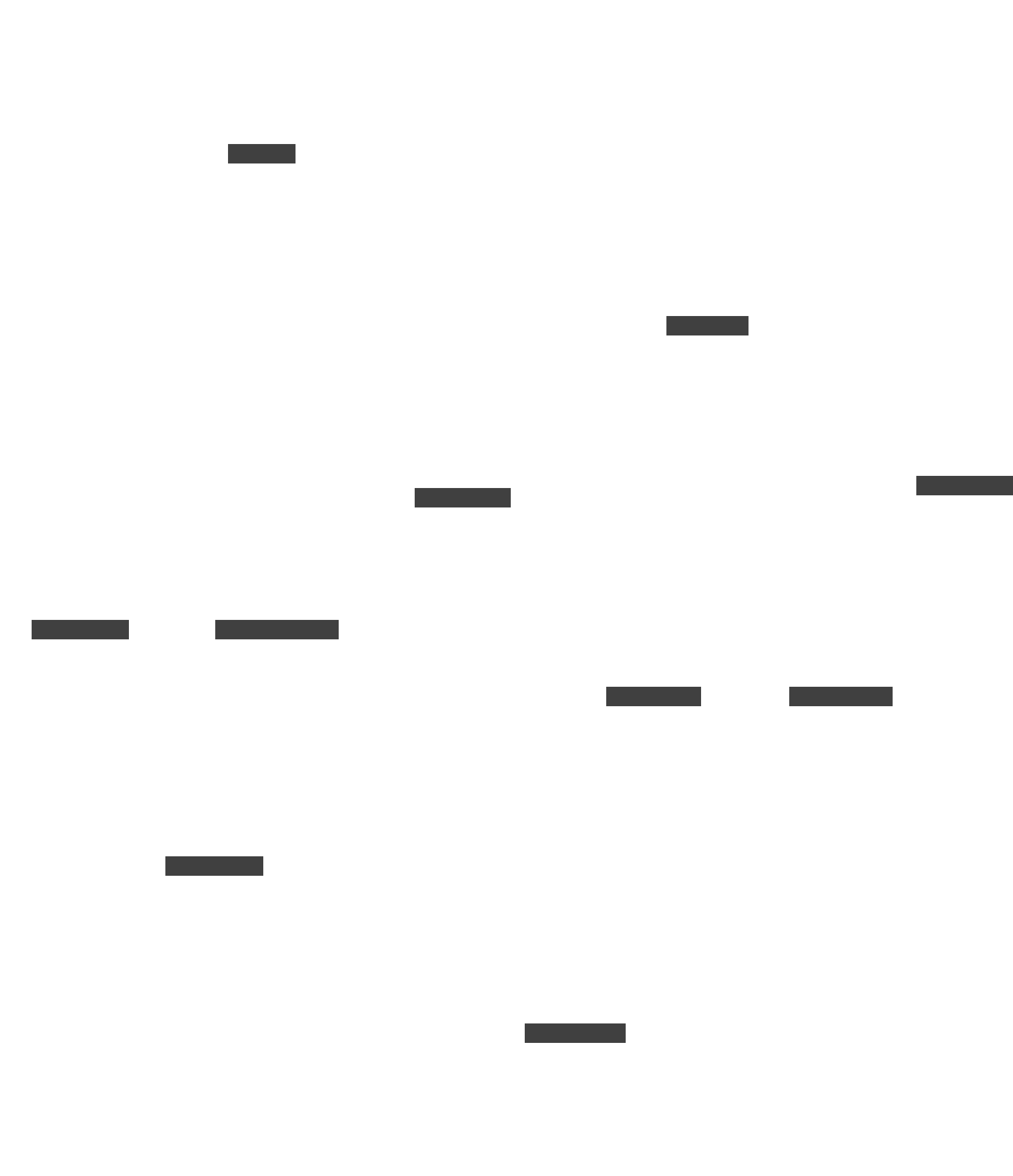
A scalable web crawler functions as a pipeline-driven distributed system with multiple interconnected components. Each part plays a specific role, and together they form a continuous loop of discovery, fetching, processing, and scheduling. Understanding how these components interact is essential before diving into the details of any individual piece, as design decisions in one component ripple through the entire system.
Core components
The crawl controller acts as the brain of the system. It manages initial seed URLs, configures politeness rules, oversees distributed workers, and monitors errors and performance across the entire crawl operation. It coordinates crawl campaigns, handles configuration updates without downtime, and provides the operational interface for adjusting crawl behavior in response to changing conditions.
The URL frontier serves as the large-scale queue managing URL prioritization, sharding across domains using consistent hashing, preventing domain overload through quotas, and maintaining freshness through recrawl scheduling. It ensures fetchers always have work while keeping crawling fair across different websites and mitigating hotspots from high-traffic domains.
Fetcher workers are distributed nodes that pull URLs from the frontier, retrieve content using HTTP clients with connection pooling, handle redirects and retries with exponential backoff, and obey domain-level rate limits. These workers form the crawling engine that scales horizontally across data centers, with geographic distribution reducing latency to regional content.
The parsing and extraction layer processes fetched HTML to extract text, metadata, and normalized URLs using canonicalization algorithms that handle session parameters, tracking tags, and URL variations. For JavaScript-rendered pages, this layer can invoke headless browsers when standard parsing proves insufficient.
The storage layer persists raw HTML in compressed object storage, parsed content in document stores, metadata in NoSQL databases, and link graph information in graph databases or adjacency list structures. This layer must be extremely scalable and fault-tolerant given the massive data volumes involved. At one billion pages per month with an average compressed page size of 500KB, storage requirements reach approximately 500TB monthly for raw HTML alone.
The deduplication service detects duplicate or near-duplicate pages through cryptographic hashing for exact matches, SimHash and MinHash for near-duplicate detection, content shingling for granular similarity comparison, and Bloom filters for approximate membership tests at massive scale.
Request and response flow
A typical lifecycle for a URL begins when it is added to the frontier and assigned to a specific shard based on its domain hash using consistent hashing. A fetcher worker claims the URL, resolves DNS using cached results where possible, fetches the page while respecting rate limits, and delivers raw HTML to the parser through a message queue like Kafka or Pub/Sub. The parser extracts hyperlinks, text content, and metadata, then passes discovered URLs through deduplication filters that check against Bloom filters for URL uniqueness and content fingerprint stores for duplicate detection.
Pro tip: Design the fetcher-to-frontier feedback loop to include crawl status, retry schedules, and freshness information like last-modified headers and ETag values. This metadata tightens the crawl loop and improves efficiency over iterations by enabling intelligent recrawl scheduling.
Clean URLs that survive deduplication re-enter the frontier with updated priority scores based on source page importance, link depth, and freshness requirements. Raw and processed data flows to the appropriate storage systems with backpressure signals preventing pipeline overload when downstream components fall behind. This creates a continuous loop that expands coverage and maintains freshness without manual intervention, operating 24/7 while adapting to changing web conditions.
Distributed system considerations
Building this architecture at scale introduces coordination challenges that do not exist in single-machine systems. Frontier queues must be synchronized across regions to prevent duplicate work while allowing geographic distribution of crawl load for latency optimization. Workers scale horizontally across data centers, requiring careful load balancing and failure handling that treats crashed workers as routine events rather than exceptional circumstances.
Deduplication must handle billions of URLs efficiently using probabilistic data structures that trade perfect accuracy for massive scale. A Bloom filter with a 0.1% false positive rate requires approximately 10 bits per element.
Storage systems must support high write throughput and large objects while remaining cost-effective at petabyte scale through lifecycle policies that transition older content to cheaper storage tiers. Politeness enforcement needs accurate domain-level state that persists across worker restarts and failures, typically implemented through distributed caches like Redis. The architecture must balance throughput against correctness and politeness, as crawling fast is meaningless if you get blocked from major websites or fill storage with duplicate content. With the overall architecture understood, the URL frontier deserves detailed examination since it determines the entire crawl strategy.
URL frontier management and scheduling strategies
The URL frontier is arguably the most important component in web crawler System Design because it determines which pages get crawled, when, and in what order. Without a sophisticated frontier, a crawler can easily overload websites, miss important pages, or waste resources crawling low-value content endlessly. The frontier must balance competing priorities like freshness, coverage, fairness, and politeness while handling billions of URLs efficiently through intelligent sharding and scheduling policies.
Prioritization strategies
Breadth-first crawling prioritizes shallow links and works well for discovering site structure and maximizing coverage quickly. It ensures the crawler sees many different domains rather than diving deep into any single site. Depth-first crawling explores deep paths within sites, which can be useful for specific extraction tasks but is generally avoided in large-scale crawlers because it can miss important content on other domains.
Domain-based fairness ensures no single domain monopolizes the frontier through round-robin scheduling, quota allocation per domain, and domain-level queues that prevent popular sites from crowding out smaller ones. This is particularly important for hotspot mitigation when viral content generates millions of URLs from a single source.
Freshness priority emphasizes homepages, news sites, and frequently updated pages based on last-crawled timestamps and historical change frequency analysis. The system maintains change prediction models that estimate when pages are likely to have new content, enabling efficient incremental crawling that focuses resources on pages that have actually changed. Topic-focused crawling aggressively crawls pages matching target topics or high relevance scores, which is particularly useful for vertical search engines or competitive intelligence applications that need deep coverage of specific domains.
Historical note: Early web crawlers used simple breadth-first strategies with no domain awareness. Modern systems like Googlebot use sophisticated machine learning models to predict page importance and change frequency, dynamically adjusting crawl priority based on hundreds of signals including link graph centrality, content freshness patterns, and user engagement metrics.
Choosing between these strategies depends on your crawler’s goals. Search engines typically combine multiple approaches, using freshness priority for news while maintaining breadth-first discovery for new domains and topic focus for specialized indexes. The frontier implements these strategies through priority queues with composite scoring functions that weight different factors based on crawl objectives.
Queue implementation and sharding
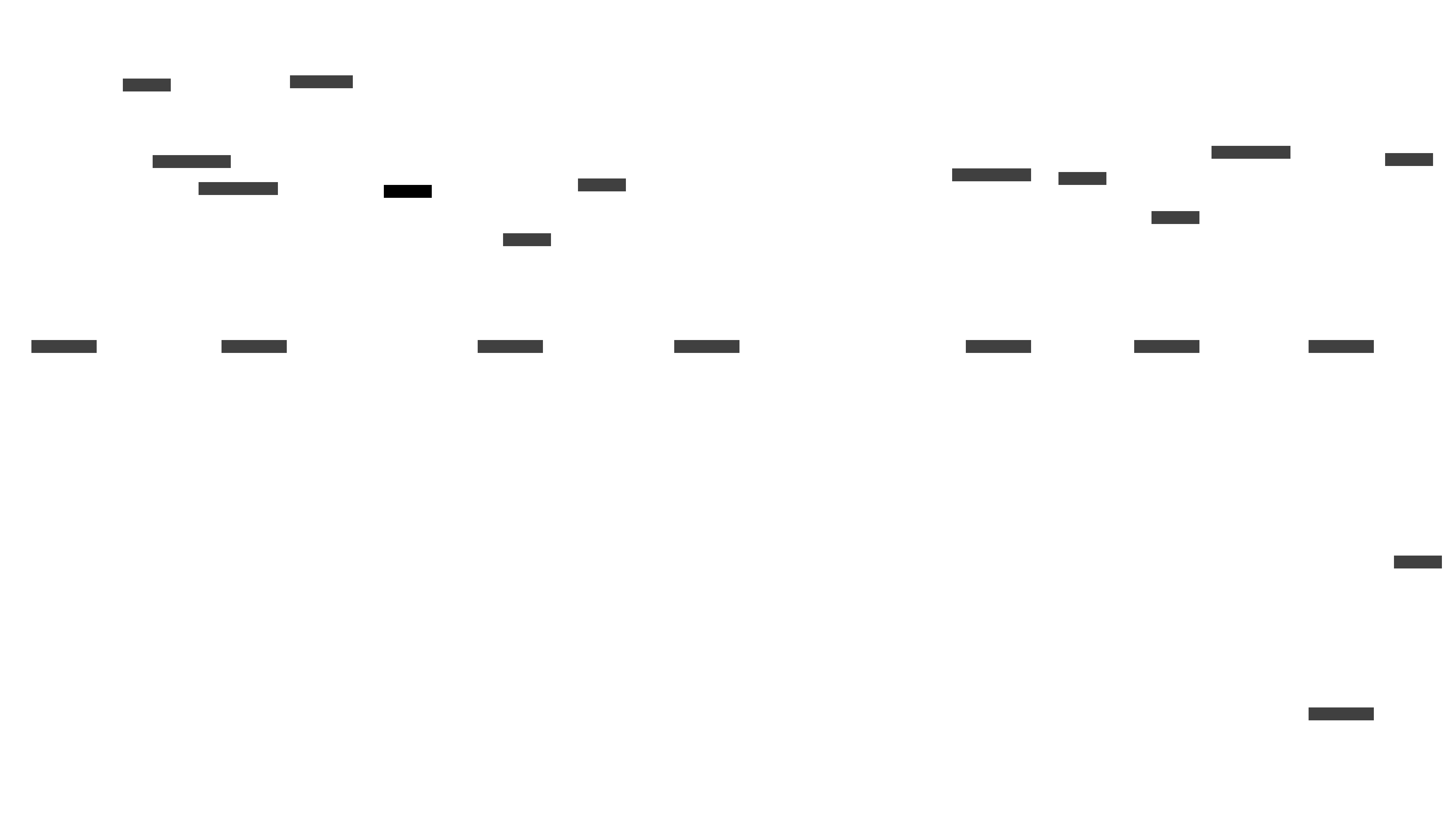
Sharding with consistent hashing assigns each domain to a specific shard based on a hash of the canonical host. This ensures fairness and distributes load evenly among workers while avoiding hotspots where popular domains overwhelm individual queue partitions. When a domain hash maps to a particular shard, all URLs from that domain go to the same queue, enabling effective rate limiting and preventing the same domain from being crawled simultaneously by multiple workers. Consistent hashing also simplifies adding or removing shards. Only a fraction of domains need reassignment rather than a complete redistribution.
Managing frontier size requires careful engineering since the queue may contain billions of URLs. Distributed queues using technologies like Kafka, Redis, or custom implementations must support high write and read throughput while expiring stale URLs that are no longer worth crawling. Memory constraints mean the frontier often spills to disk or uses tiered storage with hot URLs in memory and cold URLs on disk. For extremely large frontiers, the system may use external sorting and merge strategies to maintain priority ordering across billions of entries without keeping everything in memory.
Avoiding duplicate and cyclic URLs
URL normalization prevents frontier pollution from trivial variations that point to identical content. The canonicalization process converts HTTP to HTTPS consistently, removes trailing slashes, strips unnecessary parameters like UTM tracking tags and session identifiers, resolves canonical link tags when present, lowercases domain names while preserving path case sensitivity, and filters malformed URLs. Without strong normalization, the frontier fills with duplicates that waste fetcher capacity and storage space. A single page might be accessible via dozens of URL variations including protocol differences, www prefixes, parameter orderings, and tracking parameters.
Cyclic URL detection prevents infinite loops where pages link to each other endlessly or URL patterns generate infinite variations through calendar widgets, search facets, or pagination schemes. Bloom filters efficiently track seen URLs at scale, accepting a small false-positive rate in exchange for constant-time lookups and minimal memory usage. Combined with depth limits that cap how far the crawler follows links from seed URLs and domain-level URL budgets that limit total URLs crawled per site, these mechanisms keep the frontier focused on valuable content rather than exploring infinite URL spaces. The frontier’s sophistication directly impacts crawl quality, making this component worth significant engineering investment. The fetching layer must then retrieve content while respecting the constraints the frontier establishes.
Designing the fetching layer
The fetching layer retrieves actual content from the web, and this is where most external variability occurs. Slow servers, 404 errors, DNS issues, captchas, redirect chains, overloaded domains, and temporary failures are daily realities for any crawler operating at scale. Building a robust fetching layer requires careful attention to concurrency, politeness, failure handling, and adaptive behavior that responds to observed server conditions.
Concurrency and worker architecture
Workers must support thousands of concurrent fetches using asynchronous I/O for efficiency, as blocking on individual HTTP requests would severely limit throughput. Connection pools reduce the overhead of establishing new TCP connections, and DNS result caching prevents redundant lookups that add latency to every request. Each worker maintains state only for its currently active fetches, making workers effectively stateless from a system perspective. This statelessness simplifies disaster recovery and enables aggressive autoscaling. You can add or remove workers without coordination overhead, and a crashed worker’s pending URLs simply return to the frontier for reassignment.
Intelligent retry logic distinguishes between transient failures worth retrying and permanent failures that should be abandoned. A page returning 503 Service Unavailable might succeed on retry after the server recovers, while a 404 Not Found indicates the content no longer exists and should not be retried. Exponential backoff prevents retry storms from overwhelming already-stressed servers, with each subsequent retry waiting longer than the previous one. Retry budgets limit how many times any single URL can be attempted before being deprioritized or marked as permanently failed, preventing pathological cases from consuming unlimited resources.
Watch out: HTTP 429 Too Many Requests responses require immediate backoff for the entire domain, not just the specific URL. Ignoring 429 responses will quickly get your crawler blocked, and some sites share blocklists that can affect your access to multiple properties.
Politeness and domain-level rate limiting
A responsible crawler must follow robots.txt rules that specify which paths can be crawled and by which user agents. The robots.txt file may also specify crawl-delay directives indicating minimum intervals between requests. Even without explicit directives, throttling requests based on observed server response times prevents overwhelming smaller websites that cannot handle aggressive crawling. A server responding slowly is effectively signaling that it needs relief, and a well-designed crawler should back off automatically rather than adding to the load.
Domain-level rate limiting requires maintaining state about recent requests to each domain, including timestamps and response characteristics. This state must be accessible to all workers that might crawl that domain, typically handled through a shared cache like Redis or a distributed rate limiting service. The rate limiter should adapt to server behavior dynamically. It should back off when response times increase or error rates rise, and potentially increase throughput when servers respond quickly and consistently. This adaptive approach maximizes crawl efficiency while maintaining politeness across varying server capabilities.
Handling problematic websites
Real-world crawling encounters numerous edge cases that simple HTTP clients do not handle well. Servers may respond extremely slowly, requiring timeouts that balance patience against resource waste. Typically this means 30-60 seconds for initial connection and several minutes for complete response on large pages. Infinite redirect loops must be detected and terminated, with most crawlers limiting redirect chains to 5-10 hops. Heavy JavaScript rendering may require headless browsers like Puppeteer or Playwright for accurate content extraction, though this dramatically increases resource costs by 10-100x compared to simple HTTP fetching.
Captcha challenges indicate the crawler has been detected and must either solve the challenge through third-party services or back off significantly to avoid permanent blocking. Some crawlers maintain domain-level reputation scores that influence future crawling behavior, automatically deprioritizing domains with consistent problems like frequent timeouts, high error rates, or aggressive bot detection. Strategies for these scenarios include exponential backoff for slow responses, switching to cached results when fresh fetches consistently fail, and rotating user agents to avoid fingerprinting-based detection while staying within robots.txt guidelines.
Fetcher-to-frontier feedback
Fetchers send metadata back to the frontier that improves future crawling decisions through a continuous feedback loop. This feedback includes crawl status indicating success or failure type with specific HTTP response codes, discovered URLs for frontier insertion after normalization and deduplication, retry schedules for failed URLs with appropriate backoff intervals, and freshness information like Last-Modified headers and ETag values that enable conditional requests on future crawls. The feedback loop tightens over time as the crawler learns which domains are reliable, which URLs change frequently, and which patterns indicate low-value content worth deprioritizing. Once content is successfully fetched, it moves to the parsing layer where raw HTML transforms into structured data ready for storage and analysis.
Parsing, content extraction, and data normalization
After fetching, the crawler enters one of its most crucial phases. It transforms raw HTML into structured data that enables downstream indexing, storage, link analysis, and prioritization. A high-quality parsing pipeline is essential because even small errors in link discovery or text extraction cause large gaps in coverage or skewed datasets that compound over billions of pages. The parser must handle the messiness of real web content while extracting maximum value from every fetched page.
HTML parsing pipeline
Fetched pages arrive in diverse formats including well-structured HTML, malformed markup, XML-based content, JSON endpoints, PDFs containing valuable text, and dynamically generated pages requiring JavaScript execution. The parser must handle all of them gracefully without crashing on unexpected input. A typical workflow validates content type first to determine processing strategy, decodes based on charset while handling mismatches between declared and actual encoding, cleans malformed HTML using forgiving parsers that recover from syntax errors, builds a DOM tree for structured traversal, extracts key metadata including title tags and meta descriptions, extracts textual content for indexing while removing boilerplate navigation and advertisements, and finally extracts hyperlinks for frontier expansion.
Robust parsers must be defensive because real-world pages contain broken tags, invisible elements, mixed encodings from user-generated content, and intentionally misleading structures designed to confuse crawlers or stuff keywords. Character encoding issues are particularly common. Pages may declare UTF-8 in headers but contain Windows-1252 characters, or include content from multiple sources with incompatible encodings. The parser should detect and handle these inconsistencies rather than producing corrupted output that pollutes downstream indexes.
Pro tip: Libraries like BeautifulSoup, lxml, and jsoup handle malformed HTML gracefully through error recovery modes. Avoid strict XML parsers that fail on the first syntax error. They will reject a significant percentage of real web pages and leave gaps in your coverage.
URL extraction and normalization
URLs extracted from HTML require careful processing because duplicate and malformed URLs are pervasive across the web. The extraction process converts relative URLs to absolute using the page’s base URL, normalizes casing since paths are case-sensitive but domains are not, removes trailing slashes consistently based on your normalization policy, strips unnecessary parameters like UTM tracking tags and session identifiers that do not affect content, resolves canonical link tags when present to identify the authoritative URL for duplicate content, and filters invalid or malformed URLs before they enter the frontier and waste resources.
Without strong canonicalization, the frontier becomes polluted with URLs that point to identical content. A single page might be accessible via dozens of URL variations including HTTP versus HTTPS, with or without www prefix, with different parameter orderings, with various tracking parameters attached, and through URL shorteners or redirects. Each variation wastes a fetch request and storage space if not normalized to a canonical form. Advanced canonicalization also handles session tokens embedded in paths, infinite URL spaces generated by calendar or search interfaces, and deliberately obfuscated URLs designed to evade crawlers.
Content deduplication techniques
Duplicate content wastes fetcher capacity and storage while degrading index quality if identical pages appear as separate results. Even small formatting differences like updated timestamps or personalized headers do not necessarily represent new information worth storing separately. Exact duplicate detection uses cryptographic hashes like MD5 or SHA-256 to identify byte-for-byte identical content with essentially zero false positives. However, most duplicates differ in minor ways that require more sophisticated detection approaches.
SimHash generates fingerprints where similar documents produce similar hashes, allowing detection of pages that differ only in headers, footers, or minor text changes by comparing Hamming distances between fingerprints. MinHash estimates Jaccard similarity between documents efficiently using locality-sensitive hashing, enabling fast comparison against millions of previously seen documents. Content shingling breaks documents into overlapping n-grams for granular similarity comparison, providing more nuanced duplicate detection than whole-document approaches. Bloom filters provide approximate membership tests for tracking seen content at massive scale, accepting a tunable false-positive rate in exchange for constant-time operations and minimal memory usage. Approximately 10 bits per element achieves a 0.1% false positive rate.

A comprehensive deduplication service operates at multiple levels. URL deduplication in the frontier uses normalized canonical forms. Content hash deduplication during parsing uses cryptographic hashes. Near-duplicate clustering for index quality uses SimHash or MinHash comparisons. This layered approach prevents redundant processing throughout the pipeline while balancing computational cost against detection accuracy.
Handling non-HTML content
Modern crawlers encounter diverse content types beyond standard HTML pages. XML sitemaps provide structured URL lists with priority hints and change frequency information directly from site owners, offering valuable discovery paths the crawler might never find through link following alone. JSON API responses from dynamic sites contain structured data that may be more valuable than rendered HTML. PDFs contain valuable text content that requires specialized extraction tools. Embedded media like images and videos may warrant metadata extraction even when full content processing is not performed.
Sitemaps deserve particular attention as a discovery mechanism. They provide URLs the crawler might never discover through link following, often including deep pages, recently added content, and priority signals from site owners who understand their content best. A well-designed crawler checks for sitemap.xml at the domain root and processes any discovered sitemaps alongside link-based discovery, combining both approaches for maximum coverage.
Parsing as a scalable pipeline
Parsing must keep up with fetching throughput to avoid becoming a bottleneck that leaves fetchers idle or causes unbounded queue growth. This requires distributed parser workers that scale horizontally, message queue pipelines using Kafka or Pub/Sub for reliable delivery and replay capability, asynchronous processing that decouples fetch completion from parse initiation, and backpressure management that slows fetchers when parsers fall behind rather than allowing unbounded queue growth. Parser workers should be stateless and horizontally scalable, receiving work items from queues and outputting structured data to storage systems without maintaining local state that would complicate failure recovery. With content parsed and deduplicated, the crawler needs storage systems capable of handling the resulting data volumes efficiently at reasonable cost.
Storage systems for web crawlers
Storage is one of the heaviest components of a crawler because the web produces enormous amounts of unstructured data. At scale, crawlers process petabytes of HTML, maintain metadata for billions of URLs, and store link graphs with hundreds of billions of edges. Storage systems must support high ingest rates during active crawling, low coordination overhead for parallel writes from thousands of workers, and efficient retrieval for analysis or indexing while remaining cost-effective over multi-year retention periods.
Raw HTML storage
Raw HTML is typically stored in object storage systems like AWS S3, Google Cloud Storage, or HDFS. These systems offer cheap storage per gigabyte with costs under $0.02/GB/month for infrequently accessed data, high durability through automatic replication across availability zones, and integration with distributed analytics tools like Spark and Presto for batch processing. Crawled HTML is usually compressed using gzip or brotli to reduce volume by 70-90%, dramatically cutting storage costs at scale. At one billion pages per month with 500KB average compressed size, storage requirements reach approximately 500TB monthly, making compression essential for cost control.
Object storage works well for raw HTML because access patterns are write-heavy during crawling with infrequent reads during indexing or analysis. The eventual consistency model of most object stores is acceptable since raw HTML is not modified after initial storage. Lifecycle policies can automatically transition older content to cheaper storage tiers like S3 Glacier after configurable periods, or delete it entirely after retention periods expire. This tiered approach keeps frequently accessed recent content on fast storage while archiving historical crawls at minimal cost.
Real-world context: The Internet Archive’s Wayback Machine stores over 700 billion web pages using a custom WARC format optimized for temporal access patterns. This enables retrieving all versions of a URL over time, supporting both historical research and legal compliance requirements.
Metadata and extracted content storage
Metadata includes URL, HTTP status, crawl timestamp, content hash, canonical URL, redirect chains, page size, and extracted signals like language, content type, and quality scores. This structured data is typically stored in NoSQL systems like DynamoDB, Cassandra, or Bigtable that provide large scale capacity measured in billions of rows, high write throughput matching crawler ingest rates, and flexible schemas that accommodate evolving metadata requirements without costly migrations. The metadata store serves as the crawler’s memory, tracking what has been crawled, when, and with what result to enable freshness scheduling, duplicate detection, and operational monitoring.
For indexing or downstream NLP tasks, extracted text is usually stored separately from raw HTML in columnar or document stores like Elasticsearch, OpenSearch, or BigQuery. This separation supports fast keyword search for content analysis, machine learning processing on clean text, language analysis and classification, and page quality metrics computation without the overhead of parsing raw HTML repeatedly. Columnar formats also compress text efficiently and enable analytical queries across the entire corpus.
Link graph storage
Link graph storage represents relationships between pages, tracking which pages link to which others with anchor text and link attributes. This data enables PageRank-style scoring that measures page importance based on link structure, structural analysis for understanding site architecture, link-based relevance signals for search ranking, and internal graph analytics for identifying link farms or spam networks. At scale, link graphs reach billions of nodes and hundreds of billions of edges, requiring careful partitioning and storage format selection.
Storage options include graph databases like Neo4j or JanusGraph for complex traversals and pattern matching, columnar stores with adjacency lists for simple lookups and batch processing, and big-data frameworks like Spark GraphX for distributed graph algorithms. The choice depends on query patterns. Real-time PageRank updates favor graph databases, while batch recomputation works well with columnar formats. Many systems use hybrid approaches with graph databases for interactive queries and columnar exports for large-scale analytics.
Data partitioning and lifecycle management
Partitioning strategies depend on access patterns and must balance even distribution against query locality. Sharding by domain hash works well for domain-level queries and politeness enforcement since all URLs from a domain reside together. Sharding by URL hash prefix provides better load balancing during parallel analysis by distributing URLs uniformly regardless of domain. Sharding by crawl wave or timestamp enables efficient time-based queries and simplifies lifecycle management by allowing entire partitions to be archived or deleted together.
Not every page needs to persist forever, and lifecycle management keeps storage volume under control while preserving valuable content. TTL strategies typically keep shallow pages and homepages for shorter periods since they are recrawled frequently, while deep or rarely updated pages persist longer with lower recrawl priority. Stale content that has not changed across multiple crawl cycles may be deleted or compressed more aggressively. These policies require coordination between the frontier’s freshness scheduling and the storage layer’s retention rules to ensure important content remains accessible. With storage in place, the final challenge is scaling the entire system to handle web-scale workloads reliably across distributed infrastructure.
Scaling, sharding, and performance optimization
For broad coverage, a crawler must scale horizontally across many machines, potentially spanning multiple data centers and geographic regions to reduce latency and provide redundancy. Scaling introduces coordination challenges, fault tolerance requirements, and performance bottlenecks that do not exist in single-machine systems. Success requires careful attention to distributed system fundamentals including partitioning, replication, consensus, and failure detection.
Distributed fetcher architecture
Fetchers are stateless nodes that retrieve pages and scale by adding new workers to the pool, balancing load across frontier shards through consistent assignment, running multiple concurrent requests per worker using asynchronous I/O, and leveraging geographic distribution to reduce latency to regional content. Statelessness simplifies disaster recovery dramatically. A crashed worker’s pending URLs return to the frontier and get claimed by another worker without data loss or complex recovery procedures. This also enables aggressive autoscaling based on queue depth and crawl targets, spinning up additional workers during high-priority crawl campaigns and scaling down during quiet periods.
Workers should be geographically distributed to reduce latency when crawling sites hosted in different regions and to provide redundancy against regional outages. A crawler with workers in North America, Europe, and Asia can maintain coverage even if an entire region becomes unavailable due to network issues or cloud provider problems. Each worker fetches faster from nearby servers, and geographic distribution also helps avoid triggering geo-based rate limiting that some sites implement.
Frontier sharding and hotspot avoidance
Frontier queues must be sharded to avoid single queue bottlenecks that limit throughput, domain overload that violates politeness policies, and contention between workers competing for the same URLs. Sharding by domain hash or canonical host ensures fairness and distributes load evenly among workers. However, certain websites like news portals, e-commerce platforms, and social networks attract disproportionate crawl volume and can overwhelm individual shards if not handled specially.
Hotspot mitigation strategies include assigning high-traffic domains larger quotas within their shards, separating extremely popular domains into dedicated shards with more resources, dynamically splitting shards when load exceeds thresholds based on queue depth monitoring, and applying more aggressive deduplication to reduce URL volume from viral content. These approaches ensure smaller sites receive adequate crawling attention while high-value sites get the coverage they warrant without destabilizing the system.
Watch out: A single viral news story can generate millions of URLs across social media shares, tracking parameters, and aggregator sites. Without dynamic hotspot handling, this can overwhelm frontier shards and delay crawling of unrelated domains for hours or days.
Adaptive crawling and backpressure
A crawler must adapt its behavior based on observed conditions rather than operating at fixed rates. When fetch latency increases, reduce domain concurrency to avoid overwhelming servers that are showing signs of stress. When servers respond quickly, increase concurrency to improve throughput and make better use of available capacity. Implement global throttles to prevent bursting object storage write capacity or overwhelming downstream parsing queues. Use backpressure signals from downstream components to slow fetchers when parsers, deduplication services, or storage systems fall behind their input queues.
Dynamic adjustment keeps the system efficient and stable across varying conditions that change by time of day, day of week, and server load patterns. A static crawl rate that works at 3 AM when servers are idle may overwhelm the same servers during peak traffic hours, while the same rate may dramatically underutilize capacity during off-peak periods. Adaptive systems maximize throughput while maintaining politeness by continuously measuring and responding to environmental signals.
Failure handling at scale
Distributed crawlers face frequent failures including worker crashes, queue delays, network partitions between data centers, DNS resolution issues, and temporary domain unavailability. These are not exceptional circumstances requiring manual intervention. They are daily realities at scale that the system must handle automatically. Resilience strategies include retry queues with exponential backoff that absorb transient failures, temporary blocklists for domains experiencing persistent problems, fallback DNS resolvers when primary resolution fails, failover parsing clusters that activate when primary clusters become overloaded, and centralized monitoring dashboards that highlight issues before they cascade into system-wide problems.
Failures should not halt the crawler or lose progress. Failed URLs are logged with failure reasons and requeued with appropriate delays based on failure type. Persistent failures trigger automatic deprioritization so resources are not wasted on broken pages that consume retry budgets without producing results. The crawler continues making progress on healthy domains while waiting for problematic ones to recover, maximizing useful work even during partial outages.
Monitoring and observability
Critical metrics that require real-time dashboards and alerting include pages fetched per second across all workers, active worker count versus desired count, queue depth across frontier shards with trend analysis, failure percentages broken down by error type and domain, average fetch latency by domain and region, duplicate detection rates at URL and content levels, and parser throughput relative to fetcher output. These metrics should be available on real-time dashboards with alerting thresholds that notify operators of anomalies before they become critical problems.
Observability helps identify issues like crawl stalls where queue depth grows but throughput drops indicating workers are blocked, bottlenecks where one component limits overall throughput despite available capacity elsewhere, and gradual degradation where latency increases slowly before causing failures. Proactive monitoring prevents small issues from becoming major outages that require emergency intervention. Understanding these scaling patterns prepares you to discuss web crawler design effectively in interviews where these questions appear frequently.
Interview preparation and common questions
Web crawler System Design appears frequently in System Design interviews, particularly at companies building search engines, data platforms, or web-scale infrastructure. The topic showcases your ability to design distributed, fault-tolerant, high-performance architectures while handling real-world complexity that spans networking, storage, and distributed coordination. Preparing thoroughly for crawler questions demonstrates breadth across many distributed systems concepts and your ability to make principled trade-offs.
Structuring your answer
A strong interview answer follows a clear progression that demonstrates both breadth and depth. Start with functional and non-functional requirements to establish scope and constraints before jumping into solutions. Sketch high-level architecture showing major components and their relationships. Dive into URL frontier design including prioritization strategies and sharding approaches. Explain fetching logic including concurrency, politeness enforcement, and retry policies. Cover parsing and deduplication approaches including specific algorithms like SimHash and Bloom filters. Describe storage architecture for different data types and access patterns. Discuss scaling strategies and failure handling mechanisms. Conclude with trade-offs and alternatives you considered to show you understand this is not the only valid design.
This structured flow demonstrates mastery while keeping your answer organized and easy to follow. Interviewers appreciate candidates who establish requirements before jumping into architecture because it shows you understand that design decisions depend on constraints. A crawler designed for freshness has different priorities than one designed for coverage, and clarifying these upfront prevents wasted time on misaligned solutions.
Common deep-dive questions
Interviewers frequently probe specific areas where trade-offs are most interesting. How do you keep crawling polite and fair across domains with different capacities? How do you detect and avoid duplicate pages at scale using both exact and near-duplicate detection? How do you shard your frontier to prevent bottlenecks while maintaining domain-level coordination? How do you prioritize freshness for important content while still discovering new pages? How do you prevent infinite crawling loops from calendar widgets or search interfaces? How do you handle JavaScript-heavy websites that require rendering, and what is the cost trade-off? What happens if a worker crashes mid-crawl, and how do you ensure no URLs are lost? Being ready to explain trade-offs for each question is essential since there is rarely a single correct answer.
Pro tip: Distinguish between crawlers and scrapers in your answer. Scrapers target specific pages for structured extraction using site-specific parsers, while crawlers explore the entire web following links and managing massive frontier queues. This distinction demonstrates depth of understanding beyond surface-level familiarity.
Capacity estimation practice
Strong candidates demonstrate quantitative reasoning with back-of-envelope calculations that ground architectural decisions in concrete numbers. If crawling one billion pages per day with an average compressed page size of 500KB, you need roughly 500TB of daily storage throughput. At 100,000 pages per second, you need thousands of concurrent connections across hundreds of workers assuming 100 concurrent fetches per worker. Network bandwidth requirements at this scale reach tens of gigabits per second. These calculations show you can reason about scale and identify potential bottlenecks before they become problems.
| Metric | Small crawler | Medium crawler | Large crawler (Google-scale) |
|---|---|---|---|
| Pages per day | 1 million | 100 million | 10+ billion |
| URLs in frontier | 10 million | 1 billion | 100+ billion |
| Storage per day | 500 GB | 50 TB | 5+ PB |
| Fetcher workers | 10-50 | 500-2000 | 10,000+ |
| Concurrent connections | 1,000 | 100,000 | 10+ million |
| Network bandwidth | 100 Mbps | 10 Gbps | 1+ Tbps |
For structured practice, resources like Grokking the System Design Interview provide crawler-like problems and teach the architectural thinking behind distributed systems. Building this foundation prepares you for both interviews and real-world crawling challenges where the same concepts apply. To solidify understanding, walking through a complete end-to-end example shows how all components work together in practice.
End-to-end example of a production web crawler
Walking through a complete example illustrates how all components work together in a real crawler operating continuously. This covers everything from seed URLs entering the system through discovery and feedback loops to processed data landing in storage ready for indexing.
Starting the crawl
Seed URLs are loaded into the frontier from multiple sources including manually curated lists of important domains, URLs extracted from previous crawl campaigns, sitemap discoveries from robots.txt parsing, and submissions from external systems. Each URL is assigned to a specific shard based on its domain hash using consistent hashing, ensuring all URLs from the same domain land in the same queue partition. Workers claim tasks from their respective shards, with the frontier ensuring fair distribution across domains through round-robin scheduling and domain quotas that prevent any single site from monopolizing crawler resources.
Fetching and parsing phases
Fetcher workers resolve DNS using cached results where available to minimize latency, fetch pages while respecting per-domain rate limits stored in a shared Redis cache, handle redirects up to configured limits with loop detection, and retry transient failures with exponential backoff. Each successful fetch produces raw HTML, HTTP status code, response headers including caching directives, and timestamps for freshness tracking. The raw content flows to parser workers via Kafka message queues that provide durability and replay capability. Parsers extract hyperlinks using DOM traversal, text content after boilerplate removal, and metadata while normalizing URLs through the canonicalization pipeline and handling character encoding issues gracefully.

Deduplication and reinsertion
Discovered URLs pass through deduplication systems operating at multiple levels. URL deduplication uses Bloom filters to check whether normalized URLs have been seen before, with a configurable false-positive rate balancing memory usage against duplicate fetches. Content deduplication computes cryptographic hashes of page content to identify exact duplicates that should not be stored separately. Near-duplicate detection using SimHash fingerprints clusters pages that differ only in headers, footers, or timestamps, preventing storage bloat from minor variations. URLs surviving all deduplication stages re-enter the frontier with priority scores based on source page importance derived from link graph analysis, depth from seed URLs, and freshness requirements based on historical change patterns.
Storage and continuous operation
Raw HTML flows to object storage with gzip compression achieving 70-90% size reduction, organized by crawl date for lifecycle management. Metadata lands in DynamoDB or Cassandra tables indexed by URL for fast lookups during deduplication and freshness scheduling. Link relationships populate adjacency list structures or graph databases depending on query requirements. Extracted text feeds Elasticsearch indexes for full-text search or columnar stores like BigQuery for analytical processing. The crawler loops continuously. It refreshes important pages on hourly or daily schedules based on change prediction models, revisits less important pages on weekly or monthly cycles, adapts crawl rates based on server responses, monitors for failures through centralized dashboards, and scales workers up and down based on queue depth and crawl priorities.
Real-world context: Major search engines run thousands of specialized crawlers for different content types. News crawlers refresh homepages every few minutes to capture breaking stories. Image crawlers handle different storage requirements and extraction pipelines. Deep web crawlers use form submission and JavaScript execution to access content behind interactive interfaces.
Cloud implementation considerations
Mapping abstract crawler components to cloud services accelerates implementation and leverages managed infrastructure for reliability, operational simplicity, and elastic scaling. Understanding these mappings helps both practitioners building real systems and interview candidates discussing deployment options with concrete technology choices.
On AWS, the URL frontier maps to SQS for simple queue workloads or Kafka on MSK for high-throughput scenarios requiring replay capability, with Redis on ElastiCache providing domain-level rate limiting state accessible to all workers. Fetcher workers run on ECS or EKS for containerized deployment with autoscaling based on queue depth metrics, while AWS Batch handles large-scale batch crawling jobs with automatic instance provisioning and cost optimization through spot instances. Raw HTML lands in S3 with lifecycle policies transitioning older content to Glacier for archival storage, while metadata goes to DynamoDB for high-throughput key-value access with single-digit millisecond latency.
EventBridge enables scheduled crawling for incremental freshness maintenance, triggering crawl jobs for specific domain sets on configurable schedules based on change frequency analysis. Step Functions can orchestrate complex crawl workflows spanning multiple services with built-in retry logic and failure handling. CloudWatch provides monitoring and alerting across all components with custom metrics for crawler-specific indicators like pages per second and deduplication rates. Similar patterns apply on GCP using Pub/Sub, Cloud Run, BigQuery, and Cloud Storage, while Azure equivalents include Service Bus, Container Instances, Cosmos DB, and Blob Storage. The architectural concepts remain consistent across providers while specific service names and performance characteristics vary.
Conclusion
A production-grade web crawler represents one of the most challenging and rewarding systems you can design. It requires mastering distributed coordination for workers spread across data centers, frontier scheduling that balances competing priorities through consistent hashing and domain-based sharding, parsing pipelines that handle the messiness of real HTML including malformed markup and JavaScript-rendered content, deduplication at multiple levels using SimHash, MinHash, and Bloom filters, storage architectures spanning petabytes with intelligent lifecycle management, and fault tolerance that treats failures as normal operations rather than exceptions. Each component presents interesting trade-offs, and understanding how they interact separates surface-level familiarity from genuine expertise.
The future of web crawling continues evolving as the web itself changes. JavaScript-heavy content increasingly requires headless browser rendering, adding significant resource costs that demand intelligent selection of which pages warrant the investment. Stricter anti-bot measures require more sophisticated politeness and rotation strategies. Growing data volumes push storage and processing requirements ever higher, making efficient deduplication and compression essential for cost control. Machine learning increasingly drives crawl prioritization, predicting page importance and change frequency better than static heuristics through models trained on historical crawl data. Edge computing may distribute crawling closer to content sources, reducing latency and improving geographic coverage for globally distributed content.
By understanding each component and how they fit together, you gain the ability to architect scalable crawlers capable of exploring billions of URLs reliably. These foundations serve you whether you are building production crawling infrastructure or demonstrating distributed systems expertise in your next interview. The patterns you have learned here, including sharding, deduplication, rate limiting, backpressure, and fault tolerance, are fundamental concepts that appear throughout distributed systems. This makes web crawler design an excellent lens for understanding large-scale architecture more broadly.