
Every second, millions of messages flow through Slack’s infrastructure, reaching their intended recipients in under 200 milliseconds. Behind this seemingly simple act lies one of the most sophisticated distributed systems in modern software engineering. When your team sends a quick “sounds good” in a channel, that message traverses WebSocket connections, Kafka pipelines, fan-out workers, and persistent storage layers before appearing on every subscriber’s screen. Understanding how Slack orchestrates this complexity offers invaluable lessons for anyone designing systems that must handle real-time communication at massive scale.
This guide walks you through the architectural decisions that power Slack’s messaging platform. You will learn how Slack evolved from treating workspaces as isolated shards to supporting shared channels across organizations. You will also see how cellular architecture contains failures to minimize blast radius and why fan-out on write remains the dominant strategy for real-time delivery. Whether you are preparing for a System Design interview or architecting your own collaboration platform, these patterns will sharpen your thinking about distributed systems, multi-tenancy, and low-latency delivery.
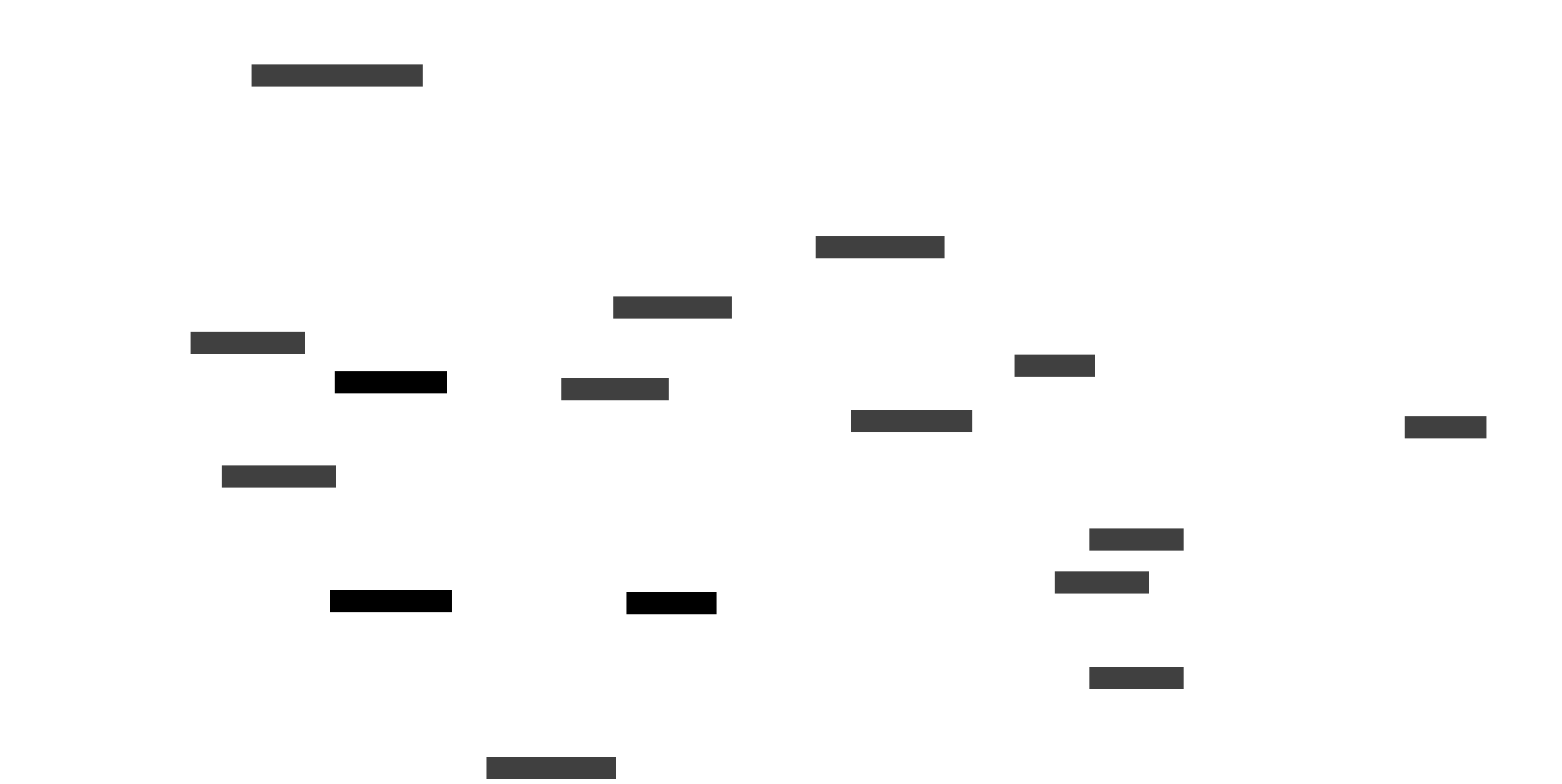
The following diagram illustrates Slack’s high-level architecture, showing how client connections flow through API gateways, WebSocket layers, and message processing pipelines to reach storage and delivery systems.
Core functional and non-functional requirements
Before designing any distributed system, you must establish clear boundaries around what you are building. Slack’s feature set is deceptively broad, encompassing real-time messaging, threaded discussions, file sharing, presence indicators, and enterprise compliance tools. Identifying the must-haves early prevents bloated designs and incorrect assumptions that can derail an architecture months into development. The distinction between functional requirements (what the system does) and non-functional requirements (how well it performs) becomes critical when engineering teams must make trade-offs between features and system qualities.
Functional requirements
A Slack-style system must support real-time messaging where messages sent in any channel appear instantly to all subscribed users. Each workspace can contain hundreds or thousands of channels, each with unique membership lists and permission boundaries. Direct messages and group DMs require strong permission rules and fast retrieval, operating outside the public channel paradigm. Threaded replies allow users to respond to specific messages, generating nested conversations with their own timestamps and participant lists.
Presence indicators show whether a user is active, idle, offline, or on mobile. Typing indicators provide ephemeral signals of ongoing activity. Search functionality must span channels and message history with fast, filterable results across billions of stored messages. File uploads require support for attachments, thumbnails, and previews stored durably in object storage. Finally, multi-device sync ensures that messages, read states, and UI indicators remain consistent across desktop, mobile, and web clients simultaneously.
Real-world context: Slack Connect, which enables shared channels between separate organizations, fundamentally changed how enterprises collaborate. This feature required Slack to rethink its original workspace-as-shard assumption and introduce cross-workspace routing mechanisms that added significant architectural complexity.
Non-functional requirements with measurable targets
Real-time updates should be delivered end-to-end with p99 latency under 200 milliseconds, with ingestion latency targets of 20 to 30 milliseconds at the median. High availability is non-negotiable since teams rely on Slack for critical communication. This requires a minimum SLA of 99.99% uptime, which translates to less than 53 minutes of downtime per year. The system must scale to support millions of users online simultaneously, processing over 100,000 messages per second during peak periods, with billions of stored messages across potentially millions of concurrent WebSocket connections across global regions.
Strong consistency within channels ensures that messages appear in the correct order for all participants, preserving the mental model of a coherent conversation. Slack implements strong consistency for message ordering within individual channels while accepting eventual consistency for cross-channel metadata like unread counts. This trade-off acknowledges that users tolerate slight delays in badge updates but expect perfect conversation flow within any single channel.
Durability guarantees require that once a message is acknowledged, the probability of data loss must be less than 0.0001%. This is achieved through synchronous replication to at least three nodes before returning success to the client. Enterprise customers demand encryption at rest using AES-256 and in transit using TLS 1.3, detailed audit logs, configurable retention policies, and data governance controls that satisfy compliance frameworks like SOC2, HIPAA, and GDPR.
Pro tip: When defining non-functional requirements, always specify percentile targets rather than averages. A system with 50ms average latency might have p99 latency of 2 seconds, creating a terrible experience for 1% of requests. Define SLIs (Service Level Indicators) like p50, p95, and p99 latency, then set SLOs (Service Level Objectives) as targets for each.
Multi-tenant isolation guarantees that workspaces cannot affect each other’s performance or data boundaries. This is implemented through strict resource quotas and data partitioning. Cost efficiency strategies manage the storage of years of messages across millions of workspaces through tiered storage, moving older messages to cheaper storage classes while maintaining fast access to recent history.
Edge cases and stress scenarios
Beyond core requirements, Slack must handle edge cases that stress the system in unexpected ways. Message bursts during company-wide announcements can spike traffic by 10x or more within seconds, concentrated in specific channels. Large channels with tens of thousands of members create expensive fan-out scenarios where a single message triggers massive delivery overhead. Users switching rapidly between devices demand seamless session handoff without message loss or duplication.
High-frequency presence updates generate significant backend load, particularly in large organizations where thousands of users transition between active and idle states simultaneously. Multi-region routing adds complexity to every data path, requiring careful consideration of consistency versus latency trade-offs. Mapping these constraints early shapes decisions about storage partitioning, fan-out strategies, and delivery guarantees throughout the architecture. Achieving one non-functional requirement may require compromising another.
The following table summarizes the key non-functional requirements with their measurable targets and implementation strategies.
| Requirement | Target metric | Implementation strategy |
|---|---|---|
| Message delivery latency | p99 < 200ms | Regional WebSocket clusters, Kafka partitioning |
| Availability | 99.99% uptime | Cellular architecture, multi-region failover |
| Throughput | 100K+ messages/second | Horizontal scaling, adaptive batching |
| Durability | < 0.0001% data loss | Synchronous 3-node replication |
| Consistency | Strong per-channel ordering | Single Kafka partition per channel |
With clear requirements established, the next step is understanding how Slack’s major components work together to satisfy these constraints while handling the complexity of real-time message delivery.
High-level architecture for Slack-style messaging
Slack’s architecture orchestrates a complex ecosystem of message streams, user events, channel memberships, and real-time updates. Understanding the major components and their interactions provides a framework for deeper design decisions and reveals why certain trade-offs exist throughout the system. The architecture separates concerns into distinct layers, each optimized for specific access patterns and scaling characteristics.
Major system components
The API Gateway handles REST calls for login, workspace operations, file uploads, and channel actions. It terminates TLS, authenticates requests, and routes traffic to appropriate backend services. The Authentication Service issues tokens, manages user and workspace permissions, and integrates with SSO providers, OAuth, and enterprise identity systems. These components form the entry point for all client interactions with the platform, implementing rate limiting and request validation before traffic reaches internal services.
The WebSocket Layer maintains persistent connections for message delivery, broadcasting messages, presence updates, and typing events in real time. This layer scales horizontally via connection brokers that distribute load across regional clusters, with each server managing tens of thousands of concurrent connections. The Message Ingestion Service validates incoming messages, applies permission checks, and publishes events to the pub/sub system. It serves as the critical chokepoint where all user-generated content enters the pipeline.
The Channel Router and Fan-Out Service routes messages to the correct channels and subscribers while ensuring consistent ordering within each channel. The Pub/Sub Backbone, typically implemented with Kafka or Apache Pulsar, provides durable and scalable delivery of channel messages through partitioned topics. This backbone enables the decoupling necessary for horizontal scaling across all downstream consumers while providing replay capabilities for failure recovery.
Watch out: When designing your pub/sub topology, partition by channel_id rather than workspace_id. Partitioning by workspace creates hot partitions when large organizations generate disproportionate traffic. Channel-based partitioning ensures that all messages for a single channel flow through the same partition, preserving order without requiring expensive cross-partition coordination.
The Message Storage Layer combines NoSQL databases like Cassandra or DynamoDB for large-scale message logs, SQL databases like MySQL with Vitess for workspace metadata, and object storage services like S3 for files and attachments. The Search Indexing Layer, often built on Elasticsearch, stores inverted indexes for fast text search across message content, metadata, and file attributes. The Presence and Ephemeral Event Service tracks user state and sends typing indicators, connection events, and reaction notifications through lightweight channels separate from the main message stream.
Full message flow example
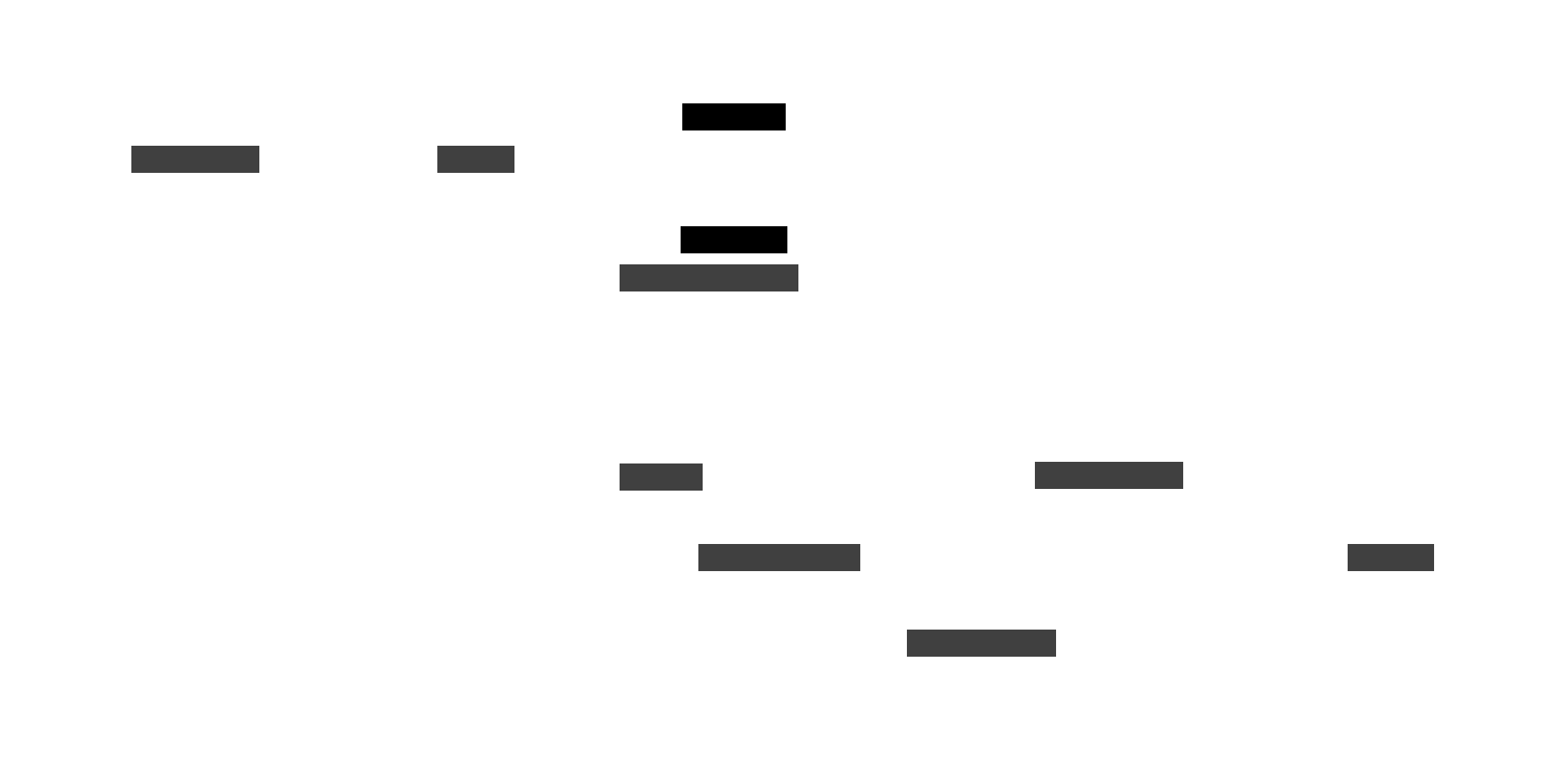
When a user sends a message, the WebSocket connection or HTTP endpoint delivers it to the Message Ingestion Service. This service validates the payload, checks permissions against the channel’s access control list, and packages the message with a unique ID, timestamps, and metadata. The packaged message publishes to a Kafka topic partitioned by channel_id, triggering consumption by fan-out workers subscribed to that partition.
Fan-out workers identify all channel members by querying the membership service, then query the presence service to determine which users are currently online. For online users, workers push the message through WebSocket connections to active clients, batching deliveries when possible to reduce per-connection overhead. Simultaneously, the message persists to the NoSQL storage layer through an asynchronous write path, and a separate process updates the search index.
Historical note: Slack’s at-least-once delivery semantics emerged from early incidents where network partitions caused message loss. The engineering team decided that users would rather see occasional duplicates than miss messages entirely. This led to client-side idempotency checks using message IDs to deduplicate any repeated deliveries.
Offline users receive push notifications through APNs or FCM, triggered by the fan-out workers when presence checks indicate the user has no active connections. Multi-device sync services update read states across all logged-in clients, using vector clocks to handle conflicting updates from devices that were temporarily offline. This flow achieves Slack’s goal of real-time collaboration with persistent history, typically completing in under 200 milliseconds for online recipients.
The following diagram shows the end-to-end message lifecycle from the moment a user sends a message until it appears on recipient screens.
The architecture must also implement comprehensive observability to maintain these latency targets. SLIs track message ingestion latency, fan-out completion time, and end-to-end delivery latency at p50, p95, and p99 percentiles. Monitoring dashboards alert on-call engineers when metrics exceed SLO thresholds, enabling rapid response before users experience degraded service. Understanding this component architecture sets the stage for examining how Slack models the data structures that flow through these systems.
Designing channels, threads, and multi-tenant workspaces
Slack organizes messages into hierarchically structured workspaces, channels, and threads. Proper data modeling at this layer is crucial because everything else depends on these relationships. This includes storage partitioning, search indexing, and fan-out efficiency. The multi-tenant nature of Slack adds additional complexity that shapes nearly every architectural decision, requiring careful isolation between customers while enabling features that span organizational boundaries.
Workspace architecture and the shared channels challenge
Slack’s original architecture treated each workspace as an isolated shard where all data belonged within one workspace boundary, including users, channels, and messages. This approach simplified queries and enabled straightforward horizontal scaling by adding more shards as the customer base grew. However, this assumption broke when Slack introduced shared channels, which allow two or more separate organizations to collaborate in a single channel without exposing other data.
Supporting shared channels required Slack to introduce a shared_channels table that bridges between workspaces, fundamentally changing the data model. Messages in shared channels must route across shards, requiring careful coordination to maintain ordering guarantees. Channel metadata requires workspace-specific overrides for names and purposes, since each organization might want different display names. Permissions must reconcile differing policies between organizations, creating complex access control scenarios.
Real-world context: Slack’s engineering team documented that shared channels were one of their most architecturally challenging features. The workspace-as-shard model that served them well for years became a constraint they had to carefully work around rather than replace entirely. This demonstrates how initial architectural assumptions can require significant rework as product requirements expand.
Each workspace must maintain isolated data with independent channels and message history, custom retention and compliance rules, and separate access controls that prevent cross-tenant data leakage. The data model for a channel typically includes channel_id, workspace_id, name, type (public or private), members list, pinned items, and metadata like topic and creation timestamp. Partitioning by workspace_id and channel_id keeps queries efficient while enabling horizontal scaling across database shards. However, shared channels require additional routing logic to span multiple shards.
Thread design and permission enforcement
Threads reduce channel noise by anchoring replies to a parent message, creating nested conversations that don’t interrupt the main channel flow. Each thread tracks a parent_message_id, a list of replies with timestamps, a reply_count for display purposes, and a participants list for notifications. Slack handles threads as separate collections or partitions, enabling scalable retrieval without loading the entire channel history. This separation also allows thread-specific notification rules that differ from channel-level settings, letting users follow specific conversations without subscribing to all channel activity.
Permissions differ significantly across public channels, private channels, direct messages, group DMs, and shared channels across workspaces. The system must enforce access control lists, workspace roles, message visibility policies, and per-message access rights for sensitive environments. Enterprise deployments often require additional granularity, including controls over who can create channels, invite external users, or access message history beyond certain dates. Audit logging captures all permission checks and changes for compliance reporting, creating a complete trail of who accessed what data and when.
Handling large channels at scale
Large channels present unique challenges that deserve special architectural attention. Enterprise channels with over 10,000 members make fan-out extremely expensive, as each message triggers delivery attempts to thousands of connections. Unread counters grow quickly across large member sets, creating database pressure as the system tracks per-user read positions. Presence events generate heavy load when thousands of users in the same channel transition between active and idle states.
Solutions include batched message delivery to reduce per-connection overhead, where fan-out workers group deliveries to users on the same WebSocket server. Selective presence updates skip inactive users who haven’t engaged with the channel recently, reducing unnecessary broadcasts. Reduced ephemeral signals in huge channels disable typing indicators or limit them to a sample of participants. Channel-level sharding in the backend distributes member lists across multiple nodes, enabling parallel fan-out operations. These optimizations keep Slack responsive even when a company-wide announcement channel receives simultaneous messages to tens of thousands of recipients.
Pro tip: Implement adaptive fan-out strategies based on channel size. For channels under 1,000 members, use direct fan-out. For larger channels, use hierarchical fan-out where primary workers delegate to secondary workers responsible for subsets of the membership list. This enables parallel processing without overwhelming any single worker.
The data modeling decisions for channels and threads directly impact how the real-time delivery layer operates. Understanding WebSocket scaling is essential before examining the complete message pipeline.
Real-time delivery with WebSockets and event streams
Real-time communication forms the heart of any Slack System Design. The platform relies on persistent WebSocket connections to deliver messages, typing indicators, presence updates, and file preview events without the latency inherent in polling-based approaches. Understanding how to scale this layer while maintaining sub-200-millisecond delivery is essential for any real-time messaging architecture that must serve millions of concurrent users.
Why WebSockets and how to scale them
WebSockets provide full-duplex communication with minimal latency and efficient bandwidth usage. Unlike HTTP polling or long-polling, WebSockets maintain a persistent connection that eliminates the overhead of repeated connection establishment. This reduces latency from hundreds of milliseconds to single-digit milliseconds for message delivery. This efficiency becomes critical at Slack’s scale, where polling millions of clients would overwhelm servers with connection churn and increase delivery latency beyond acceptable thresholds.
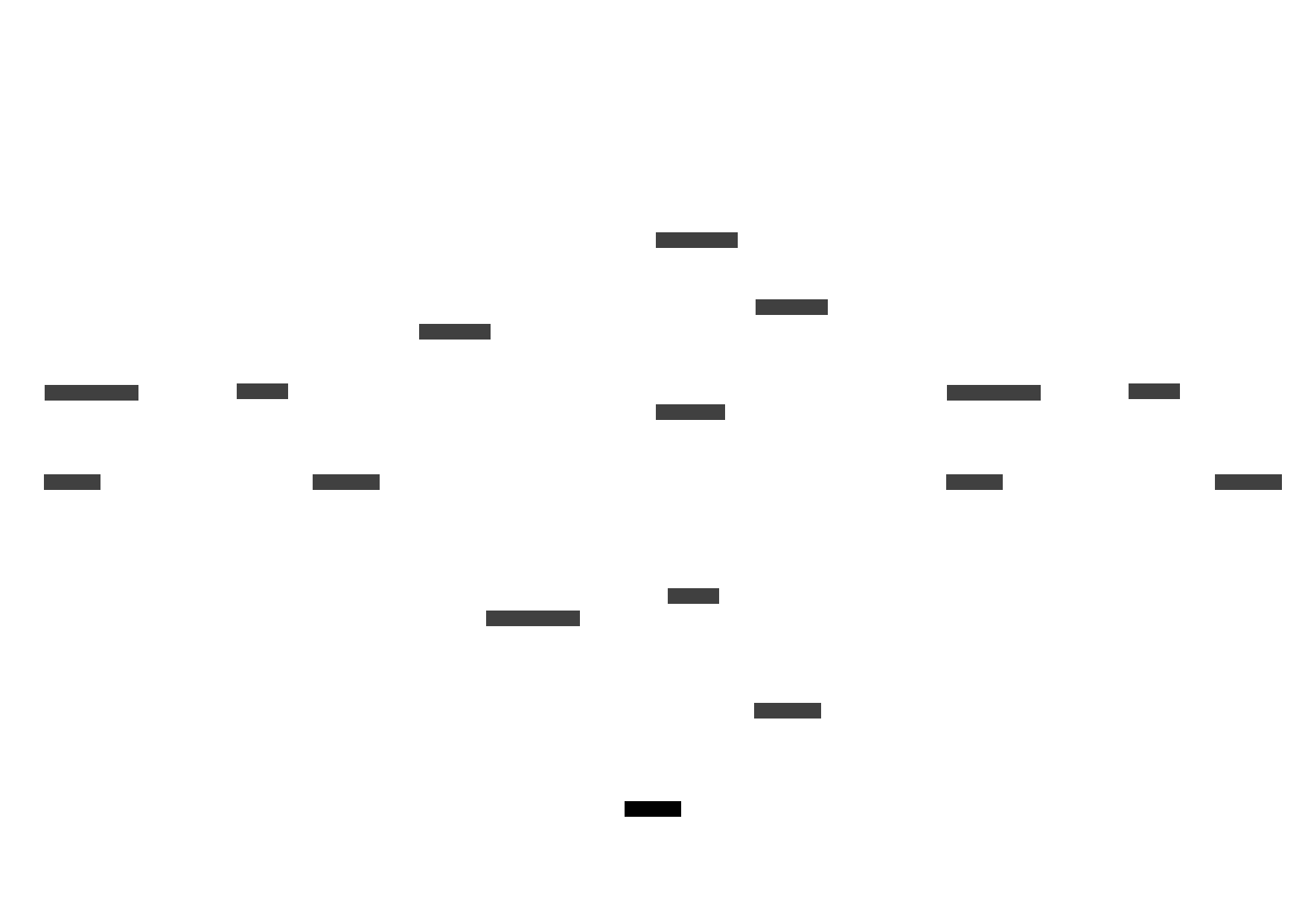
Scaling to millions of concurrent WebSocket connections requires careful architectural decisions across multiple dimensions. WebSocket servers remain stateless at the application layer, with connection state stored in distributed metadata stores like Redis. This enables any server to handle reconnections. Load balancers use consistent hashing to map users to specific servers, providing session affinity without tight coupling that would prevent horizontal scaling. Regional clusters reduce round-trip time for geographically distributed users, placing WebSocket servers close to user concentrations. Heartbeat mechanisms monitor connection health every 30 seconds, detecting and cleaning up stale connections promptly to free resources.
Watch out: WebSocket connections are inherently stateful at the TCP level, which complicates load balancing and failover. If a WebSocket server fails, all connected clients must reconnect and potentially fetch missed messages via REST APIs. Design your reconnection logic with exponential backoff starting at 1 second and maxing at 30 seconds to prevent thundering herd problems during server restarts.
The event types delivered over WebSockets span the full range of Slack functionality. Channel messages and thread replies form the core payload, requiring guaranteed delivery and correct ordering. Presence updates indicating user activity states flow at lower priority, tolerating occasional drops. Typing events, emoji reactions, message edits and deletions, channel membership changes, and file upload progress notifications each have different latency requirements and durability expectations. Messages and reactions must be persisted and delivered reliably. Typing indicators are ephemeral and can be dropped without significant user impact during high-load periods.
Reconnection, failover, and ordering guarantees
Mobile network conditions create significant challenges for maintaining WebSocket reliability. Users frequently move between WiFi and cellular networks, travel through areas with spotty coverage, or switch between networks entirely, causing connections to drop unexpectedly. Slack implements reconnection with exponential backoff strategies, starting with immediate retry and progressively increasing delays to avoid overwhelming servers during widespread network events.
During reconnection windows, clients fetch missed messages via REST APIs using a cursor-based approach. The client maintains a local cursor tracking the last received message ID, enabling efficient delta synchronization after brief disconnections. For longer offline periods, the client requests a batch of recent messages since the last known cursor, merging them with locally cached content. Session handoff when users switch between devices uses a similar mechanism, with the new device requesting state since its last synchronization point.
Slack ensures ordering guarantees at the channel level through careful partition design in the underlying message pipeline. Messages in a single channel consume from the same Kafka partition, ensuring sequential processing by fan-out workers. WebSocket workers push messages in arrival order, maintaining the sequence established by Kafka. Client-side sorting resolves rare out-of-order cases that might occur during network partitions or failover scenarios, using timestamps as a secondary sort key. Message IDs provide idempotency keys for deduplication, allowing clients to safely ignore duplicate deliveries that may occur during at-least-once delivery.
The following diagram illustrates how WebSocket connections scale across regional clusters with failover handling.
The WebSocket layer’s reliability directly depends on the message ingestion and fan-out pipeline that feeds it. This makes the pub/sub architecture the next critical system to understand.
Message ingestion, pub/sub, and fan-out to channels
Routing messages efficiently to the correct channel members represents one of the most important challenges in Slack System Design. The platform must ingest messages, validate them, route them through a durable pub/sub backbone, and fan them out to potentially thousands of listeners. All of this must happen while maintaining extremely low latency and strict ordering guarantees. This pipeline must handle both steady-state traffic and dramatic spikes during company-wide announcements that can increase load by an order of magnitude.
Message ingestion workflow
When a user sends a message through a WebSocket connection or HTTP endpoint, Slack’s backend performs several sequential steps with aggressive latency targets. First, the system validates that the user is authenticated and authorized to post in the target channel, checking both workspace membership and channel-specific permissions. Payload sanitization removes invalid characters, prevents XSS attacks through content encoding, and normalizes text to UTF-8. The service then constructs a message object containing message_id (a UUID or Snowflake ID), workspace_id, channel_id, user_id, timestamp with microsecond precision, content, and metadata including thread IDs, edit history, and attachment references.
The packaged message immediately publishes to Kafka, partitioned by channel_id to preserve ordering within each channel. The client receives a fast acknowledgment indicating the message was accepted before storage completion, enabling the sub-30-millisecond ingestion latency targets. This optimistic acknowledgment improves perceived performance while the system handles persistence asynchronously. If storage fails after acknowledgment, compensating actions including retry queues and client notifications ensure eventual consistency without blocking the user’s workflow. Such failures are rare given the durability of the message queue.
Pro tip: Implement adaptive batching for message ingestion during traffic spikes. When the incoming rate exceeds thresholds (measured via a sliding window counter), batch multiple messages into single Kafka writes to improve throughput. This technique helps handle the 10x or greater traffic increases that occur during company-wide announcements without increasing latency for normal traffic.
Choosing a pub/sub backbone
Slack-like systems require a durable, horizontally scalable, high-throughput message bus that can handle millions of messages per second while preserving ordering guarantees. Kafka has become the standard choice due to its partitioning model that enables ordered consumption within partitions, replication for durability across broker failures, consumer groups that support multiple fan-out workers reading from the same topics, append-only logging optimized for sequential reads, and the ability to buffer load spikes without data loss through configurable retention.
The partitioning strategy directly impacts system behavior under load. Partitioning by channel_id ensures all messages for a channel flow through the same partition, preserving order without cross-partition coordination. However, this creates hot partition risk when large channels generate disproportionate traffic. Solutions include splitting very large channels across multiple sub-partitions with client-side merge sorting, or using compound partition keys that include time buckets to distribute load while maintaining per-time-window ordering.
| Technology | Throughput | Ordering guarantee | Durability | Operational complexity |
|---|---|---|---|---|
| Apache Kafka | Very high (millions/sec) | Per-partition | Strong (replicated) | High |
| Apache Pulsar | High | Per-partition | Strong (BookKeeper) | High |
| Redis Streams | Moderate | Per-stream | Configurable | Low |
| Amazon SQS | Moderate | FIFO optional | Strong | Very low |
Fan-out models and handling hot partitions
Slack uses fan-out on write for real-time delivery, pushing messages to all online subscribers immediately upon receipt from the message queue. This approach provides real-time updates with minimal latency since messages flow directly to recipients without waiting for pull requests. Users experience consistent behavior regardless of channel size, receiving messages within the same latency envelope whether the channel has 10 or 10,000 members. The trade-off is higher infrastructure cost, particularly for large channels where a single message triggers thousands of delivery operations.
Fan-out on read, where clients pull messages on demand, reduces system load by batching retrievals and eliminating push overhead for inactive users. However, the higher latency makes it unsuitable for real-time messaging where users expect instant delivery. Slack reserves pull-based retrieval for historical message loading and search results, where slight delays are acceptable and batching improves efficiency. Some hybrid approaches use fan-out on write for active users detected by recent presence signals, falling back to pull-based delivery for users who have been idle beyond a threshold.
Historical note: During major product announcements, Slack has observed traffic spikes of 10x normal volume concentrated in specific channels. Their infrastructure evolved to use adaptive batching and rate limiting to survive these bursts without degrading the experience for unaffected workspaces. This pattern emerged from post-incident analysis of early scaling failures.
Large enterprise channels create hot partition problems requiring special handling strategies. When a channel has tens of thousands of members, a single message triggers enormous fan-out cost that can overwhelm worker capacity. Solutions include partitioning large channels across multiple consumer groups that process member subsets in parallel, batching message delivery to reduce per-connection overhead by grouping users on the same WebSocket server, compressing payloads to minimize bandwidth consumption, and rate-limiting ephemeral events like typing indicators in massive channels where they provide diminishing value.
Backpressure mechanisms prevent cascading failures when fan-out workers cannot keep pace with incoming traffic. Rather than allowing queues to grow unbounded until memory exhaustion causes crashes, workers signal capacity limits upstream. This enables the ingestion layer to shed load gracefully. This might mean delaying delivery to less-active users or throttling ephemeral events while prioritizing message delivery. The message pipeline’s reliability depends on durable storage for both real-time delivery and long-term persistence.
Storage, search, and message history persistence
Slack stores billions of messages across millions of channels, with some workspaces retaining years of conversation history. Designing a scalable, cost-effective, and searchable storage layer represents one of the most challenging aspects of the system. It requires careful optimization for different access patterns. The architecture must balance write throughput for real-time ingestion, read performance for channel history, and query capabilities for full-text search while maintaining durability guarantees that ensure no acknowledged message is ever lost.
Storage architecture components
Slack employs multiple complementary storage systems optimized for different access patterns and durability requirements. NoSQL databases like DynamoDB or Cassandra handle channel message logs, providing horizontal scalability through consistent hashing, high write throughput through append-only operations, and efficient time-range queries for historical access. These systems partition data by workspace_id and channel_id as composite keys, enabling fast retrieval of recent messages while supporting pagination through older history. Replication factor of three ensures durability with tunable consistency levels for reads.
SQL databases, particularly MySQL with Vitess for horizontal sharding, store workspace configurations, user accounts, channel metadata, and permission structures. The relational model supports the complex joins and transactional guarantees required for administrative operations like permission changes that must be atomic. Vitess provides the sharding layer that enables MySQL to scale beyond single-instance limits while maintaining familiar query semantics, using consistent hashing on workspace_id to route queries to appropriate shards.
Object storage services like S3 or GCS handle file uploads, attachments, thumbnails, and media previews. They offer effectively unlimited capacity, eleven nines of durability, and cost efficiency for large binary objects. Slack generates presigned URLs for direct client uploads and downloads, reducing load on application servers while maintaining security through time-limited access tokens. Lifecycle policies automatically transition older files to cheaper storage classes like S3 Glacier after configurable periods, reducing storage costs for rarely accessed content.
The following diagram illustrates the multi-tier storage architecture showing how different data types flow to appropriate storage systems.
Message retrieval and search indexing
Users frequently scroll through channel history, requiring efficient pagination over potentially millions of messages. Messages are retrieved in chunks using cursor-based pagination with the last message_id as the cursor. This avoids the performance problems of offset-based pagination on large datasets. Indexes on timestamp and message_id enable fast seeks to any point in channel history. Time-based partition keys accelerate sequential reads for recent history. Long channels spanning years of history require chunk-based retrieval that avoids loading entire message streams into memory, streaming results to clients as they scroll.
Slack’s search engine, typically built on Elasticsearch, indexes message content, channel metadata, file names and extracted content, user mentions, and thread hierarchies. The indexing process runs asynchronously to avoid blocking message delivery, accepting a brief delay of typically under 30 seconds between message send and search availability. This eventual consistency for search is acceptable because users rarely search for messages they just sent. The decoupling prevents search infrastructure problems from impacting real-time delivery.
Watch out: Search indexing at scale requires careful attention to permission filtering. A naive implementation might index all messages globally, then filter results at query time based on the requesting user’s permissions. This approach leaks information through timing attacks (queries that would return results take longer) and strains the search cluster with post-filtering. Instead, build workspace-isolated indexes or implement document-level security within Elasticsearch that filters at index time.
Search challenges multiply at Slack’s scale, requiring indexing billions of messages efficiently without falling behind the real-time ingestion rate. Index freshness must be maintained as new messages arrive continuously at rates exceeding 100,000 per second. Query latency must remain low despite massive index sizes, using techniques like index sharding across workspace boundaries and caching frequent query patterns. Result filtering by workspace, channel, and user permissions must happen efficiently without exposing unauthorized content.
Retention policies and compliance
Enterprise customers specify detailed retention requirements that add significant architectural complexity beyond consumer messaging systems. Time-based limits require automatic deletion of messages older than 30, 90, or 365 days depending on workspace configuration. Legal holds prevent deletion during litigation, preserving messages that would otherwise be deleted when investigation or regulatory requirements demand them. eDiscovery capabilities enable exporting message archives in standard formats for legal review. Controlled deletion policies log all removal actions, creating an audit trail that proves compliance with retention rules.
Slack must periodically scan messages against these rules through background jobs that evaluate each message’s retention status. Messages are archived or deleted according to workspace-specific configurations, with different rules potentially applying to different channels within the same workspace. Audit logging captures administrative actions including message deletions, permission changes, and access patterns for security review. These logs are stored in append-only storage separate from the main message pipeline to prevent tampering.
Legal hold functionality overrides normal retention rules when litigation or investigation requires preserving evidence. Administrators can place holds on specific users, channels, or entire workspaces, preventing any message deletion until the hold is released. The storage system must track hold status efficiently, as checking every deletion against potentially thousands of active holds would create unacceptable latency. Solutions include materialized views of held content or bloom filters for fast negative lookups. These enterprise features require durable logging infrastructure separate from the main message pipeline, ensuring compliance records survive even if primary storage experiences problems.
With messages stored durably and searchable, the next challenge is keeping all user devices synchronized with consistent state across the presence, notification, and sync systems.
Presence, notifications, and multi-device sync
Keeping all user devices synchronized represents a core challenge in Slack System Design. Desktop applications, mobile apps, web browsers, and tablets must all display consistent state even as users switch networks or go offline for extended periods. The presence system, notification infrastructure, and sync mechanisms work together to create the seamless experience users expect from modern collaboration tools. This requires careful coordination to avoid both inconsistency and excessive overhead.
Presence management at scale
Slack tracks whether users are active, away, offline, on mobile, or in do-not-disturb mode. This provides social context that helps teams understand availability. At scale, this tracking requires low-frequency updates, typically every 30 to 60 seconds, to avoid overwhelming the system with constant heartbeats from millions of connected clients. State machines prevent noisy updates by requiring hysteresis before transitioning between states. A brief network hiccup does not immediately mark a user as offline and trigger unnecessary presence broadcasts.
Regional presence clusters cache user state close to WebSocket servers, reducing cross-region queries during message delivery when fan-out workers need to determine which users are online. The presence service maintains recent states in memory backed by Redis for durability across server restarts. This enables fast lookups that don’t add latency to the message delivery path. In large channels with thousands of members, Slack reduces presence noise by limiting updates to a subset of members visible in the user’s current view, or by batching presence changes rather than broadcasting every individual transition.
Pro tip: Implement conflict resolution based on hybrid logical clocks rather than simple timestamps for presence updates arriving from multiple devices. This approach handles the edge case where a user’s phone reports away while their desktop reports active with similar timestamps. It ensures deterministic resolution across all clients without requiring coordination between devices.
Typing indicators exemplify ephemeral events that require different handling than persistent messages. They must be fast with sub-100-millisecond delivery, short-lived with automatic expiration after a few seconds without renewal, rate-limited to prevent spam from clients that send updates on every keystroke, and resilient to network fluctuations without queuing for later delivery. These events use lightweight pub/sub topics separate from main message streams, enabling them to flow quickly without impacting message delivery infrastructure. Dropping occasional typing indicators during high load is acceptable since users will simply not see the indicator. This differs from message delivery where loss is unacceptable.
Multi-device sync and notifications
Slack must ensure consistent state across devices including read position within each channel, synchronized message deletions and edits that reflect across all devices, thread expansion state remembering which threads the user has opened, channel list ordering based on recent activity, and accurate reaction counts that update in real time. The sync service maintains per-device cursors tracking the last synchronized state, enabling efficient delta updates when devices reconnect after brief offline periods.
Local caching on mobile clients stores recent messages and metadata, allowing basic functionality during temporary offline periods when users are in elevators or on airplanes. Users can draft messages while offline, with the app queuing them for transmission upon reconnection. The sync service reconciles offline drafts with any messages that arrived during the disconnection period. It handles conflicts gracefully by preserving both the draft and any intervening messages rather than silently dropping content.
Notifications trigger when users receive direct messages, get mentioned in channels via @username, receive thread replies to conversations they’re participating in, or are tagged with @channel or @here broadcasts. The notification system must deduplicate across devices to prevent multiple alerts for the same message when a user has both phone and desktop active. It must respect user preferences for quiet hours configured in their profile, channel-specific mute settings, and integration with APNs for iOS and FCM for Android mobile delivery.
Real-world context: During large announcements using @channel in enterprise workspaces, notification throttling prevents storms that would overwhelm both infrastructure and users’ devices. Slack batches notifications when the rate exceeds thresholds, showing “5 new messages in #general” rather than five separate alerts. This improves both system stability and user experience.
The synchronization and presence systems must remain available even when parts of the infrastructure fail. This makes resilient architecture critical for enterprise deployments.
Cellular architecture and multi-region resilience
Slack’s evolution toward cellular architecture represents one of the most significant infrastructure changes in the platform’s history. Moving from monolithic regional deployments to cell-based service topology dramatically improved fault isolation and reduced the blast radius of failures that previously affected all users simultaneously. Understanding this pattern is essential for designing systems that must maintain high availability at scale while enabling rapid recovery from inevitable failures.
Understanding cellular architecture
In a cellular architecture, services deploy into isolated cells that combine multiple availability zones but limit inter-cell dependencies. Each cell operates semi-independently, hosting replicas of critical services including WebSocket gateways, message ingestion, fan-out workers, and storage proxies. When a cell experiences problems from software bugs, hardware failures, or capacity exhaustion, the impact remains contained to workspaces assigned to that cell rather than cascading across the entire platform.
Slack routes workspaces to specific cells based on consistent hashing of workspace identifiers. This ensures that all services handling a particular workspace operate within the same cell. This assignment minimizes cross-cell communication during normal operations, reducing latency and eliminating dependencies on other cells’ availability. Cells can be sized to balance between isolation granularity (smaller cells mean smaller blast radius affecting fewer customers) and operational overhead (more cells mean more infrastructure to manage and monitor).
Historical note: Slack’s migration to cellular architecture was motivated by several large-scale incidents where failures in shared infrastructure affected all users simultaneously. A single bad deployment or database failure could impact every workspace globally. The cellular model accepts some efficiency loss from running duplicate services in each cell in exchange for dramatically improved resilience and faster incident recovery through cell-level isolation.
Multi-region deployment extends this resilience globally, placing cells in geographic regions close to user concentrations across North America, Europe, and Asia-Pacific. Regional routing reduces round-trip latency for geographically distributed teams. Cross-region replication enables disaster recovery when entire regions become unavailable due to widespread infrastructure failures. The architecture must balance consistency requirements (some data like message ordering must be globally consistent) against latency constraints (cross-region coordination adds 100-200 milliseconds of delay).
The following diagram shows how cellular architecture organizes services into isolated failure domains with regional deployment.
Slack typically prioritizes availability and partition tolerance in the CAP theorem trade-off, accepting eventual consistency for non-critical data like presence aggregations while maintaining strong consistency for message ordering within channels. During network partitions between regions, each region continues operating independently with local consistency, reconciling any conflicts when connectivity restores. This approach ensures users can continue communicating even during infrastructure problems. However, cross-region features like shared channels may experience degraded functionality until the partition heals.
With the complete architecture understood, the final step is learning how to present these concepts effectively in System Design interviews.
Slack System Design interview strategies
Slack appears frequently in System Design interviews because it blends real-time messaging, distributed systems, multi-tenancy, search, and synchronization challenges into a single problem. Presenting a clear, structured answer demonstrates mastery across multiple domains while showcasing your ability to make and defend trade-off decisions under time pressure. The key is structuring your response to cover breadth while having depth ready for interviewer follow-ups.
Structuring your answer
Begin by clarifying requirements with your interviewer rather than assuming scope. Ask about scale expectations including number of users, channels, and message volume to calibrate your design appropriately. Clarify ordering guarantees to understand whether strict per-channel ordering is required or best-effort is acceptable. Confirm feature scope to know whether file uploads, search, and threads are in scope or out of scope. Understand persistence requirements to learn how long messages must be retained. Finally, establish sync expectations to determine whether real-time delivery is required or eventual consistency is acceptable. Defining boundaries explicitly demonstrates senior-level thinking and prevents wasted time on features outside scope.
Present your architecture in a logical progression that builds understanding incrementally. Start with clients and WebSocket connections as the entry point. Move through ingestion and validation as the first backend interaction. Explain the pub/sub messaging layer as the core routing mechanism. Detail fan-out delivery mechanisms as the path to recipients. Describe storage subsystems as the persistence layer. Cover search indexing as a parallel concern. Address presence and ephemeral events as supplementary systems. Explain notification delivery for offline users. Conclude with scaling strategies and key trade-offs that tie everything together.
Pro tip: Draw your architecture diagram as you explain it, adding components progressively rather than presenting a completed diagram upfront. This approach demonstrates your thought process, shows how components relate to each other, and makes it easier for interviewers to ask clarifying questions at each stage rather than waiting until you finish.
Addressing common challenges
Interviewers frequently probe specific challenges to test depth of understanding. For handling millions of concurrent WebSocket sessions, discuss horizontal scaling with stateless servers, consistent hashing for session affinity, and regional clustering for latency. For ensuring ordered message delivery within channels, explain Kafka partitioning by channel_id and single-consumer-per-partition semantics. For indexing billions of messages for search, describe async indexing pipelines, workspace isolation, and permission-aware filtering. For preventing search queries from overwhelming the system, mention query caching, result pagination, and index sharding.
For scaling fan-out for large channels, discuss hierarchical fan-out, adaptive batching, and ephemeral event throttling. For sharding strategies, explain composite keys with workspace_id and channel_id, and discuss the shared channels challenge. For achieving low latency across geographic regions, describe regional cell deployment, local consistency with cross-region replication, and the consistency versus latency trade-off. Each answer should include what to do and why that approach was chosen over alternatives.
Strong candidates demonstrate depth through trade-off reasoning that shows understanding of alternative approaches. Compare WebSockets versus Server-Sent Events for real-time delivery, explaining that WebSockets provide bidirectional communication while SSE is simpler but only supports server-to-client flow. Discuss fan-out on write versus fan-out on read, articulating that write-time fan-out provides lower latency but higher cost for large channels. Explain NoSQL versus SQL choices, noting that NoSQL handles message append workloads while SQL better serves complex metadata queries. Describe mobile sync strategies that balance freshness against battery and bandwidth consumption through delta sync and local caching. Reference specific technologies like Kafka, Redis, Vitess, and Elasticsearch where appropriate, showing familiarity with production-grade solutions rather than purely theoretical designs.
Conclusion
Designing a system like Slack reveals the intricate balance between real-time delivery, durable storage, and multi-tenant isolation that powers modern collaboration tools. The architecture handles competing concerns at every layer. WebSocket connections must scale to millions while maintaining sub-200-millisecond latency at the 99th percentile. Kafka pipelines must preserve ordering while enabling horizontal fan-out across thousands of workers. Storage systems must serve both real-time queries and long-term archival needs with configurable retention policies. The evolution from workspace-as-shard to shared channels demonstrates how initial architectural decisions create constraints that require creative solutions as products grow beyond their original scope.
Looking ahead, real-time collaboration platforms will face new challenges from increasingly distributed workforces demanding lower latency across global regions, stricter compliance requirements around data sovereignty and retention, and user expectations for instant, reliable communication across any device. Cellular architecture patterns will likely become standard for high-availability systems that must contain failures to small user populations. Edge computing may push message routing closer to users for even lower latency, potentially enabling sub-100-millisecond delivery globally. Observability and automated remediation will become increasingly important as systems grow too complex for manual incident response.
Mastering Slack System Design prepares you for the broader category of real-time distributed systems. These include gaming platforms requiring instant state synchronization, financial trading systems demanding microsecond latency, and IoT networks coordinating millions of devices. The principles explored here apply universally across domains. Pub/sub messaging enables decoupling. Fan-out strategies handle delivery. Presence tracking manages user state. Cellular architecture provides resilience. Whether you are building the next collaboration platform or simply want to understand how the tools you use every day actually work, these architectural patterns form an essential foundation for modern software engineering.